
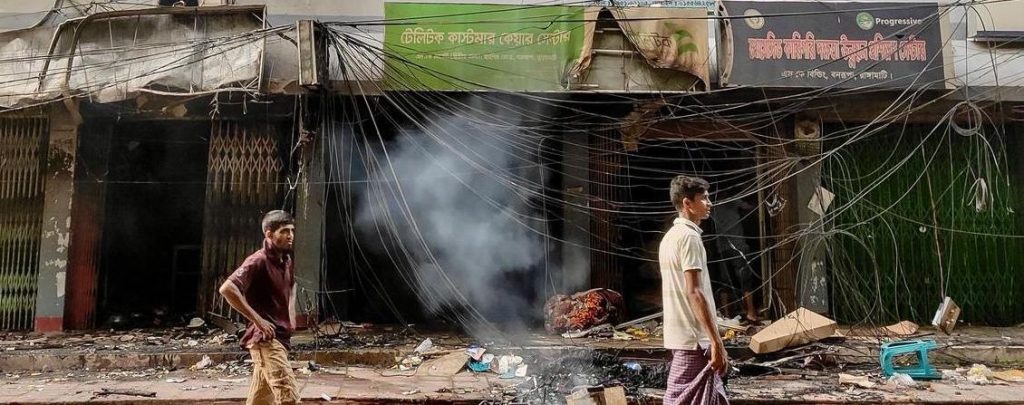
Photo courtesy of The Hindu
The conflict between Bangladesh’s indigenous people and the government has been portrayed as violence of an Islamic government against its minority ethnicities but while digging deep, it goes back to the ages of British ruling. The relationship between the government and the indigenous communities (collectively called Jumma or Pahari people) of the Chittagong Hill Tracts (CHT) is defined by a long standing, multi-faceted conflict concerning land rights, regional autonomy and ethnic identity. This complex situation includes serious, internationally reported allegations of human rights abuses.
The roots of the conflict are firmly planted in the colonial era, a crucial point often obscured in contemporary coverage. The core issue is not a religious war but a struggle for land rights and ethnic self-determination stemming from the gradual erosion of historical protections.
Under British rule, the CHT was designated as a totally excluded area governed by the 1900 CHT Regulation. This regulation established a special administrative system that legally protected indigenous control over land and explicitly prohibited the permanent settlement of non-indigenous people (Bengalis) from the plains without prior permission. This protection enshrined the Jumma people’s customary land rights.
Following the partition of India in 1947, the CHT was included in East Pakistan (later Bangladesh) despite having a non-Muslim majority. This was the first major betrayal of the colonial promise. Tensions escalated sharply after 1971.
Identity and constitution: Following the creation of Bangladesh, indigenous leaders in the CHT protested the 1972 Constitution for not recognizing the distinct ethnic identities and cultures of non-Bengali citizens, instead endorsing a unified Bengali national identity.
Displacement and demographics: Early grievances included the displacement of tens of thousands of people due to the construction of the Kaptai Dam, completed in 1962. Crucially, the abrogation of the 1900 Regulation starting in the 1960s, followed by the controversial government policy starting in the late 1970s that facilitated the mass, state-sponsored settlement of non-indigenous Bengali people from the plains into the CHT, fundamentally altering the region’s demographic balance and triggering severe land disputes.
Armed insurgency: The indigenous political organization, the Parbatya Chattagram Jana Samhati Samiti (PCJSS), and its armed wing, the Shanti Bahini, launched an insurgency in 1977 demanding regional autonomy and the preservation of indigenous rights.
Twenty seven years have passed since the historic CHT Peace Accord was signed, officially ending a decades-long armed conflict. Yet, for the indigenous Jumma people inhabiting the region, the peace remains little more than a fragile political facade. The primary driver of the ongoing crisis is the incomplete implementation of that agreement, leaving the door open to persistent violence, systemic human rights abuses and deep-seated mistrust between the communities and the state.
The conflict formally ceased on December 2, 1997 when the government and the Parbatya Chattagram Jana Samhati Samiti (PCJSS) signed the accord. This landmark agreement recognized the CHT as a tribal-inhabited area and outlined a path toward limited regional autonomy.
The core objectives were clear and designed to address the historical grievances of the indigenous population:
- Institutional autonomy: Establishing a Regional Council and Hill District Councils to grant local governance.
- Land justice: Creating a functional Land Commission with the authority to resolve complex and pervasive land disputes.
- Demilitarization: Outlining steps for the phased reduction of the military presence in the region.
The accord initially held promise as the Shanti Bahini, the indigenous armed wing, formally disarmed and refugees who had fled to India began to return home. However, the momentum quickly stalled. The subsequent two decades have been characterized by the government’s failure to fully deliver on its commitments. The ongoing crisis is rooted directly in the violation of the accord’s spirit and letter, particularly regarding the two most sensitive issues: land disputes and militarization.
The Land Commission, intended as the cornerstone of reconciliation, has failed to effectively resolve land ownership conflicts, which are often exacerbated by the continued influx of non-indigenous Bengali settlers. Furthermore, the environment remains highly militarized. The promised withdrawal of temporary military camps has not been fully realized, maintaining a highly visible and permanent security presence that indigenous communities view as an occupation.
The escalating violence in the Chittagong Hill Tracts in late 2025 is driven by a convergence of immediate flashpoints and profound institutional failures. Recent communal clashes were primarily triggered by serious allegations of sexual assault against indigenous minors by Bengali settlers, which rapidly devolved into widespread ethnic confrontation amid a perceived lack of judicial accountability. These clashes are further complicated by the controversial role of Bangladesh security forces, who are accused of using excessive force against indigenous protestors and showing alleged impartiality during settler-led attacks and property destruction. Fundamentally, these immediate crises are symptoms of the larger, unresolved land crisis where the non-functional CHT Land Dispute Resolution Commission fails to protect indigenous customary land rights from continuous encroachment by settlers and powerful corporations, creating the structural pressure cooker for sustained conflict.
Sameera Mahboobdeen