
Photo courtesy of Harvey Wallbanger
“The true test of international law is not how it restrains the weak, but whether it can restrain the powerful.”
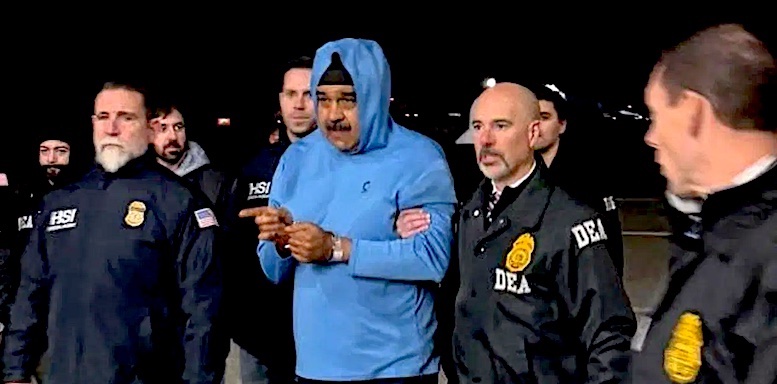
In an extraordinary and unprecedented escalation of global geopolitics, the US launched a large scale military operation in Venezuela in the early hours of January 3 resulting in the capture of Venezuelan President Nicolás Maduro and his wife Cilia Flores, whom US authorities transported to the US to face criminal charges. The operation stunned the world raising urgent legal, humanitarian and diplomatic questions that go far beyond Venezuela’s borders. More than a bilateral confrontation, the incident has come to symbolise the fragile state of the international order and the growing tension between power politics and the principles of international law.
The global reaction was immediate and intense. Governments, international organisations, legal scholars and civil society actors questioned not only the legitimacy of the operation but also its implications for sovereignty, human rights and the authority of the UN system. At a time when the world is already grappling with conflict, economic instability and declining trust in multilateral institutions, this episode has reignited debates over whether international law still meaningfully restrains the actions of powerful states.
According to official US accounts, President Donald Trump announced that US forces had executed a large scale strike against Venezuelan military and strategic targets in Caracas and surrounding areas following months of mounting pressure aimed at dismantling Maduro’s government. Shortly thereafter, US authorities confirmed that Maduro and his wife were captured and flown out of Venezuela. They were reportedly transferred to New York where Maduro is expected to face federal charges, including allegations related to drug trafficking and narco-terrorism.
The Trump administration framed the operation as a decisive act of justice and national security. Officials argued that Maduro’s continued leadership posed a threat not only to Venezuelans but also to regional stability and US interests. In a controversial statement, Trump asserted that the United States would run Venezuela temporarily until a political transition could be arranged citing governance failures, economic collapse and the humanitarian crisis. This declaration intensified international concern as it suggested not merely an arrest operation but a broader assertion of control over a sovereign state.
Under long established principles of international law and the UN Charter, no sovereign state has the legal authority to unilaterally enter another nation’s territory, remove its head of state and detain them without explicit authorisation from the UN Security Council or a narrowly defined claim of self-defense against an imminent armed attack. Article 2(4) of the UN Charter explicitly prohibits the use of force against the territorial integrity or political independence of any state.
The capture of a sitting president by foreign military forces is virtually without modern precedent and raises serious questions about violations of sovereignty, unlawful use of force and the erosion of international norms. Even where allegations of criminal conduct exist, international law requires extradition procedures, international warrants or judicial mechanisms – not unilateral military intervention.
World leaders reacted strongly. Brazil, Mexico, China and France condemned the US action as an unlawful breach of Venezuela’s sovereignty and a dangerous precedent for global politics. Several states called for emergency discussions at the UN, urging the international community to reaffirm the UN Charter and prevent further normalisation of unilateral force. At the same time, a limited number of political actors welcomed Maduro’s removal, viewing it as an opportunity for democratic renewal in Venezuela. These competing reactions revealed deep divisions within the international system over how legality, morality and power should intersect.
The roots of this dramatic confrontation extend back years. Venezuela has experienced profound political polarisation, disputed elections, economic collapse and a prolonged humanitarian crisis marked by mass migration, shortages of essential goods and institutional breakdown. US-Venezuelan relations deteriorated sharply following sanctions, diplomatic isolation and Washington’s refusal to recognise Maduro’s legitimacy after contested electoral processes.
Historically, interventions of this nature such as the U.S. ouster of Panama’s Manuel Noriega in 1989 were accompanied by claims of legal justification and regional security concerns, often involving some degree of multilateral coordination. The 2026 operation, however, lacked broad international endorsement and has been widely perceived as an assertion of unilateral power rather than collective security.
Critics argue that abandoning the UN Charter’s core principles, particularly respect for sovereignty and the prohibition of force, risks undermining the very foundations of the international order. Supporters of the US action contend that extraordinary circumstances demand extraordinary measures yet legal experts remain divided, emphasising that domestic criminal charges do not automatically confer international jurisdiction or legitimacy for military action.
The UN emerged as a central but constrained actor in the aftermath of the incident. While many member states called for investigations, resolutions and accountability, the structure of the UN Security Council limits meaningful enforcement. As a permanent member, the US possesses veto power enabling it to block any binding resolution that challenges its actions.
This institutional reality highlights a long standing paradox: the UN is tasked with maintaining international peace and security yet its most powerful members are often the least accountable. Even if a resolution condemning the operation were proposed, it would likely be amended, weakened or vetoed, rendering the UN unable to take decisive action. This paralysis reinforces perceptions of double standards and selective application of international law.
Beyond diplomacy and law, the human consequences of such operations cannot be ignored. Any military action, particularly in densely populated urban areas, risks civilian harm, displacement and long term instability. Venezuela’s population, already suffering from economic hardship and social breakdown, faces renewed uncertainty, fear and vulnerability.
Globally, the incident sends a troubling signal. If powerful states can bypass international institutions without consequence, smaller states may lose faith in multilateralism altogether. This erosion of trust could accelerate a shift toward a more fragmented, power-driven world order where force increasingly replaces law as the primary tool of political change.
Whatever one’s perspective, the US capture of Venezuela’s president has shaken the foundations of international relations in the 21st century. It has forced a global reckoning with the limits of state power, the fragility of international law and the effectiveness of the UN system. The incident underscores a central dilemma of modern geopolitics: whether the rules designed to govern the international system apply equally to all or only to the weak.
As nations debate legality, morality and consequence, the world watches closely. What unfolds next will not only shape Venezuela’s future but also define the credibility of the global order itself. In this sense, the episode marks not merely a regional crisis but a defining moment in contemporary international diplomacy.