
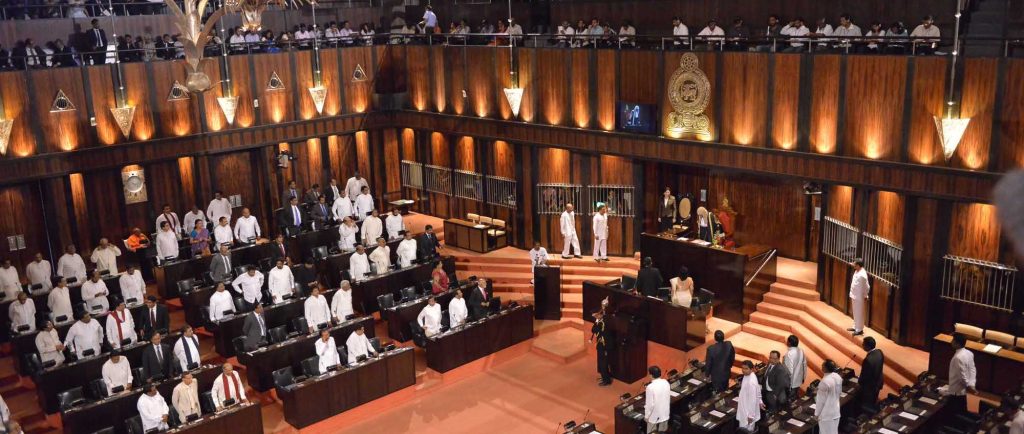
Photo courtesy of Constitutionnet
The debate over parliamentary pensions has resurfaced in Sri Lanka, raising critical questions of fairness, accountability and fiscal responsibility. At a time when citizens face economic hardship, tax pressures and reforms to their own retirement benefits, the privileges enjoyed by elected representatives are under unprecedented scrutiny.
Globally, many democracies have grappled with similar issues. In response, they have restructured parliamentary pension schemes to reflect principles of equity, sustainability and transparency. Sri Lanka now has an opportunity to learn from these best practices. Instead, government has introduced a bill to abolish parliamentary pensions altogether – a move that appears more populist than principled.
Historically, parliamentary pensions in Sri Lanka and elsewhere have been far more generous than those available to ordinary civil servants or private sector employees. Lifetime pensions after a short period of service, early qualifying ages and minimal contribution requirements have fuelled perceptions of privilege.
These concerns have intensified amid the economic crisis, IMF-backed fiscal reforms and public sector restructuring. Understandably, the question of whether lawmakers should retain special benefits while austerity measures affect the wider population has become a matter of civic debate.
On January 7, the Parliamentarians’ Pension Abolition Bill was introduced in parliament. Justice Minister Harshana Nanayakkara announced that once enacted, parliamentary pensions will be completely abolished and no individual will be entitled to such benefits thereafter. He argued that this responds to public opposition to MPs receiving pensions without contributions after minimal service unlike civil servants who must meet strict requirements.
While a fair salary and reasonable pension are not privileges, past practice allowed MPs lifetime pensions after just five years in office. Under the new law, even MPs who have served for decades will receive nothing in old age. The JVP, the dominant force within the NPP, believes politics should be voluntary public service, not a profession. It pays salaries to its cadres but offers no provident fund benefits, encouraging members to secure their future through other means.
The government seems to assume that serving as a public representative should be entirely voluntary, ignoring global best practices. The SJB supports the bill without offering constructive alternatives, allowing its leadership, drawn largely from business and professional elites, to maintain control.
International experience shows that successful pension reform depends on several key principles:
- Equality and fairness: Align MPs’ pensions with national systems. In many countries, MPs contribute to the same fund as civil servants and receive benefits under identical rules.
- Sustainability: Move towards funded, contributory systems with regular reviews to ensure long term viability.
- Transparency and oversight: Disclose pension rules, costs and benefits publicly. Independent bodies – not politicians – should manage funds.
- Adequacy without excess: Reject lifelong pensions for minimal service. Link benefits to career average earnings, not inflated final salaries.
- Retirement age alignment: MPs should qualify for pensions at the same age as other citizens – typically 60 to 65 – and be able to transfer rights when returning to other professions.
Lessons from other democracies:
- United Kingdom: MPs’ pensions are based on career average earnings, with eligibility tied to the state pension age and oversight by an independent authority.
- France and Italy: Special parliamentary schemes abolished. MPs now participate in national contributory systems.
- Australia: Defined benefit pensions scrapped. New MPs enrolled in the national scheme.
- Canada: MPs pay mandatory contributions. Benefits are capped and costs are disclosed transparently.
Rather than abolishing pensions outright, Sri Lanka should consider:
- Phasing out special schemes and aligning MPs’ benefits with national frameworks.
- Establishing an independent statutory body to manage parliamentary pensions.
- Requiring annual public disclosure of pension costs and actuarial assessments.
- Eliminating minimum service periods and short term pensions.
Parliamentary pension reform is not merely a technical issue; it is a test of political credibility. In today’s climate, a genuine commitment to fairness and shared sacrifice can help rebuild trust between citizens and their representatives.
By aligning policies with global best practices and honouring legislative commitments, the NPP leadership can demonstrate that they are willing to listen to other opinions and live by the same rules they impose on others. Populist slogans may win headlines but sustainable governance demands reasoned debate and balanced reform. Abolishing pensions altogether risks turning parliamentary politics into a domain accessible only to the wealthy.