
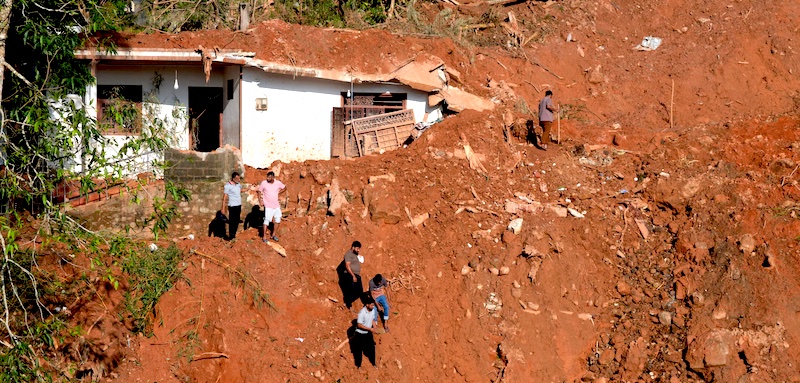
Photo courtesy of The National News
In late 2025, as economic anxieties deepened and global climate warnings grew louder, a tropical storm formed over the Bay of Bengal and intensified into what would be known as Cyclone Ditwah. The storm moved across Sri Lanka’s northern and eastern regions bringing torrential rainfall, severe flooding, landslides and widespread infrastructure damage. The numbers were staggering: approximately $4.1 billion in losses – nearly 4% of national GDP – two million people affected and thousands of workers experienced livelihood disruption. Roads collapsed. Crops were destroyed. Power lines were downed. Homes, particularly in low income and informal settlements, were washed away or rendered uninhabitable.
What we call a “natural disaster” is in fact a repeated institutional stress test. The hazard may be atmospheric but the scale and distribution of harm are structured by inequality, land use decisions, labour precarity and policy design. In Sri Lanka, as in much of the Global South, climate shocks do not strike neutral terrain; they strike landscapes shaped by decades of uneven development. If exposure is predictable, why are the same communities rebuilding the same vulnerabilities every year?
The myth of the “natural” disaster
The language of disaster obscures more than it reveals. When we describe events like Cyclone Ditwah as “natural,” we subtly absolve institutions of responsibility. We frame devastation as fate rather than failure. We position suffering as unavoidable. But hazards are natural; disasters are not.
A cyclone passing over uninhabited land is a meteorological event. A cyclone that displaces millions, destroys livelihoods and pushes households into long term poverty is the product of layered vulnerability. It is the outcome of decisions about where housing is permitted, how drainage systems are maintained, who has access to insurance, which workers have social protection and whose early warnings reach in time.
In Sri Lanka, the geography of disaster overlaps almost perfectly with the geography of inequality.
Flood plains are densely settled by low income households who cannot afford higher ground. Informal settlements along waterways lack adequate drainage and waste management infrastructure. Coastal communities dependent on fisheries face repeated storm surges with limited state-backed risk buffers.
Cyclone Ditwah as a stress test
When rainfall intensified, drainage systems in urban centres failed under predictable pressure. In hill country districts, saturated slopes triggered landslides in areas long identified as high risk. In agricultural belts, farmers who were already navigating input price shocks and debt burdens saw crops destroyed within hours. Informal workers – daily wage labourers, small vendors and transport operators – lost income immediately with little to no safety net.
The cyclone’s economic toll cannot be understood as a singular shock. It compounded pre-existing fiscal fragility and a broader macroeconomic crisis. For households, the losses were even more acute. A flooded home is not simply a repair cost; it is lost assets, lost savings, lost schooling days, lost workdays and increased indebtedness. For thousands of workers, disruption was not a temporary inconvenience. It was income instability in a labour market where a significant proportion of employment is informal and unprotected. When the rain stops, formal sector employees may return to work. Informal workers must first repair what was damaged before they can resume earning. This is how climate shocks translate into poverty traps.
Rebuilding the same vulnerabilities
In Sri Lanka’s hill country, landslides are not rare events. They occur with seasonal regularity during periods of intense rainfall. Yet plantation communities continue to live on unstable slopes in housing structures that were never designed for evolving climatic conditions. In flood-prone districts along major river basins, communities rebuild homes in the same locations year after year. Why? Because relocation requires land, compensation and viable livelihood alternatives – none of which are easily accessible. Urban informal settlements often occupy marginal land because it is the only land available without formal tenure barriers. Residents invest incrementally in improving homes, but structural drainage and flood mitigation infrastructure require state-level intervention.
The pattern is clear: hazard strikes, damage concentrates in known exposure zones, emergency response is mobilised, reconstruction begins and structural vulnerability remains. The cycle repeats.
This repetition is not a failure of forecasting. Sri Lanka possesses meteorological capacity and disaster management institutions capable of issuing early warnings. It is a failure of structural reform.
Inequality as infrastructure
To understand why disaster damage scales the way it does, we must examine inequality as a form of infrastructure. Where do low income households live? In cheaper, risk-prone zones. Who has insurance? Mostly higher income groups and formal enterprises. Who has savings buffers? Those with stable employment. Who depends on daily wages? Informal workers with limited protection. Who can temporarily relocate? Those with social capital, extended networks and financial flexibility.
Climate exposure intersects with labour patterns, land tenure systems and social protection architecture. The result is that two households experiencing the same rainfall event will not experience the same disaster. For a salaried urban professional, flooding may mean property damage and inconvenience. For a plantation worker or informal vendor, it probably means debt, school dropout, malnutrition or migration. When institutions do not redistribute risk, markets do. And markets concentrate it.
The cost beyond GDP
The $4.1 billion damage estimate captures physical and economic loss. It does not capture the cascading social consequences.
Repeated climate shocks are associated with increased household debt, temporary and permanent migration, school absenteeism and dropout, food insecurity, early entry of adolescents into informal labour, forced displacement and unsafe migration and heightened risks of exploitation in contexts of displacement.
These outcomes do not appear in immediate disaster accounting. They unfold over months and years. They shape life trajectories. When agricultural losses reduce household income, families may send a member to urban centres for work under informal or risky conditions. When schooling is disrupted repeatedly, educational attainment declines. When infrastructure repair lags, local economies stagnate. The cyclone ends. The vulnerability compounds.
Climate as an institutional mirror
Sri Lanka is not uniquely vulnerable; it is emblematic. Across South Asia, climate variability is increasing in intensity and frequency. Rainfall patterns are less predictable. Extreme events are becoming increasingly severe but predictability does not refer to precise timing. It refers to structural exposure: we know which districts are flood-prone, we know which slopes are landslide-prone, we know which labour sectors lack protection and we know which communities face repeated housing damage.
Climate shocks now function as institutional audits. They reveal whether land use planning integrates risk data. They reveal whether social protection systems scale rapidly during crises. They reveal whether housing policy anticipates environmental stress.
Cyclone Ditwah exposed gaps in drainage maintenance, slope stabilisation, housing quality and emergency livelihood support. It highlighted the fragility of informal labour markets. It underscored the absence of universal risk pooling mechanisms for low income households.
Beyond emergency response
Disaster response in Sri Lanka is often swift at the emergency phase. Relief distribution, temporary shelters and public communication mechanisms are activated. Yet long term resilience requires shifting from response to prevention. Prevention does not mean stopping cyclones. It means reducing the translation of hazard into disaster.
This involves risk-informed land use planning, upgrading informal settlements with drainage and flood defences, strengthening slope stabilisation and housing retrofitting in plantation regions, expanding adaptive social protection systems that scale automatically during shocks, protecting informal workers through contingency cash transfers and insurance models and integrating climate risk into fiscal planning and development budgeting
Each of these measures requires political prioritisation and sustained investment but they are less costly than repeated reconstruction at 4% of GDP.
The political economy of exposure
Why do known vulnerabilities persist? Because relocation is politically sensitive, because land reform is contested, because infrastructure upgrades require fiscal space, because informal labour protection challenges entrenched economic models and because short term recovery often takes precedence over long term transformation.
There is also a narrative convenience in describing disasters as extraordinary events. Extraordinary events justify temporary mobilisation. Structural inequality demands permanent change.
Cyclone Ditwah becomes a story about extreme weather rather than a story about development pathways. But climate change disrupts that narrative. As hazards intensify, repetition exposes denial. The abnormal becomes routine.
Reframing the conversation
Instead of asking:
“How severe was the storm?”
We ask:
“Why did it devastate this community more than that one?”
Instead of:
“How quickly can we rebuild?”
We ask:
“Why was it built this way in the first place?”
Instead of:
“How much aid is required?”
We ask:
“What structural reforms reduce the next aid requirement?”
This reframing does not minimise suffering; it contextualises it. It locates responsibility not in the sky but in governance.
The future of repeated stress tests
Sri Lanka stands at a crossroads shaped by climate volatility and economic restructuring. As fiscal constraints tighten, the cost of inaction grows. Repeated 4% GDP shocks are not sustainable. Repeated displacement of millions erodes social cohesion. Repeated livelihood disruption undermines recovery from broader economic crises.
Climate adaptation cannot remain an environmental silo. It must integrate labour policy, housing policy, urban planning and social protection reform. The question is not whether another cyclone will come. The question is whether the next cyclone will produce the same map of damage. If the same districts flood, if the same slopes collapse, if the same informal workers lose income without safety nets, then the disaster is not natural. It is institutional inertia.
Cyclone Ditwah did not invent inequality in Sri Lanka; it illuminated it. The myth of unpredictability allows us to treat climate disasters as episodic tragedies. But the pattern is visible. The exposure zones are documented. The labour vulnerabilities are known. The fiscal risks are calculable. When the same communities rebuild the same vulnerabilities year after year, we are not witnessing natural inevitability. We are witnessing structural neglect.
Disaster is not natural. It is the outcome of choices – about land, labour, investment and whose risk counts. If climate shocks are institutional stress tests, then the results are already in. The challenge now is not forecasting the next storm. It is deciding whether to keep failing the test.
This article is part of the series, Climate Stress Tests: Inequality, Institutions and the Future of Resilience in Sri Lanka, which examines how climate shocks expose the underlying structures that shape vulnerability from inequality and labour precarity to governance failures and asks what it would take to build systems that protect people before crises escalate.