
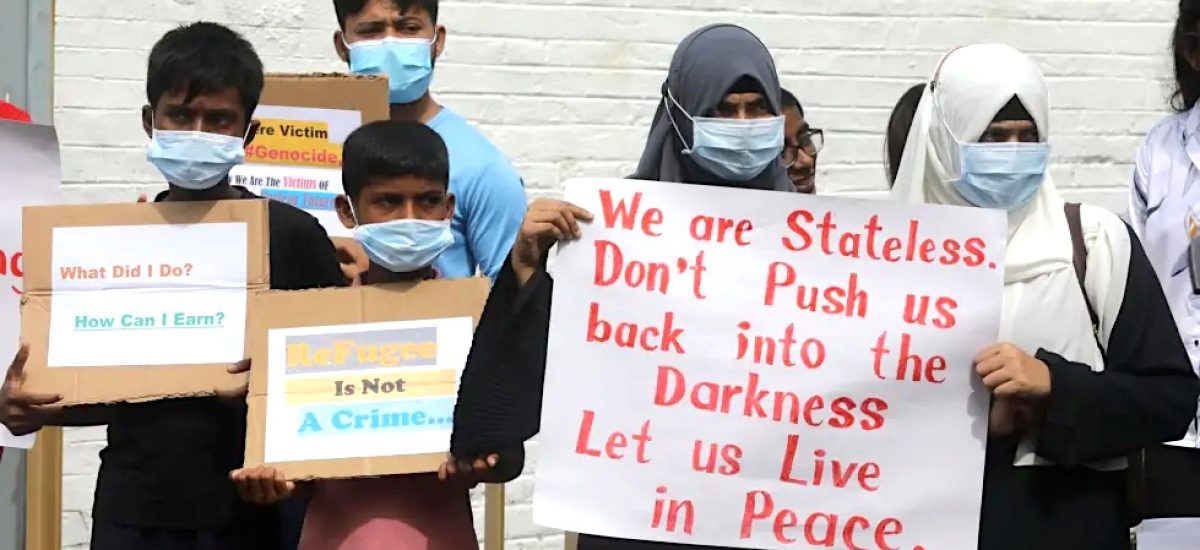

Photo courtesy of EFE
Fatima is a 17 year-old refugee child who has been living in Sri Lanka nearly 14 years. She and her family had arrived in Sri Lanka in 2012 and have been recognised as refugees by the UN High Commissioner for Refugees (UNHCR) in 2015. But they have no prospects of permanent settlement in any country, including Sri Lanka, in the foreseeable future.
Despite this hopeless, uncertain situation and challenges in covering costs of housing, food, healthcare and education, Fatima is going to school, excelling in studies and other school activities. She is due to sit for the O’Level examination later this year but has been informed by the school that she was not allowed to do so as her passport had expired. She appealed in writing to the Minister of Education on March 25 but there was no response. Calls to the ministry indicated her request had been forwarded to the Commissioner General of Examinations but there was no response from the Commissioner General either. After many calls, a Deputy Commissioner General said on June 12 that she would not be allowed to sit for the examination without a valid passport.
Refugees who flee their countries in fear of persecution are not able to approach their governments or high commissions or embassies to renew passports. In Sri Lanka, Refugee and Asylum Certificates issued by UNHCR have been accepted by the authorities under successive governments for about two decades in lieu of passports and visas to allow refugees and asylum seekers to temporarily stay in the country without any penalties. Now the government is denying an exceptionally bright refugee child the opportunity to sit for a significant examination in terms of future academic and career prospects solely due to lack of a valid passport.
This is a blatant violation of Article 12(1) of the constitution, which states all persons (not just citizens) are equal before the law and must have equal protection of the law. It doesn’t cover any restrictions on Article 12(1) allowed by Article 15(7). It also violates Sri Lankan law, specifically Article 5 of International Covenant on Civil and Political Rights Act no 56 or 2007 (ICCPR Act), which states that “the best interest of the child shall be of paramount importance” in matters concerning children. This provision is not limited to children who are citizens and extends to all children within the jurisdiction of Sri Lanka.
Sri Lanka is a party to the International Convention on Rights of the Child (CRC). Article 2 of the CRC obliges state parties to ensure the rights in the convention to every child without discrimination of any kind, including on grounds of the child’s or her parent’s national origin or other status. Article 3 requires that in all actions concerning children, the best interests of the child shall be a primary consideration. Article 22 requires state parties to take appropriate measures to ensure that a refugee child receives appropriate protection and humanitarian assistance in the enjoyment of applicable rights. Article 28 recognises the right of every child (not just children with citizenship or in possession of documents decided by state authorities) to education and requires states to take measures to ensure that the right is realised in practice. Denying Fatima the opportunity to sit for O’Levels will violate the legally binding obligations under the CRC.
Asylum seeker children and adults in indefinite detention
Since December 2024, authorities have been detaining about 116 Rohingya asylum seekers, about 57 of whom are children, including 18 below five years. Statistics as of January 2025 are from the Human Rights Commission of Sri Lanka.
On December 19, 2024, fishermen in Mullaitivu observed a boat in the sea, few hundred metres away from the shore, crowded with many people and children. The fishermen visited them in fishing boats, provided food and drinking water and also took a doctor, local journalists and Navy officers to the boat. Despite pleas from fishermen to bring them ashore, and many in the boat being unwell and not having enough food, they were kept at sea most of the day by the authorities. In the evening, the Navy took them to Trincomalee through a further journey by sea and they were allowed to land in Sri Lanka only on the morning of December 20. They were taken to an Air Force camp in Mullaitivu few days later and have been detained there since then. The Air Force camp has been officially declared as a Temporary Immigration Detention Centre by the Secretary to the Minister of Public Security.
The Human Rights Commission of Sri Lanka was initially denied access but later allowed to visit, after writing to the president and summoning senior officials to the commission. On May 9, 2025, the commission issued a media release, which noted the importance of addressing the specific needs and vulnerabilities of children and infants at the detention centre and made a series of recommendations to enhance the protection and welfare of female detainees and children. Although the Department of Immigration and Emigration informed the commission that a focal point to receive aid from concerned persons and groups had been appointed, there has been no response by the department to offers of assistance. The department had also rejected the commission’s proposal to allow access to journalists. The commission also stated that the use of the term “illegal migrants” in contrast to “asylum seekers” and the claim that the persons detained were not asylum seekers because they may have entered Sri Lanka illegally reflects a misunderstanding of the concept of asylum seeker and that any person who seeks asylum in another country may be appropriately termed an asylum seeker. The commission urged the department to facilitate UNHCR’s access the asylum seekers, appoint a focal point to receive humanitarian aid and allow access to journalists, none of which has happened.
The group had been at sea for about 16 days, facing storms and two of the three boats had sunk and six people had died with their bodies thrown to the sea. Their testimonies clearly indicated the harrowing persecution they had faced in Myanmar including killing of family members, aerial strikes, bombings, burning of houses, lack of freedom of movement, lack of communication, large scale displacement and lack of access to UN and other aid agencies. They had decided to buy a boat by selling lands, jewellery and belongings, paying different parties. These testimonies indicate they are asylum seekers fleeing well-founded fear of persecution rather than those being trafficked or engaged in illegal migration. Fishermen in Mullaitivu who themselves had faced similar persecution during the war and were the first to visit and assist the Rohingyas when their boat was still sea, understood them to be people fleeing persecution and seeking protection, pleading with the Navy to bring them ashore and to state that the government should take care of them. But government authorities have failed to understand this for one and half years.
Documents in relation to the genocide case filed by Gambia against Myanmar at the International Court of Justice, reports by the UN Human Rights Council’s Fact Finding Mission, UN Human Rights Council’s Special Rapporteur on Myanmar and UN High Commissioner for Human Rights and numerous other international groups have found Rohingya to be stateless and facing serious persecution.
Despite this, the Deputy Minister of Foreign Affairs and Foreign Employment said that the group of Rohingyas will be considered as illegal migrants. These statements led to criticism and questioning, including by the opposition leader and other opposition MPs. In January 2025 protests were held in Mullaitivu where the boat was first seen and in Colombo calling on the government not to deport Rohingyas and treat them in line with international law. Government ministers later assured parliament that no decision has been taken to deport the Rohingyas who came by boat in December and that the government would act humanely and in accordance with national and international laws. Significantly, the Minister of Justice recognised the persecution and displacement faced by Rohingyas in parliament.
UNHCR’s limited roles in Sri Lanka
The agreement between UNHCR and the government signed in December 2005 facilitates UNHCR’s international protection and humanitarian assistance functions in favour of refugees and asylum seekers in Sri Lanka. The government has agreed to grant UNHCR unimpeded access to such people at all times. The Terms of Reference offered by the government to UNHCR in May 2006 in relation to asylum seekers and refugees has allowed UNHCR to issue asylum certificates, giving opportunity to the government to object entry of specific individuals based on grounds such as national security or public security.
In December 2023, UNHCR stopped the monthly living allowance and educational support offered to refugees and closed its office in December 2024, stopping refugee status determination for asylum seekers and facilitating of permanent resettlement for refugees. UNHCR’s presence in Sri Lanka is now reduced to a liaison officer based in office of the UN Resident Coordinator. This has created a situation of uncertainty, stress and desperation for about 500 refugees and asylum seekers. The majority of them are Rohingyas while a significant number are from Pakistan. There are also small numbers from Palestine, Syria, Iraq and Afghanistan.
UNHCR must continue to fulfil its unique roles in refugee status determination and facilitating permanent resettlement, if needed, getting reinforcements from regional and international offices. The UN country team should also come forward to protect and support asylum seekers and refugees, especially in terms of housing, food, education and healthcare. Other countries, which have supported refugees for many years by providing permanent resettlement, must continue to do that. More countries must also come up with schemes such as private sponsorship programmes that have assisted refugees to get permanent resettlement without involvement of UNHCR.
Intolerance and hostility from the government
Sri Lanka has provided limited care to a very small number of asylum seekers and refugees by tolerating their temporary stay while UNHCR processes their applications and they await permanent resettlement in other countries. Sri Lanka also provided limited healthcare and protection when they faced hostility and violence. Asylum seekers and refugees have not been detained in Sri Lanka except on few occasions for short periods. Sri Lanka has also not resorted to deportation of asylum seekers except on few occasions. Asylum seekers and refugees have not had to produce passports or visas to temporarily stay in the country, with UNHCR issued Asylum and Refugee Certificates being accepted.
But there have been alarming indications of intolerance and hostility towards asylum seekers and refugees from the NPP government since 2024. This is the first time any government detained more than hundred asylum seekers for such a long period and denied them access to UNHCR. It’s the first time any government has detained about 57 children without allowing them access to education. This is also the first time any government has consistently maintained that a group of persons explicitly saying they are seeking asylum from persecution are illegal migrants. This is particularly ironic because they are Rohingyas, a community that is widely recognised, including by the UN and government’s justice minister, as facing persecution and genocide and there is no evidence to the contrary for one and half years. This is the first time a government is denying access to lawyers, activists and lawyers to detained asylum seekers.
Last year, a woman who had temporarily been in Sri Lanka as a refugee and subsequently become a citizen of the US was deported when she tried to visit her husband in Sri Lanka despite having had Electronic Travel Authorization and a return ticket. This indicated refugees and asylum seekers are prohibited from returning to Sri Lanka after they have resettled in other countries.
Refugee rights activists have faced harassment and intimidation with two organizers of the Mullaitivu protest in January 2025 being summoned by police for questioning in Colombo from Mannar and Mullaitivu.
Welcoming, caring and supporting refugees
Leaders of the JVP, the party of the president and dominant party of the NPP government, have sought and received refugee status in the past. The president himself and others have publicly shared experiences of seeking protection in face of persecution. Thus, the NPP has a moral and political obligation, in addition to legal obligations, to welcome, protect, care and support the small number of asylum seekers and refugees. The two third majority the government holds in parliament allows them to take legislative, administrative, social, political measures to protect and support asylum seekers and refugees. In the short term, the government must provide employment opportunities, healthcare, education for children, housing, food and include them in state’s social welfare schemes. Sri Lanka must also ensure asylum seekers and refugees will be entitled to fundamental rights such as non-discrimination, right to information, freedoms of expression, assembly, association and not to be arbitrarily arrested. In the long term, Sri Lanka must ratify the 1951 Refugee Convention and its optional protocols and enact domestic legislature to facilitate the granting of refugee status and permanent resettlement to at least a small number of persons as part of its commitment to address global refugee crisis.