
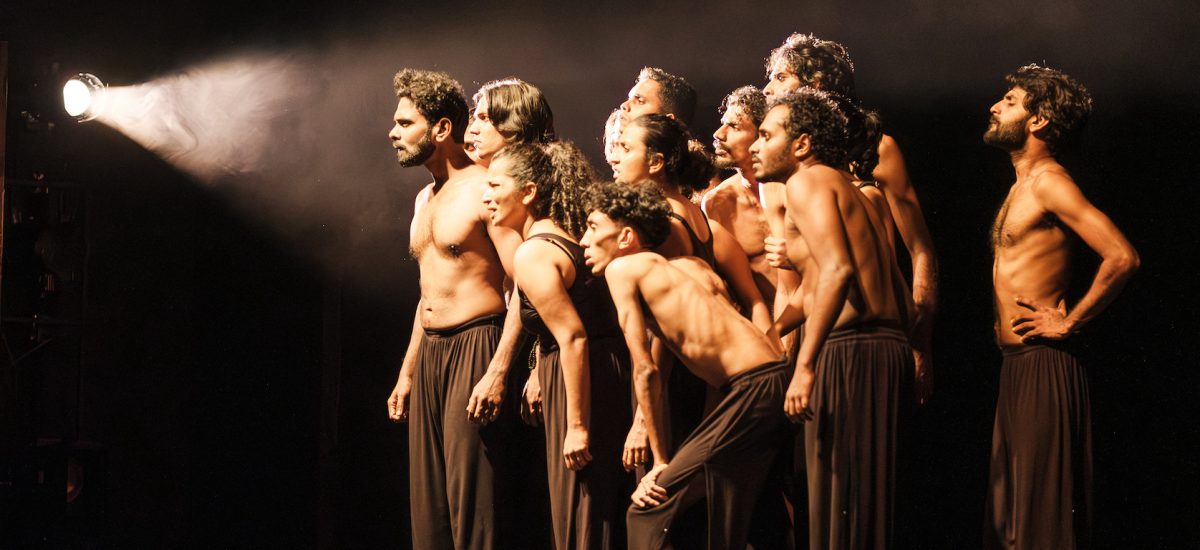

Photos courtesy of STG
For the first time, a Sri Lankan play was presented at the prestigious international theatre festival, Theater der Welt 2026, in Chemnitz in Germany, its first performance in Europe after being shown in Sri Lanka, India, Rwanda and Abu Dhabi.
The invitation to stage Dear Children, Sincerely – 7 Decades of Sri Lanka (DCS) marks a significant moment of recognition for the Stages Theatre Group (STG) and for Sri Lankan theatre, placing a locally researched, devised and performed production within official selection of a global programme.
DCS, directed by award winning playwright and theatre director Ruwanthie de Chickera, is a research-based, highly charged ensemble performance that takes audiences through 70 years of Sri Lanka’s dark and turbulent history. Across seven scenes, each representing a different decade, the production traces the country’s socio-political journey from independence in the 40s through to the end of the war in 2009.
DCS asks how a country remembers itself, what younger generations inherit from the histories they are born into and how art can open conversations about memory, violence, silence, loss and resilience.
The production draws from conversations with senior citizens born in the 1930s. Their memories, reflections and lived experiences form the foundation of the performance, bringing personal testimony and national history into direct conversation with present day audiences.
STG performed the play in front of packed audiences in the small East German town of Chemnitz and the country’s capital Berlin with respected stage actors such as Sanjeewa Upendra, Nipuni Sharada, Akalanka Prabashwara, Duminda Sandaruwan and Pia Hatch alongside a young and energetic ensemble.
STG is one of Sri Lanka’s leading professional theatre companies known for creating original, socially engaged and research-based performance work. Through productions, workshops and long term community arts initiatives, STG continues to develop theatre as a space for dialogue, critical reflection and creative collaboration.
Ruwanthie spoke to Groundviews about the response to the play and what Sri Lanka can learn from Germany about handling its violent past.
How were you able to perform the play in Germany?
Theater der Welt, which is an international theatre festival held once every two to three years, is a 40-year old festival. This is the first time a Sri Lankan theatre company participated in it. It’s a very recognised festival in Europe, sponsored by the state to use it as a way to develop German towns by bringing the world to those places and also investing resources. This time around they curated the festival through six international curators, which had not been done before. Each curator was responsible for a region. The curator for our region saw our play performed in Kerala and put it forward as a recommendation. Ours is a big cast of 21 people. All expenses were covered for the four days of the festival but I felt it was a missed opportunity for such a big troupe to travel all the way to Germany and perform in a small town to an almost exclusively white audience. I felt that the play needed to be seen by a more cosmopolitan audience and by the Sri Lankan diaspora. We decided to take the risk and go to Berlin, asking for an eight day visa, which we got. We didn’t have a place to stay, we didn’t have a show and we had no money. But then, little by little, things came through and we went to Berlin where we had a place to stay and we were well looked after. We did a show in Berlin, which was very well attended. The audience included diaspora Sri Lankans. At the end of the day, it was a really successful tour and because of the generous contribution of many individuals we managed to finance the Berlin part of the tour as well.
How were you generally received?
I was nervous about the Chemnitz performance because in previous venues, the audience had some reference points because we shared a similar sensibility, history and knowledge. I felt that I had no reference points with the audience in East Germany. But I was really surprised because we received standing ovations and encores. The press gave us good reviews and it was a highly rated, appreciated piece of theatre. It was enlightening for me that a play that is so specific actually has the capacity to travel into other contexts that are very removed from it. The Berlin performance was to an audience that mostly knew the context that we were talking about. There were Germans who were connected to our circles. People were very receptive and appreciative. There was the Sinhala diaspora and the Tamil diaspora. However I felt an unease in the audience that I had never felt before in a DCS play. There was a quietness. It was a bit of a disquiet, rather. There was a bit of uneasiness between those two groups of people watching a play that chronicled the history of Sri Lanka and talking about things like racism and violence. I think the Tamil community was appreciative of the fact that we were talking about these issues whereas from the Sinhala community, I got responses ranging from “Why are you washing our dirty linen in public?” to “Do we really need to be talking about things like this, why can’t we just move on?” However, there were some Sinhalese who were also very appreciative.
How have the Germans dealt with their violent past as opposed to what we are doing?
The Germans are open and proactive when talking about their violent past; their education and culture has grown from that. It has become so much part of their identity that it seems like they have moved on. But clearly it has been a massive preoccupation and it has been addressed at policy level. They are a people that both memorialise and study their past but they also seem to be moving on, which I think is a good balance. It’s just there right on the surface. That is something that we as a society are just so far away from – all the many things we don’t talk about, the issues in our country that we just don’t really address. If we don’t take on horrible violence of our past, we are not going to be able to move beyond it.
What did members of STG gain from the experience?
In the last 26 years, STG has travelled overseas a lot because I believe we have to take the Sri Lankan story out and also I want to give Sri Lankan artists as much exposure as possible to give them a sense of respect and show them how other countries treat their artists. Many people feel that what they are doing has no value. But when they go to these countries, they see how the state sponsors artists and how artists are treated with respect and reverence. Then they come back feeling that at least they are in the right vocation but maybe in the wrong country. And it gives them strength to keep fighting the fight. For many of them, it was just the exposure. Many of them had never been to Europe before so being there and seeing how the system works in a country that supports the arts was a good experience. It’s also to take a play like this and seeing how it is received. I think it changes things in artists. When you perform and you have standing ovations and many people say it’s amazing what you’re doing, you feel that it actually works to be this honest about things in your past. It can bring people together; it doesn’t distance people, it doesn’t create gulfs but actually binds people.
Did you get any support from the Sri Lankan government?
There was nothing forthcoming. We weren’t even asking for money. For six months, we relentlessly pursued all the contacts we could through the government. I was of the opinion that if such a big group of Sri Lankans is travelling at no cost to the government and being invited officially to a big festival taking a play that reflected Sri Lankan history, that the play was deserving of state patronage. If a cricket team goes, it gets recognition, support and news coverage. I believe that that it was our due. We were saying, can you introduce us to Sri Lankan communities there so that then we can coordinate with them and get things done? Can you acknowledge us officially? Can you stand by us? Can you just align yourself with this play officially? The government doesn’t have any process or procedure for a Sri Lankan group that is representing the country. That is a big lapse in foreign policy because this is soft power. I always tell my artists that when we travel abroad we are ambassadors for the country. Our theatre company does only Sri Lankan stories. When we go for international festivals, we’re not just going to Germany; we are meeting people from Africa, Asia and South America. The potential of the soft power of those relationships and networks is an untapped resource of foreign policy. There is no respect, no support and no appreciation for the arts in this country.
Did the issue of Palestine come up?
We talked about violence and genocide. Some of the other artists did bring it up. But I was told in no uncertain terms that anything on Palestine would not go down well. So yes, that is a blind spot that exists there. Of course, I know there are Germans there who are pro-Palestinian but there is no visibility for it at all.