
Photo courtesy of FT
For much of the post-war period, external engagement in Sri Lanka’s Northern and Eastern provinces followed a predictable geography of influence. India was visibly embedded in the region’s political and social fabric while China operated primarily through Colombo, focused on state to state diplomacy and large scale infrastructure development. That balance is now shifting in tone rather than structure as new layers of engagement begin to emerge alongside older patterns.
China’s growing visibility in the North and East, reflected in diplomatic visits, selective engagement with local actors and attention to fisheries, energy and connectivity sectors, signals a gradual widening of its footprint. India remains the dominant external presence in the region shaped by history, proximity and sustained political engagement. Yet China is no longer entirely absent from local political and social spaces and that change is becoming increasingly difficult to ignore.
The key issue is not substitution but reorientation. The more relevant question is why China is moving closer to a space it once engaged only indirectly and what this reveals about Sri Lanka’s evolving geopolitical architecture. The answer lies less in competition and more in the gradual redistribution of attention across different layers of the island’s strategic geography.
India’s position in the North is structurally rooted in the post-conflict settlement shaped by the Indo-Lanka Accord, the experience of the Indian Peace Keeping Force and the continuing institutional relevance of the 13th Amendment framework. These are not symbolic references but foundational elements that continue to shape political expectations around devolution and reconciliation.
Beyond this political layer, India’s presence is sustained through a dense network of practical engagement. Housing projects, rail reconstruction, fisheries diplomacy, religious connectivity, educational exchange and routine diplomatic contact have created a form of embedded influence that operates at both state and community levels. The result is not episodic engagement but structural proximity, reinforced over decades.
China’s trajectory has followed a different logic. During the final phase of the war, its engagement was primarily aligned with the state, concentrated on diplomatic support and strategic alignment at the centre. In the post-war period, this evolved into a major infrastructure-driven presence, anchored in projects such as Hambantota Port and Colombo Port City alongside expressways, energy investments and broader development financing that reshaped national scale connectivity.
Despite this expansion, China’s engagement remained geographically and politically concentrated in Colombo. In the Northern and Eastern Provinces, it was largely absent from everyday political discourse and civic interaction. It did not feature meaningfully in debates on devolution, fisheries disputes or post-war reconciliation and its visibility among local institutions, communities and political actors remained limited. This created a clear separation between national level influence and local level presence.
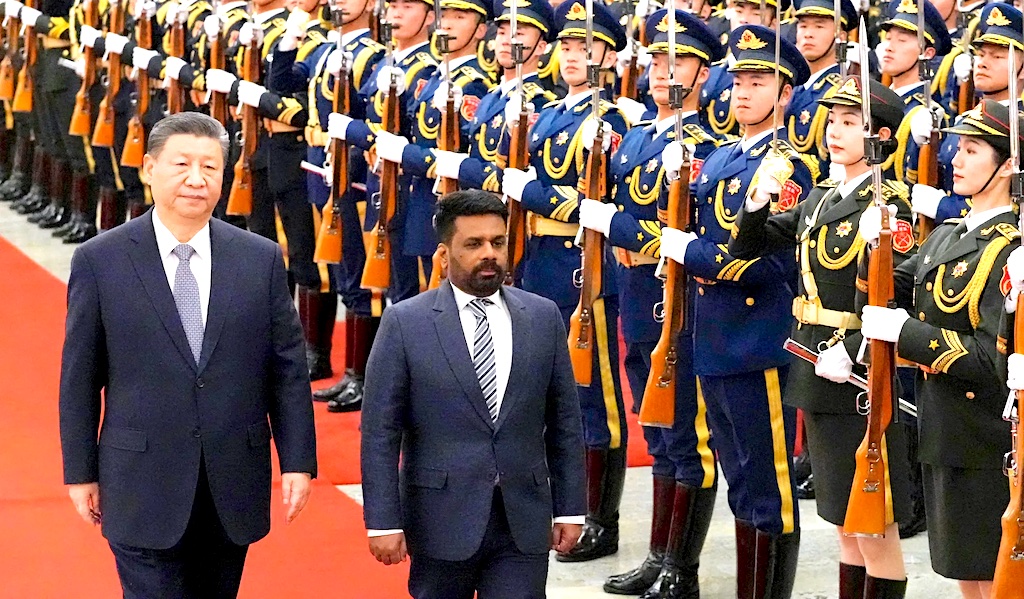
That separation is now becoming less distinct. Over the past decade, and more visibly in recent years, Chinese diplomatic engagement has begun extending beyond the capital with visits to Northern and Eastern provinces, meetings with local representatives, interaction with universities and outreach to sectoral stakeholders, particularly in fisheries and development-related fields. These initiatives remain modest in scale yet their direction is significant, indicating a gradual shift from centralised engagement to more distributed forms of presence.
This shift is unfolding alongside a broader transformation in the structure of the North itself. The region is no longer best understood as a static post-conflict periphery but as a space increasingly integrated into wider maritime and economic systems. The Palk Strait continues to function as a sensitive fisheries corridor shaped by ecological pressure and cross border tensions where livelihoods are directly affected and where bilateral diplomacy is frequently tested.
At the same time, Mannar has emerged as a key site in renewable energy transition where wind and solar investments are reshaping land use patterns and local economic structures. Connectivity initiatives involving KKS harbour and Palaly airport, along with proposed ferry links to India, are gradually repositioning the North within regional transport corridors that link South India to the broader Bay of Bengal economy. In the East, Trincomalee reinforces this trajectory through its strategic maritime location and energy potential.
Even long debated proposals such as the Sethusamudram Shipping Canal Project contribute to a broader conceptual shift in how the region is imagined where the North is increasingly seen not as a marginal borderland but as part of an interconnected maritime continuum.
Within this evolving context, external actors are adjusting their modes of engagement. A quieter but increasingly important layer of activity is visible in maritime research and oceanographic operations. Survey vessels, seabed mapping and resource exploration undertaken by multiple regional powers reflect a growing competition not only over maritime presence but also over maritime knowledge. Control over oceans today extends beyond naval capability into data systems that map currents, seabed structures, fisheries patterns and navigational intelligence, turning information itself into a strategic asset.
This matters because the Indian Ocean is now being continuously observed, measured and interpreted by multiple actors, each building informational advantages that shape long term influence. For Sri Lanka, this creates a complex policy environment in which scientific activity, strategic interest and diplomatic sensitivity increasingly overlap.
At the local level, these shifts are already visible through lived experience rather than abstract strategy. Fishing communities in the North have repeatedly raised concerns about Indian trawler activity, citing ecological damage, declining fish stocks and pressure on livelihoods. In moments of heightened frustration, these grievances have occasionally been framed in broader geopolitical terms, reflecting an awareness that local disputes exist within a larger regional power environment.
This development signals a deeper change in political consciousness. Local actors are no longer confined to purely domestic frames of reference. They are increasingly aware of regional power dynamics and are beginning to situate their demands within them, transforming what were once localised disputes into issues with wider strategic resonance.
It would be misleading, however, to interpret these developments as a straightforward contest between India and China. India remains the most deeply embedded external actor in the Northern and Eastern Provinces while China continues to exercise its primary influence at the national level through infrastructure and finance. The emerging reality is not one of replacement but of layering where multiple forms of external engagement operate simultaneously across political, economic and spatial domains.
The central question is therefore not which actor dominates but how local political structures interpret and respond to this evolving environment. Tamil political discourse has long centred on devolution, rights and post-war reconciliation and these remain foundational concerns. Yet the broader strategic context is changing, as maritime governance, energy transition, connectivity infrastructure and regional integration increasingly shape the region’s future trajectory.
For years, analysis of Sri Lanka’s North rested on a simplified geography in which India mattered locally and China operated elsewhere. That analytical division is becoming harder to sustain. China’s expanding presence in the North does not signal displacement of India but rather convergence within a space that is gaining strategic importance for multiple actors simultaneously.
India recognised this early and built its engagement accordingly. China is now adjusting its approach in response to the same underlying shift. The unresolved question is not external positioning alone but whether local political discourse is evolving at the same pace as the strategic environment surrounding it where land, sea and influence are no longer separable but increasingly interwoven across the same contested space.