
Photo courtesy of HRW
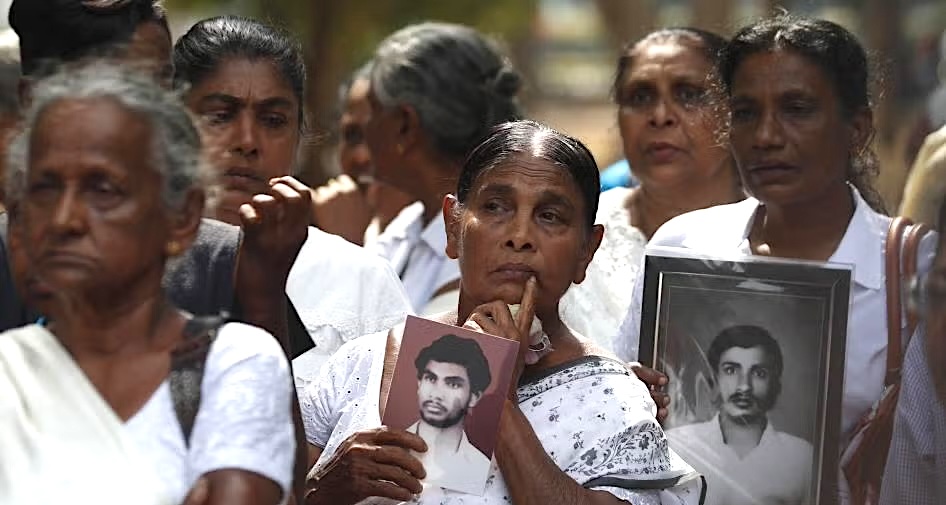
Seventeen years after the guns fell silent, thousands of Sri Lankan families still cannot answer the most basic question about a missing relative: what happened? That unanswered question exposes the distance between ending a war and building peace.
The decisive question is no longer simply whether Sri Lanka has prevented a return to organised warfare. It is whether the country has confronted the human suffering, institutional failures and political inequalities that the war left behind. Peace cannot be assessed only through the silence of the guns; it must also be judged through the experience of citizens who continue to wait for truth, recognition and justice.
This article examines that wider question through one of Sri Lanka’s most unresolved post-war realities: the fate of missing and forcibly disappeared persons. The Office on Missing Persons (OMP) provides a particularly important test. Its establishment signalled an official willingness to search for the truth but its record also reveals the distance between creating an institution and delivering answers. Drawing on academic scholarship, legal standards and available institutional evidence, the article argues that reconciliation becomes meaningful only when truth seeking produces credible findings, reparations preserve rather than replace the right to know, accountability is independent and public institutions are reformed to prevent recurrence.
Why the absence of war is not peace
Peace scholarship provides a demanding standard. Johan Galtung distinguishes the absence of direct violence from positive peace while John Paul Lederach understands reconciliation as the long term transformation of damaged relationships rather than a short post-conflict programme. Lederach’s Building Peace: Sustainable Reconciliation in Divided Societies locates sustainable peace in changes to relationships, institutions and patterns of conflict. By this standard, measuring Sri Lanka’s peace only through the non-recurrence of organised warfare is analytically inadequate.
Transitional justice scholarship adds a second test: truth-seeking, criminal accountability, reparations, institutional reform and guarantees of non-recurrence must reinforce one another. As Sujith Xavier’s Sri Lanka-focused critique of transitional justice emphasises, violent histories must be confronted through accountability, justice and reconciliation. These elements cannot be traded against each other. A truth mechanism cannot compensate for failed prosecution and reparations cannot extinguish the continuing right to know.
Finally, the article treats victim participation as a substantive standard rather than a procedural event. Mirak Raheem’s study of Sri Lanka’s 2016 consultations argues for a genuinely victim-centred transitional justice process. This is particularly relevant where families have repeatedly testified without receiving case-specific answers. Consultation has democratic value only when testimony shapes institutional design, investigation and remedy; otherwise participation risks becoming the extraction of painful narratives for processes over which victims exercise little influence.
The war ended but the conflict was not politically resolved
Sri Lanka’s armed conflict ended in May 2009. The defeat of the LTTE removed its territorial control and brought an end to organised warfare, suicide bombings, forced recruitment and recurrent military confrontation. This achievement matters. Yet the continued absence of war cannot by itself demonstrate that reconciliation has occurred. A battlefield may disappear while the structures, memories and inequalities that sustained conflict remain politically active.
Galtung’s distinction between negative and positive peace provides the appropriate analytical starting point. Negative peace refers principally to the absence of direct violence; positive peace requires the transformation of structural violence and the development of institutions, relationships and social conditions capable of sustaining justice. Sri Lanka has largely preserved negative peace since 2009. It has been far less successful in constructing positive peace.
This failure is partly rooted in the character of the war’s ending. The conflict concluded through military victory rather than a negotiated political settlement. No agreed post-war compact addressed the distribution of political power, minority security, devolution, land, language equality or the institutional guarantees required to prevent recurrence. The state treated military defeat of the LTTE as though it also resolved the political conflict. It did not.
The LTTE committed grave crimes: suicide attacks against civilians, political assassinations, child recruitment, forced conscription, the expulsion of Muslims from the Northern Province and violence against Tamil dissenters. These violations must form part of any honest national record. But their gravity cannot extinguish the state’s separate obligation to investigate alleged violations by its own institutions. International law does not permit one party’s crimes to legalise those of another. Nor can reconciliation be constructed by asking victims to accept a politically convenient balance of suffering in which responsibility becomes indistinct.
Negative peace can coexist with continuing injustice
The post-war state invested heavily in physical reconstruction and the restoration of administrative control. Roads, railways and public buildings were rebuilt. Such measures were necessary but infrastructure was frequently presented as a substitute for political reconciliation. Development cannot answer a mother who asks what happened to a child taken into custody nor can a new road resolve the absence of credible accountability, the fear surrounding memorialisation or the distrust produced by opaque security institutions.
Positive peace requires more than coexistence and ceremonial harmony. It requires citizens to experience the state as lawful, impartial and equally accessible. The appropriate indicators are therefore not simply the number of interfaith events or reconciliation workshops held. They include whether Tamil-speaking citizens can obtain public services in their language; whether land disputes are resolved without political manipulation; whether families can mourn without intimidation; whether security institutions are subject to civilian oversight; and whether allegations against powerful officials can be investigated independently.
Sri Lanka’s difficulty is not a lack of reconciliation vocabulary. Successive governments have repeatedly invoked unity, healing and domestic mechanisms. The deeper problem is the separation of reconciliation from the redistribution of power and the enforcement of rights. When reconciliation is detached from justice, it becomes an expectation imposed upon victims rather than an obligation imposed upon institutions.
The disappeared expose the incompleteness of peace
Enforced disappearances provide the clearest evidence that the past remains present. They occurred during the southern insurrections and throughout the conflict in the North and East. The Human Rights Commission of Sri Lanka’s 2025 parallel report records that earlier inquiries identified personnel connected to the police, army, navy and air force as well as the JVP, LTTE and other militant or paramilitary organisations as responsible in different periods. Disappearance is therefore neither the property of one community nor an event confined to one phase of history. It is a recurring instrument of political violence.
Nevertheless, recognising the nationwide history of disappearance must not erase differences in scale, context and institutional responsibility. Tamil communities in the North and East experienced extensive disappearances during the war and its final stages, including cases involving persons alleged to have surrendered or been taken into state custody. Families of missing members of the armed forces and victims abducted by the LTTE also possess an equal right to know what happened. An inclusive inquiry must acknowledge every victim while maintaining evidentiary clarity about the actor responsible in each case.
A disappearance is not merely an unresolved death. It produces what scholarship describes as ambiguous loss: the family cannot conclusively mourn because the person’s fate remains unknown. A spouse is suspended between marriage and widowhood; parents move between hope and despair; and children inherit both economic insecurity and an unanswered history. The violation continues because concealment continues.
This is why time cannot be used as a substitute for truth. Seventeen years of silence do not convert an unresolved disappearance into a resolved case. Under the international framework, the disappeared person and family members who suffer direct harm are victims, and the violation continues until fate and whereabouts are clarified.
The OMP: necessary institution, inadequate truth
The establishment of the Office on Missing Persons under Act No. 14 of 2016 was a significant institutional innovation. Operational since 2018, the Office on Missing Persons (OMP) is mandated to search for and trace missing persons, clarify the circumstances of disappearance, maintain records, facilitate certificates of absence, recommend reparations and refer suspected offences to law enforcement or prosecutorial authorities after consulting relatives. Its mandate includes conflict-related disappearances, political unrest and members of the security forces missing in action.
The political importance of this institution should not be underestimated. Chulani Kodikara’s study, Office on Missing Persons in Sri Lanka: Why Truth Is a Radical Demand, argues that even non-judicial truth seeking became politically threatening because it could disturb nationalist accounts of an uncomplicated humanitarian victory. In this sense, preserving an official institution devoted to the missing has value. Yet the OMP must ultimately be judged by whether it establishes truth, not merely by whether it continues to exist.
The evidence reveals a serious outcome gap. According to the Human Rights Commission’s parallel report, by August 2024 the OMP had conducted 6,374 inquiries, referred 4,131 cases to the Office for Reparations, 2,305 cases for certificates of absence and 411 cases for death certificates. During Sri Lanka’s examination by the UN Committee on Enforced Disappearances in September 2025, however, the state reported that only 23 missing persons had been successfully traced. The contrast between thousands of inquiries and this limited tracing outcome is the central fact against which the OMP must be evaluated.
This does not mean that every untraced case reflects negligence. The OMP inherited decades-old cases, fragmented databases, inconsistent spellings and incomplete records. Witnesses may have died, evidence may have deteriorated and many cases require cooperation from institutions that possess the relevant archives. Yet these difficulties strengthen rather than weaken the case for transparent performance reporting.
The public needs to know how many persons were traced alive, how many deaths were independently confirmed, how many remains were identified, how many cases produced a finding on circumstances, how many were referred for criminal investigation and how many remain unresolved. Inquiries conducted is an activity indicator. It is not an outcome indicator. Counting processed files can create an appearance of progress without demonstrating that families received answers.
The OMP’s principal structural limitation is that it is not a prosecutorial body. Where its work indicates criminal conduct, accountability depends on the police, Criminal Investigation Department and Attorney General’s Department. This arrangement is particularly problematic when allegations concern state officials. An institution associated with the alleged perpetrator cannot be the sole investigator of that allegation without generating a conflict of interest.
The Human Rights Commission concluded that ordinary investigations into abductions have historically been ineffective and recommended an independent special office to investigate and prosecute serious crimes allegedly committed by state officials. Its evidence is sobering: an earlier Disappearance Investigation Unit investigated 3,615 cases, completed 2,462, filed 376 High Court cases and obtained only 12 convictions. The institutional lesson is clear. Truth collected by the OMP can reach a dead end when the accountability system receiving that truth lacks independence or capacity.
Certificates and compensation cannot close the file
A certificate of absence is useful because it allows a family to manage property, access welfare and perform administrative functions without declaring the missing person dead. Reparations may also respond to urgent economic harm. Women who have searched for disappeared relatives while sustaining households have carried a particularly severe social and financial burden.
But neither a certificate nor a payment establishes what happened. Administrative recognition of absence is not factual clarification of fate. A death certificate issued without a credible investigation risks transforming uncertainty into an official conclusion for bureaucratic convenience. Compensation can mitigate consequences; it cannot determine responsibility.
Families should not be required to choose between material survival and justice. Accepting compensation or a certificate of absence must never be treated as consent to close an investigation. Reparations are meaningful only when they recognise a rights violation and accompany, not replace, truth and accountability. Otherwise, the state risks converting a political and legal obligation into welfare administration.
Mass graves and the state’s forensic deficit
The discovery of human remains at locations including Mannar, Matale, Mullaitivu, Kilinochchi, Chemmani and Colombo demonstrates why disappearance cannot be addressed through documentation alone. A grave is not self-explanatory evidence. It requires secure excavation, forensic archaeology, ante-mortem information, DNA comparison, a protected chain of custody and criminal investigation into the circumstances of death.
The Human Rights Commission reported that the OMP obtained observer status in several excavation proceedings and recommended preservation of evidence. This is constructive. Yet the commission also warned that subsequent criminal investigations risk ineffectiveness if they depend entirely upon the existing apparatus. Sri Lanka needs a permanent, independent and adequately resourced forensic framework, not an improvised response each time human remains are uncovered.
Mass graves also test political intention. A state genuinely committed to truth would preserve sites, fund independent expertise, publish procedural information and keep families informed. Delay, inadequate protection and fragmented responsibility allow biological evidence to degrade and public confidence to collapse. In such circumstances, time becomes not a neutral difficulty but a mechanism through which accountability is weakened.
Another commission cannot substitute for political will
Sri Lanka’s record is characterised by a proliferation of commissions followed by limited implementation. The 2016 Consultation Task Force gathered extensive views on truth, justice, reparations and non-recurrence but its recommendations received inadequate political ownership. The proposed 2024 Commission for Truth, Unity and Reconciliation was criticised by the International Commission of Jurists and Human Rights Watch for weaknesses in consultation, credibility and its relationship to accountability.
The criticism is not that truth commissions are inherently useless. A credible commission can establish patterns, acknowledge victims and recommend reforms. The problem is that a new mechanism may reproduce the cycle of testimony, report and neglect. When families are repeatedly asked to narrate the same trauma without receiving answers, consultation ceases to be empowering. It becomes extractive.
Before establishing another mechanism, the government should publish a detailed implementation account of earlier commissions: which recommendations were accepted, which were completed, which remain pending, which institution is responsible and why any recommendation was rejected. Institutional proliferation without implementation is not transitional justice. It is the management of delay.
Reconciliation without accountability is disciplined forgetting
The dominant reconciliation discourse often asks whether communities are ready to move forward. This question is wrongly directed. The more important question is whether institutions are ready to disclose records, accept scrutiny and act upon evidence. Victims are frequently urged to forgive while the state is not equally required to tell the truth.
Reconciliation cannot mean a compulsory convergence around a single official memory. For some citizens, May 2009 signifies liberation from terrorism. For others, it signifies civilian death, surrender, disappearance and an unanswered search. Muslims expelled from the North, Sinhalese victims of LTTE attacks, Tamil families of the disappeared and relatives of missing soldiers carry distinct memories. A democratic state need not make these memories identical. It must create conditions in which each can be expressed without intimidation and assessed without collective blame.
Nor should truth be portrayed as a threat to military personnel as a whole. Individualised investigation protects institutions from collective accusation. Where evidence establishes innocence, it should do so. Where evidence establishes responsibility, rank and political symbolism should not prevent legal consequence. Accountability directed at individuals is more compatible with reconciliation than permanent suspicion directed at entire institutions or communities.
The danger of another missed moment
The present government has an opportunity that should not be underestimated. Its 2024 electoral victories produced an unusually strong parliamentary mandate: the NPP secured 159 of 225 seats, according to the Centre for Policy Alternatives’ manifesto tracker. A large mandate does not itself create reconciliation but it can reduce the political dependence on exclusionary nationalist constituencies that constrained earlier reforms. It gives the government space to speak honestly to Sinhala, Tamil, Muslim, Malaiyaha Tamil and other communities without presenting the recognition of one community’s suffering as a concession made against another.
There is also a morally significant historical opening. In September 2025, Foreign Minister Vijitha Herath stated that the governing political movement had itself experienced oppression and rights violations and therefore identified with those affected by conflicts on all sides. He further argued that reconciliation should arise from Sri Lanka’s own commitment to the rights and wellbeing of its people rather than merely from pressure in Geneva. That position offers an important basis for a genuinely national process: one that recognises the disappeared from the southern insurrections, the suffering of communities in the North and East, the expulsion and wartime losses of Muslims, victims of LTTE violence and the grief of families of missing security personnel.
The government has also promised to discuss a truth and reconciliation framework with the broadest possible cross section of stakeholders and to build a process capable of earning public trust. This is the correct starting point but consultation must reach beyond selected meetings in Colombo. It should include families of the disappeared, women-led victim groups, former combatants, Muslim communities displaced from the North, families affected by the southern insurrections, religious leaders, youth, journalists and local civil society organisations. Participation must influence the mandate, appointments, investigative procedures and monitoring of any mechanism, not merely legitimise decisions already taken.
The most persuasive proof of change would not be another declaration. It would be a sequence of visible actions: publish a consolidated register of missing persons; disclose measurable OMP outcomes; require state institutions to release relevant records; protect memorialisation; return land where there is no lawful basis for continued occupation; ensure language equality; and establish an investigation and prosecution process capable of acting independently when public officials are implicated. Early progress in a limited number of well documented cases would do more to restore trust than a new institution announced without an implementation timetable.
This opportunity is time bound. Every government begins with a period in which promises may still be believed. If the present administration consults widely but postpones difficult decisions, families will experience the process as another cycle of listening without answers. Failure would damage more than the credibility of one government; it would deepen the belief that no domestic mechanism can deliver truth. The government should therefore treat reconciliation not as a diplomatic file or a minority concern but as a democratic project shared by every community. Sri Lanka has had several political openings since 2009. This one must not become another missed opportunity.
What a credible transition would require
A credible transition must begin by abandoning the assumption that the absence of renewed war proves the success of reconciliation. The state should establish a consolidated and transparent national register of missing persons, reconcile earlier databases and publish clear categories without exposing protected personal information. In October 2025, the UN Committee on Enforced Disappearances similarly called on Sri Lanka to consolidate an updated register and strengthen the OMP’s search capacity.
The OMP should receive guaranteed resources, professional investigators, forensic expertise and enforceable access to official archives. It should publish disaggregated outcome data and identify institutional non-cooperation. Families must receive regular, case specific information in their own language and participate meaningfully in identification and exhumation processes.
Most importantly, Sri Lanka requires an investigative and prosecutorial mechanism sufficiently independent to address serious violations involving state officials. Truth, prosecution, reparations and institutional reform must operate as complementary components. No truth commission and no OMP can carry the entire burden of transition while the surrounding justice system remains resistant to politically sensitive accountability.
Finally, reconciliation must be joined to constitutional democracy. Language equality, land rights, meaningful devolution, protection of memorialisation, security sector oversight and equal access to public institutions are not peripheral matters. They are the institutional content of positive peace.
Peace begins where denial ends
Sri Lanka achieved an important negative peace in 2009. It ended organised warfare and removed an armed organisation that had itself committed grave crimes. But the country has not yet transformed this military outcome into a political and moral settlement grounded in truth, justice and equality.
For families of the disappeared, the war cannot be treated as wholly past. A person remains missing in the present; a family continues to search in the present; and an institution continues to withhold or fails to discover the truth in the present. The disappearance persists because uncertainty persists.
The OMP is a necessary institution but institutional existence is not institutional success. Its value will ultimately be measured by verified answers, identified remains, credible findings, effective referrals and restored confidence, not by the volume of files processed. Sri Lanka has become comparatively skilled at registering loss, certifying absence and referring families for assistance. It has been far less successful at explaining what happened and who was responsible.
The country rebuilt much of what war destroyed physically. It did not invest equal political courage in rebuilding what war destroyed socially: trust, shared belonging and confidence in the law. Truth does not obstruct reconciliation; it gives reconciliation substance. Accountability does not automatically reopen a wound; the wound remains open when power can prevent it from being examined.
The guns are silent. That silence is valuable but it is not yet positive peace. Positive peace will begin when Sri Lanka ceases to administer uncertainty and develops the courage to establish truth, repair harm, reform institutions and apply justice without ethnic or political selectivity.