
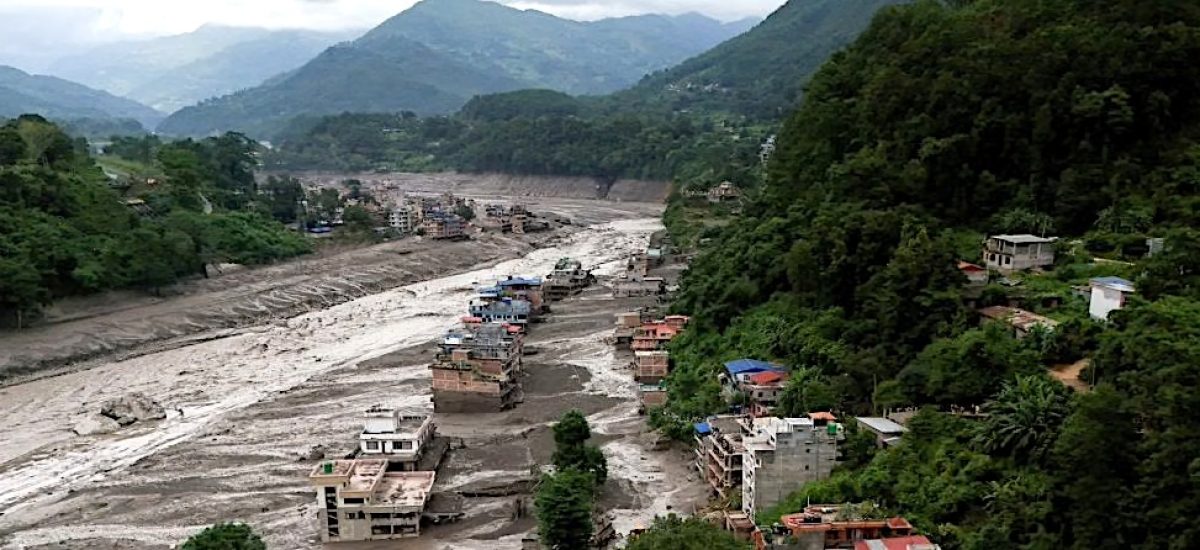

Photo courtesy of The Print
The Himalayas are often described as the roof of the world. Perhaps we should start thinking of them as something even more important: the water tower of Asia. What happens on the Tibetan Plateau does not remain in Tibet.
The rivers that rise from the Tibetan Plateau and the Himalayas flow towards some of the most densely populated regions of Asia. They cross borders, sustain agriculture, provide drinking water, generate electricity and support millions of livelihoods. That is why the recent catastrophe along the Nepal-Tibet border should not be viewed simply as another natural disaster. It should be a warning. Recent flooding in the Himalayan region has demonstrated how rapidly a glacier or unstable mountain slope can turn into a catastrophic chain of events. Scientists investigating the August 2026 disaster identified a massive collapse of ice, rock and bedrock near Langtang Lirung, producing a destructive debris flow and unprecedented changes in river levels. The event was not simply an ordinary flood; it demonstrated the extraordinary fragility of the Himalayan environment. The scientific evidence is becoming increasingly difficult to ignore.
The Hindu Kush Himalaya contains more than 54,000 glaciers, according to the International Centre for Integrated Mountain Development (ICIMOD), which glaciers are critical to the water systems of almost two billion people. ICIMOD’s latest research shows that glacier ice loss has accelerated dramatically: the rate of ice loss has effectively doubled since 2000 while glaciers have lost up to 27 metres of ice thickness since 1975 in some measurements. The Tibetan Plateau alone has been estimated to contain approximately 36,000 glaciers. Nepal’s Himalayan region has thousands more. A major inventory identified approximately 3,808 glaciers, covering around 3,902 square kilometres. These are not merely beautiful landscapes. They are reservoirs of frozen water and they are changing.
Nepal has already lost nearly one-third of its mountain ice over approximately three decades while the number and instability of glacial lakes are becoming increasingly concerning. A 2020 ICIMOD–UNDP assessment identified 47 potentially dangerous glacial lakes in the Koshi, Gandaki and Karnali river basins across Nepal, Tibet and India. The danger is not only that glaciers disappear. The more immediate danger is that melting glaciers, unstable slopes and expanding glacial lakes can create sudden and devastating floods.
At precisely the moment when the Himalayan cryosphere is becoming more fragile, China is dramatically expanding its hydropower ambitions on the Tibetan Plateau. The most extraordinary example is the project on the Yarlung Tsangpo River, the river that becomes the Brahmaputra after it enters India. China began construction in 2025 on what is expected to become the world’s largest hydropower installation. The planned project consists of five cascade hydropower stations and is expected to generate around 300 billion kilowatt hours of electricity annually with a combined capacity reported at around 60 gigawatts. The scale is difficult to comprehend. This is not simply a local Tibetan energy project. It is a project of enormous significance to China’s national energy strategy and that raises a basic question: How much infrastructure can a fragile mountain ecosystem safely absorb? Tibet does not exist as an isolated ecological space. A river manipulated at its source eventually affects people downstream. A landslide does not stop at an international boundary. A glacier does not ask for a passport before it melts and a flood does not recognise a political border.
The most worrying part of the dam debate is the geology. The Himalayas are among the most tectonically active mountain systems on Earth. The mountains themselves are a product of the continuing collision of the Indian and Eurasian tectonic plates. The planned Yarlung Tsangpo project is being constructed in an exceptionally difficult geological environment. In 2026, reporting on research by Chinese geologists highlighted concerns about an active fault beneath or close to the project area and the risks posed by earthquakes and associated landslides. This does not mean that an earthquake will destroy the dam nor does it mean that China is deliberately constructing a weapon against its neighbours. Those claims would go beyond the evidence. But it does mean that the consequences of a major geological event deserve international scrutiny. Because the river does not end in China. It flows into India and Bangladesh and wider Himalayan river system connects China with Nepal, Bhutan, India, Bangladesh and Pakistan through different basins. That is why Himalayan water cannot be treated simply as a domestic Chinese issue.
A large dam does not have to be deliberately used as a weapon to create geopolitical anxiety. The mere fact that one country controls major infrastructure at the headwaters of a transboundary river gives that country enormous strategic importance. Water can be stored, water can be released, water can be diverted. And information about water flows can be withheld. For countries downstream, the uncertainty itself becomes a security problem. India has already formally expressed concerns to China about the Yarlung Tsangpo project. India worries about the implications for downstream water flows and the environment. Nepal has another reason to be concerned. The recent disaster demonstrated how urgently downstream countries need reliable information about what is happening in the mountains. After the recent floods, Nepal again pressed China for better hydrological information and early warning cooperation. Nepali officials have complained that the information available from the Chinese side is not sufficiently comprehensive or frequent. China, for its part, says that it has provided information in a timely manner. This disagreement itself tells us something important.
There is a temptation, particularly at a time of tragedy, to blame China’s dams for every Himalayan flood. We should resist that temptation. The recent Nepal disaster should not be presented as proof that a Chinese dam caused the flood. The evidence points instead to a catastrophic glacier/rock collapse with climate change recognised as an important factor increasing the instability of Himalayan glaciers and frozen slopes. But this distinction does not make the dam issue less important. It makes it more important. Because if the Himalayas are becoming more unstable naturally as the climate warms, then we should be asking whether massive new infrastructure is being designed with the realities of this new climate in mind.
We cannot build infrastructure for the Himalayas of the 21st century when the Himalayas of the 21st century are already changing.
There is another uncomfortable truth. China is not the only country building dams in the Himalayas. India, Nepal and Bhutan are also pursuing hydropower development. Nepal itself has seen enormous damage to hydropower infrastructure during recent Himalayan flooding. The latest disaster reportedly damaged or destroyed numerous hydropower installations and affected around 10 percent of Nepal’s power capacity. Therefore, this cannot become a simple China is bad argument. The question must be bigger: How do we develop the Himalayas without destroying the ecological system on which all these countries ultimately depend?
Perhaps the greatest failure of Himalayan politics is that the mountains are shared environmentally but divided politically. China sees energy, India sees energy and national security, Nepal sees hydropower and economic development, Bhutan has its own hydropower interests and Pakistan depends heavily on Himalayan water systems but the glaciers do not see any of these borders. The rivers do not recognise them either.
What we desperately need is a regional mechanism for: real time sharing of river and glacier data, earthquake and landslide monitoring, joint glacial-lake surveillance, mandatory downstream warnings before major water releases, independent environmental impact assessments, transboundary disaster-warning systems and international scientific monitoring of major Himalayan infrastructure.
The recent disaster should be the moment when South Asia understands that water security is no longer only an environmental issue. It is a human-security issue. The roof of the world is beginning to crack. Perhaps it is time the countries beneath it started talking to one another.