
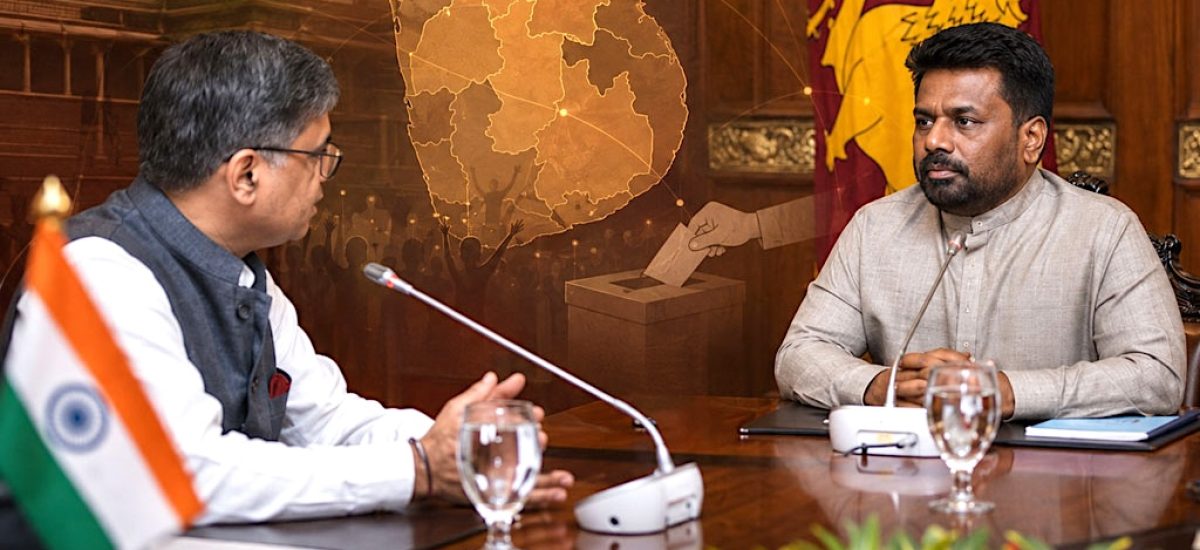

Photo courtesy of The Morning Telegraph
The government is coming under increasing pressure from the opposition and civil society as well as India for failing to hold Provincial Council elections in keeping with a constitutional requirement as well as its own election promise.
Accusing the government of stalling without taking a firm decision, despite the existence of practical and legal solutions to hold the elections, four opposition members boycotted the 10th meeting of the Parliamentary Select Committee on the Provincial Council Elections.
The decision was taken by MPs Ranjith Madduma Bandara, Mano Ganesan, Shanakiyan Rasamanickam and Nizam Kariapper. Their central grievance is that even after 10 committee meetings, no meaningful progress or clear timeline has been established to conduct the elections.
Speaking on behalf of the four opposition members, Mr. Rasamanickam informed the committee that they could no longer support a process that has consistently failed to deliver progress toward holding the polls.
The failure to conduct Provincial Council elections cannot be attributed to a lack of practical solutions. The Election Commission has already submitted a clear proposal to the select committee to hold elections under the existing proportional representation system.
This proposal also incorporates provisions to guarantee a 25 percent quota for female representation. A practical framework is already available that allows elections to proceed under the former electoral system while safeguarding women’s political participation.
Furthermore, a separate legal path remains open before parliament. A Private Member’s Bill presented by Mr. Rasamanickam, which contains the necessary legal mechanisms to hold the elections, is currently on the parliamentary order paper.
Should a majority of MPs concur, parliament could advance this bill to create the legislative framework needed to conduct the elections. With both practical and legal avenues readily available, opposition members contend that continued delays reflect a lack of political will.
At a public meeting, President Anura Kumara Dissanayake addressed the Provincial Council elections issue. “There are currently legal impediments to holding the Provincial Council elections. Once an electoral system agreed upon by all parties in parliament is decided, we will hold the elections. We will never use excuses to retain power; our trust lies solely with the people,” he said.
While this statement may appear on the surface as a government commitment to hold elections, critics point out that the condition requiring total party consensus indicates the government lacks a clear deadline for the polls.
Securing full consensus among all political parties is a lengthy process in practice. If elections remain contingent on unanimous agreement, there is a risk that Provincial Council elections will be postponed indefinitely.
Had the president and the government been genuinely committed to expediting the Provincial Council elections, opposition members would not have felt compelled to walk out of the Select Committee meeting in frustration. The walkout cannot be viewed merely as a routine boycott of a meeting. It represents a clear political protest against continued indecision after 10 consecutive sessions.
The government must decide whether to accept the Election Commission’s proposal, proceed with the Private Member’s Bill or table its own legislative amendment. Whichever path is chosen, an immediate announcement of a firm timeline is essential.
Page 128 of the NPP’s 2024 presidential election manifesto explicitly promised that Provincial Council and local government elections would be held within one year of assuming office.
While local government elections have been conducted, the government has yet to announce a firm decision or a timeframe for the Provincial Council elections. This has created a notable contradiction between the manifesto promise and the government’s current stance.
For years, the country’s Provincial Councils have functioned without elected representatives, denying citizens their democratic right to elect regional officials. Provincial Councils are a constitutional mechanism, not mere administrative entities. They are democratic institutions directly tied to regional political representation, power sharing, and local development. Therefore delaying elections cannot be treated as a routine administrative delay.
The four opposition members warned that if the Select Committee and the government fail to demonstrate genuine political commitment to holding elections, they will be forced to take severe measures. The opposition may explore several avenues, including approaching the judiciary, although no official announcement regarding legal action has been made.
What is needed now is not more meetings, new excuses or endless debates. What is required is a clear timeline outlining the chosen electoral system, when legislative procedures will conclude, when nominations will be called and when polling will take place.
While the president’s assertion that he trusts the people is welcome, that trust must be demonstrated by giving citizens an immediate opportunity to choose their representatives. The government cannot claim to respect democratic rights while holding Provincial Council elections in indefinite abeyance. The time for promises has passed; the moment has arrived for a firm decision, legal action and a confirmed election date.