
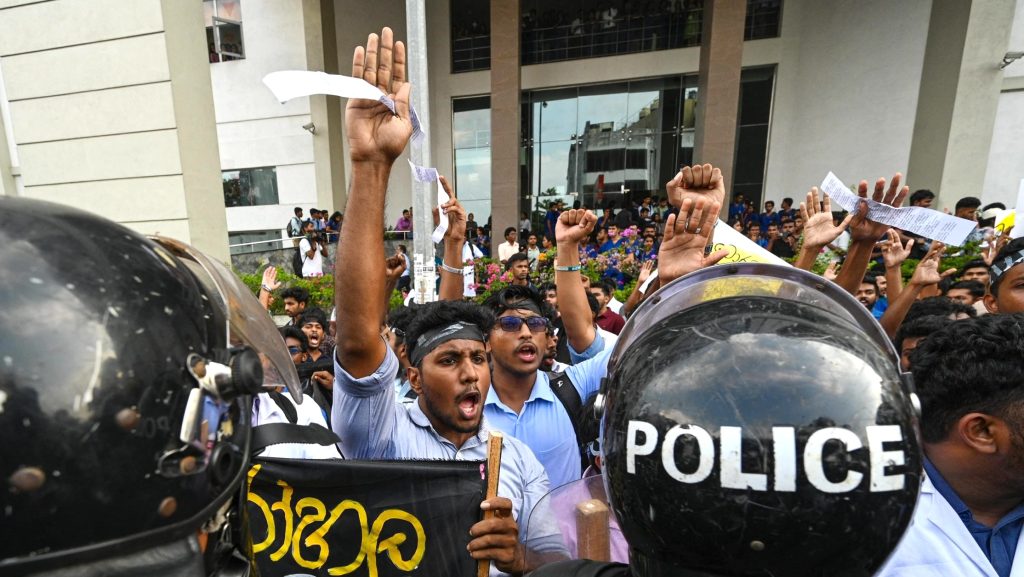
Photo courtesy of the South Asia Media Solidarity Network
If you grew up in Sri Lanka over the last decade, your introduction to the state was direct and unforgiving. You didn’t just read about policy in a textbook; you lived it in fuel queues, during rolling power outages, through hyperinflation that slashed the value of your savings and amidst an overnight policy shift that disrupted agriculture nationwide.
For Gen Z, these weren’t isolated bad luck events. They were the natural end result of a system built on top-down state control, political price fixing and opaque public monopolies.
It is time to look past the political jargon and ask a straightforward question: What does classical liberal economics actually mean for young Sri Lankans and why should Gen Z care?
In everyday political debate, economic terms often get distorted. Liberal economics, in its classical sense, isn’t about protecting multi-million-dollar conglomerates or abandoning vulnerable communities. At its core, it is about decentralising power.
It rests on three simple principles:
The state shouldn’t be a business owner – Governments excel at enforcing laws and protecting rights; they fail at running airlines, retail distribution and power grids. When the state holds a monopoly, consumers get high prices, poor service and giant public debts that citizens end up paying through taxes.
Prices are signals, not political tools – When politicians force artificial price caps on basic goods like rice or gas, suppliers stop selling, black markets emerge and goods disappear from shelves. Prices need to reflect real supply and demand so resources flow where they are needed.
Open access over cronyism – High import tariffs and dense regulatory red tape don’t protect the average citizen; they protect well-connected domestic industries from competing. Liberal economics demands a level playing field where anyone can start a business without paying bribes or navigating endless bureaucratic hurdles.
Gen Z is often mischaracterised as detached but the reality is that young people are already practicing decentralisation every day.
You trade on global digital platforms, freelance across borders, build digital communities without state oversight and value personal autonomy above all else. You naturally distrust slow, corrupt, centralised legacy systems.
Yet when it comes to economic policy, young Sri Lankans are often handed a false choice between state-dominated paternalism on one side and crony capitalism on the other. Liberal economics offers the alternative: a system where rules are transparent, competition is open and individuals retain the freedom to build their own lives without needing government permission.
If we want an economy that actually works for people in their 20s rather than protecting political incumbents, Gen Z needs to lead the shift in how we talk about policy.
Demand an end to state monopolies – Support the unbundling and privatisation of loss-making State-Owned Enterprises. Demand accountability in privatising SOEs, not just mere transfer of ownership from state to crony capitalists. Ask the state to intervene for deregulation and create level playing fields that promote competition. Public funds should support education, healthcare and targeted social safety nets, not bail out mismanaged utility monopolies.
Push to tear down border barriers – High import taxes on tech, building materials and everyday goods shrink your purchasing power and isolate Sri Lanka from the global economy. Free trade is a consumer rights issue. Notice when you pay more money for lower quality because your choice is now subordinated to taxes. A good example is vehicles.
Hold the money supply accountable – Support independent monetary policy. When central banks print money to cover government spending, it dilutes the value of every rupee you earn. Inflation is an invisible tax on young people starting their careers. You enjoy doing gigs today. These gigs don’t have superannuation. You are not worried about retirement today but don’t forget that the circle of life goes on. You will need a fallback cushion one day. What if that is worth nothing? Everyone teaches the young to save, hardly anyone tells you how to invest. Hedge your risk today against inflation.
Build decentralised alternatives – Use tech, remote work and creative entrepreneurship to bypass outdated local systems. Prove that voluntary trade and private initiative can solve problems faster than state bureaucracies.
The economic breakdown of 2022 proved that the old model of state control was unsustainable. But recovery isn’t just about surviving an IMF program; it’s about deciding who owns the future.
The state had its turn with your future and the results speak for themselves. It’s time for Gen Z to take the wheel, demand open markets and build a free economy.
The author is a Director and Fellow of the Advocata Institute, an independent board director, senior transformation adviser, and Founder of Accedo Intel.