
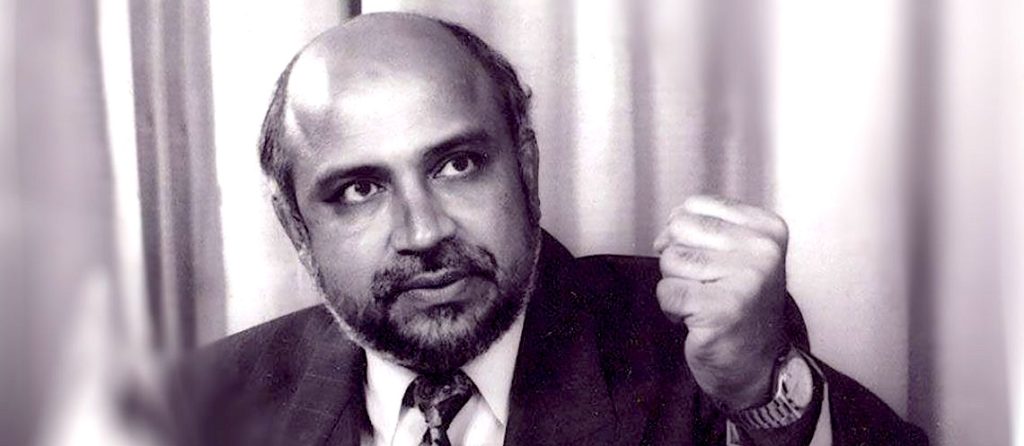
Photo courtesy of Lankasara
On September 16, 2000, M.H.M. Ashraff boarded a Sri Lanka Air Force helicopter in Colombo. Its destination was Ampara, the Eastern soil from which much of his political life had grown. He never arrived.
The helicopter crashed near Aranayake, bringing to an abrupt end one of the most consequential political careers in contemporary Sri Lankan Muslim history. Ashraff was only 51. Twenty six years later, his photographs still return to public stages every September, his speeches are remembered and the tree the symbol of the Sri Lanka Muslim Congress (SLMC) continues to carry the memory of the movement he helped turn into a national political force.
But anniversaries can easily turn politicians into monuments. Ashraff deserves a more demanding form of remembrance. The useful question is not simply who inherited his party but what he changed in politics and how much of that political project survived him.
His journey was never a straight line. He engaged closely with Tamil politics before becoming the principal architect of an autonomous Muslim political movement. He converted that movement into bargaining power, entered cabinet and used political influence for institution building and development. Yet towards the end of his life he began moving again, this time through the National Unity Alliance (NUA), towards a political platform that sought to reach beyond an exclusively Muslim constituency.
I remember that transition personally. Years before the NUA, Ashraff listened to me speak at an SLMC meeting in Maruthamunai and subsequently gave me a national responsibility in the party’s youth structure. Later, around the registration of the NUA, I had an informal conversation with him at his ministerial bungalow in Colombo. Only with the passage of time did I understand how closely those encounters were connected: the first concerned building Muslim political consciousness; the second concerned what should come after such consciousness had been built.
A life shaped in the East
Mohammed Hussein Mohammed Ashraff was born on October 23, 1948 in Sammanthurai in the Ampara District to Mohammed Meera Lebbe Hussain and Matheena Ummah. He grew up in now Kalmunai. The geography matters. Ashraff was formed in an Eastern social world where Muslims and Tamils shared the Tamil language and much of everyday life while retaining distinct religious and communal identities. Questions of land, education, administration, political representation and access to state resources were not abstractions he first discovered in Colombo; they belonged to the region that shaped him.
Educated at Wesley High School in Kalmunai, he entered Ceylon Law College and passed his examinations with first class honours. He briefly served as a State Counsel before moving into private practice, later obtaining further law degrees from the University of Colombo and becoming President’s Counsel in 1997. Yet law was only one side of him. Accounts of his student life record his leadership of the Law Students’ Muslim Majlis and Tamil Manram. He wrote on constitutional questions in Tamil and was also known as an orator, writer and poet.
His intellectual environment is equally interesting. A published historical account describes Muhammad Husain, a district magistrate and Ashraff’s uncle, as one of the figures who influenced the young lawyer and introduced him to poet and educationist Abdul Cader Lebbe of Kattankudy. This does not mean that one person created Ashraff’s politics. It does show a young man already moving through conversations about law, literature, Islam, Muslim identity and Sri Lanka’s constitutional future.
That background helps explain an apparent paradox. The man who later became the strongest advocate of an autonomous Muslim political voice did not begin by simply rejecting Tamil politics. As a young activist he admired S.J.V. Chelvanayakam, engaged with the Federal Party tradition and moved within the Tamil political world. His later insistence that Muslims needed to speak politically in their own name emerged partly from that engagement, not merely from opposition to it.
As the ethnic conflict deepened, a difficult question became harder for Eastern Muslims to avoid: they were predominantly Tamil-speaking but did speaking Tamil mean their political interests could simply be represented as Tamil interests? If the future of the North and East was to be negotiated principally between Sinhala and Tamil political forces, where would Muslims stand?
That combination of Eastern roots, legal training, Tamil literary confidence and early exposure to competing ideas of nationhood helps explain why Ashraff could speak in several political languages at once. He could argue as a constitutional lawyer, mobilise as a community leader and negotiate as a coalition politician. It also helps explain why his career resists a simple label. To describe him only as a Muslim nationalist misses his earlier Tamil political engagement and later national turn; to describe him only as a national statesman overlooks the hard identity politics through which he built his power. The more interesting Ashraff is found in the movement between those positions.
Building an independent Muslim political voice
The SLMC was established in Kattankudy in September 1981. Ahammed Lebbe of Kattankudy was its pioneering president while Ashraff was centrally involved from the formative stage. He assumed formal leadership in 1986 and gave the organisation a stronger electoral and political direction.
By then the ethnic conflict had intensified and relations between Tamils and Muslims in parts of the East were increasingly strained. The SLMC gave Ashraff an organisational vehicle through which anxieties about security, representation and political marginalisation could be converted into collective political action.
The tree became the party’s symbol but the deeper innovation was a change in where Muslim bargaining took place. Muslim politicians had served in parliament and cabinet long before Ashraff, usually through larger national parties. Ashraff sought something different; instead of individual Muslim politicians bargaining from inside those parties, he built a Muslim political organisation capable of bargaining with them.
When the SLMC entered parliament in 1989, autonomous Muslim party politics became a national reality. Ashraff’s impact also went beyond elections. The conflict was frequently described through a Sinhala-Tamil binary even though substantial Muslim populations lived in the regions at the centre of disputes over territory, devolution, land and administration. His advocacy helped force a third political reality more clearly into national discussion. Muslims could not simply be spectators to settlements negotiated by others. Contemporary historical assessments similarly credit him with making the ethnic question visibly trilateral rather than merely bilateral.
A leader who noticed young people
Ashraff’s movement was not built only through parliamentary speeches or negotiations in Colombo. He paid attention to the grassroots and to younger activists. I experienced this personally.
At the time I was serving as a District Secretary of the SLMC. A major meeting was held at the Masoor Moulana Grounds in Maruthamunai and I was given an opportunity to make a political speech. Ashraff was present. For a young activist speaking before the party leader naturally carried pressure. I delivered my speech and assumed that would be the end of it. But Ashraff had listened. Afterwards he promoted me to the position of National Propaganda Secretary of the SLMC Youth Wing.
At the time, the appointment seemed the important part. Looking back, what stays with me is that he was watching the younger generation, listening to how young activists communicated political ideas and identifying people who might carry the movement forward. The SLMC’s message then strongly emphasised Muslim identity, rights, security, unity and independent representation. I could not have known that, years later, Ashraff would speak to me about his concern over where that same political atmosphere might eventually take Muslim youth.
From votes to bargaining power and institutions
Ashraff built his movement during one of the most violent periods in modern history yet his principal political machinery remained electoral and parliamentary. This does not mean his rhetoric was always moderate. Scholarship has critically examined the ethno-political character of SLMC mobilisation. Bart Klem, argued that the party combined Muslim rights and self-determination rhetoric with political realpolitik, joining Sinhala-led governments in pursuit of access and influence. That tension – identity mobilisation combined with pragmatic coalition-making – is essential to understanding Ashraff rather than idealising him.
He understood electoral arithmetic. A minority does not always need large numbers to exercise influence. In a closely divided system, it needs strategically organised numbers. That became especially visible in 1994, when the SLMC became an important coalition partner in the People’s Alliance government and Ashraff entered cabinet. Parliament’s official record confirms his service from 1989 until his death and his portfolios in Shipping, Ports, Rehabilitation and Reconstruction.
The larger question, however, is what bargaining produces. It can end with ministerial office and appointments or it can be converted into institutions and public goods. The most enduring institutional symbol associated with Ashraff is the South Eastern University of Sri Lanka. Its wider significance lies in the principle it represents – a demand emerging from the educational disadvantages of a region and community can become part of the national institutional landscape.
His ministerial years were also associated with rehabilitation, reconstruction, infrastructure and port development. His record should not be romanticised; he operated within the personalised and patronage-oriented political culture. Yet he understood a question that remains relevant to minority politics today. After the bargaining is over and the politician leaves office, what remains?
The contradiction inside identity politics
The success of Ashraff’s strategy also produced a problem. Identity politics can protect a vulnerable community. It can create solidarity, confidence and negotiating power. But once a community has been successfully mobilised around its identity, how does a leader prevent that identity from becoming a permanent boundary between the community and the nation?
This dilemma is not uniquely Muslim. Sinhala and Tamil nationalisms have also demonstrated how political identity, continuously intensified, can harden communal boundaries. A language initially used to protect a community can eventually become a language that keeps it politically enclosed.
What makes Ashraff’s final years particularly interesting is that he appears to have begun confronting this contradiction himself. In 1998 he publicly argued that a minority party had reached the limits of what it could do and needed to expand its horizons into national politics. The NUA was formally registered on August 23, 1999. It would be too easy to romanticise this as proof that Ashraff had completely transcended identity politics. The NUA existed for too short a period and a broader alliance also made electoral sense for an ambitious national politician. But my own conversation with him made me understand the move differently.
A plate of rice and an unforgettable question
At that time, I was attached to the Department of Political Science at the University of Colombo as a lecturer. One day I received a telephone call asking me to come and meet the leader. I went to Ashraff’s ministerial bungalow in Colombo.
When I arrived, M.M. Mohideen, Sammanthurai Yaseen and several other senior SLMC leaders were there. The atmosphere was relaxed and celebratory. They were marking the registration of the NUA and sharing a meal. Ashraff noticed me and asked that a plate be brought for me. I had already eaten lunch but when the leader himself invited me, refusing did not seem appropriate. I took a little and joined them. It was an ordinary setting for what became one of my strongest political memories. There was no stage, no microphone and no formal speech, just Ashraff, senior colleagues, food and conversation. But I had a question.
I had watched him build the SLMC and knew the political strength it had given him. Through the SLMC he had entered parliament, cabinet and the centre of national decision making. Why, then, did he need another political formation? I asked why, after building the SLMC into such a powerful organisation and reaching high office through it, he had registered the NUA.
His response has remained with me for more than two decades. Ashraff reflected on the political atmosphere created while building Muslim political power. He spoke about the language used in mobilisation, including ethnic appeals and community-centred slogans that had helped unite Muslims and create political consciousness. But he was worried about where such politics might eventually take the younger generation.
His concern was particularly about Muslim youth. A political atmosphere that had been useful in awakening and organising a community could become dangerous if it continued indefinitely without correction. He did not want young Muslims to be carried in a direction he had not intended. He wanted to move them towards a broader national agenda.
What impressed me was not merely a change in electoral strategy. It was the willingness of a powerful politician to question the possible consequences of the political language that had helped him become powerful. The politics required to awaken and organise a marginalised community may not be the same politics required to lead the next generation of that community.
Seen in that light, the NUA can be read not only as electoral expansion but also as political self-correction. Ashraff was not abandoning Muslim rights or denying the need for independent representation. He seemed to be asking whether political confidence built through communal mobilisation could eventually be carried into a larger Sri Lankan citizenship. His public move towards a national platform gives independent context to that recollection although it cannot prove precisely what he intended privately.
The journey interrupted
On September 16, 2000, the helicopter crashed near Aranayake. Ashraff’s death ended not only a political career but an unfinished political experiment. There would be no opportunity to discover what the NUA might become, no Ashraff at the negotiating table during the 2002 peace process and no way of knowing whether the man who built the country’s strongest autonomous Muslim political movement could successfully lead it towards a broader national platform.
His death also exposed a weakness in the movement he had built. The SLMC had an exceptionally powerful leader but not an equally secure succession mechanism. Leadership disputes and fragmentation followed. Later scholarship on Muslim politics has examined how post-Ashraff fragmentation weakened collective political coherence and the persistence of patronage networks and competition for ministerial access. The important academic point is not that Ashraff’s era was free of patronage but that the movement’s post-founder trajectory revealed the difficulty of converting charismatic leadership into durable political institutions.
The SLMC survived. Other Muslim parties emerged. Muslim politicians continued to enter governments and obtain portfolios. Coalition bargaining survived extremely well. But did Ashraff’s method survive more strongly than his purpose?
Political leverage can obtain ministries, appointments and resources. Its larger value lies in whether it changes structural conditions – education, rights, security, administration, economic opportunity, social cohesion and the quality of representation. If bargaining repeatedly changes who holds office without changing the circumstances of the people represented, bargaining has lost its transformative purpose.
Remembering him without making him a saint
Ashraff should not be remembered as a politician who never made mistakes. He sought power, used strong community-centred rhetoric and led a highly personalised political movement. Academic assessments themselves are mixed: Mohammad Agus Yusoff and colleagues emphasise the transformation of Muslim political culture and socio-political advancement while acknowledging criticism of communal mobilisation; Andreas Johansson highlights pragmatic parliamentary politics; and Klem stresses the interaction of ethno-political rhetoric, access and patronage. Read together, these arguments produce a more useful Ashraff, not a saint or villain but a leader who expanded Muslim political agency while operating inside the contradictions of identity and coalition politics.
For me, that journey remains captured in two memories. At Maruthamunai, I saw Ashraff the organizer, a leader listening to a young activist, building a movement and cultivating Muslim political consciousness. Years later in Colombo, I encountered the same leader worrying about what could happen if that consciousness remained permanently attached to ethnic slogans. Only much later did I understand the connection. The first encounter was about building a generation. The second was about where that generation should go.
Twenty-six years after his death, Sri Lanka is different from the country Ashraff left behind. The war has ended and a younger generation has grown up without direct memories of much of the violence that shaped his politics. Yet land remains sensitive in the East, administrative boundaries remain contested, Tamil-Muslim relations can still become strained, religion can rapidly be politicised and questions of minority representation remain unresolved.
Sri Lanka therefore continues to face the larger democratic challenge that Ashraff’s unfinished journey raises: how can communities defend their identities and political dignity without turning those identities into permanent walls between citizens?
Ashraff did not solve that problem and history should not pretend that he did. But several times in his career he recognised when an existing political model had become insufficient. When traditional Muslim representation seemed inadequate, he helped build an autonomous political movement. When demographic weakness appeared to limit Muslim influence, he converted organised votes into bargaining power. When representation alone was insufficient, he used political influence to build institutions. And when the language of identity politics itself seemed capable of producing consequences he feared for the younger generation, he began exploring a broader national platform.
Then the helicopter fell. The leader disappeared. The SLMC survived. The tree survived. Coalition politics survived. The politics of bargaining survived. But the larger journey from identity, to representation, to political confidence and finally towards a broader national citizenship remains unfinished.
That is why, 26 years after his death, the most meaningful question on September 16 may no longer be simply be who inherited M.H.M. Ashraff’s party A more important question is who understood where Ashraff was trying to go next?
The author is a PhD Researcher, School of Humanities and Social Sciences, University of Peradeniya