
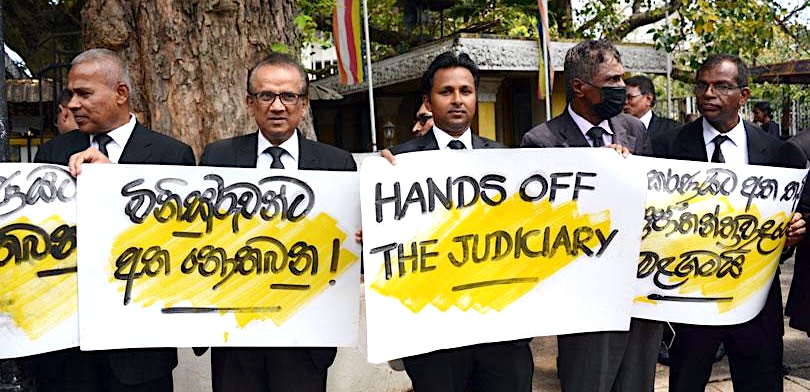
Photo courtesy of Daily Mirror
The Bill to amend the Constitution for the 22nd time, together with the proposed amendment to the Judicature Act, is currently under consideration by the Supreme Court. The immediate constitutional question is whether the proposed increase in the retirement age of judges can be enacted by a two-thirds majority in parliament alone or whether, in addition, it requires approval at a referendum. The Supreme Court is therefore placed in the unusual position of determining the constitutional question concerning the tenure of its own judges.
The amendment has encountered strong resistance within the legal profession and civil society. The principal allegation is that the government seeks to influence the composition of the judiciary by retaining judges whom it favours. The government strongly denies this and maintains that the amendment is intended, among other things, to address delays in the administration of justice. But suppose, for the purposes of argument, that the government is acting entirely in good faith and has no intention of influencing the judiciary, a more fundamental question remains: is the 22nd Amendment completely sound in the absence of any malicious intent?
To consider that question, I borrow the verse attributed to Benjamin Franklin, published in Poor Richard’s Almanack in 1758. It illustrates how an apparently unintended omission can, through a chain of consequences, ultimately produce a grave and unforeseen result:
“For want of a nail, the shoe was lost;
For want of a shoe, the horse was lost;
For want of a horse, the rider was lost;
For want of a rider, the battle was lost;
For want of a battle, the kingdom was lost,
And all for the want of a horseshoe nail.”
Tenure, salary and the independence of the judiciary
The appointment and removal of judges of the Supreme Court and Court of Appeal are dealt with in Article 107 of the Constitution, under the heading “Independence of the Judiciary” in Chapter XV, entitled “The Judiciary”. Article 107(5) specifically addresses the retirement age of those judges. At the very outset, it can be construed that the age of retirement is a matter involved in the independence of the judiciary. Another important matter addressed under the independence of the judiciary is the salaries of judges, dealt with in Article 108. Unlike Article 107, Article 108 expressly provides that the salaries, pensions and entitlements of a judge shall not be reduced after his appointment. The reason behind the protection clause is obvious: to ensure the independence of the judiciary, judges should not be placed in a position where their financial entitlements can be used as a means of pressure or intimidation. It is also an axiom that security of tenure is a matter of judicial independence. A judge should not be vulnerable to pressure because the duration of his or her judicial office can be shortened. Yet, unlike Article 108, the constitution does not expressly articulate such protection in relation to the retirement age of judges.
Any constitutional interpreter may reasonably distinguish this difference. Salary and entitlements are subject to periodic change; nevertheless, the change cannot operate in both directions. They may be increased but a reduction in salary is a matter affecting the independence of the judiciary and therefore requires a protection clause. Tenure is also a matter of judicial independence but the absence of a protection clause suggests that tenure is not subject to periodic change but rather is intended to remain fixed. Any change in either direction, whether increasing or decreasing the retirement age, is a matter concerning the independence of the judiciary. This is apparent from the manner in which the constitution is worded. That makes an express protection clause against the reduction of the retirement age of judges unnecessary. The Supreme Court has, in several judgments consistent with the constitution, recognised this relationship between judicial tenure and the independence of the judiciary.
This inevitably raises a further question: if the 22nd Amendment disrupts the fixed nature of the tenure by increasing it, it could subsequently be interpreted that the tenure could also be reduced. A future Government commanding the requisite majority could seek to restore the retirement age to 65, or reduce it even further. The consequence would be judicial tenure fluctuating with the political preferences of the Government of the day. More significantly, such a precedent could provide a route to the removal of serving judges simply by shortening their remaining tenure. One may argue that once the age of retirement is increased, it cannot subsequently be decreased. But that is merely a hopeful argument, with a greater degree of ambiguity. Governments do not leave lacunae in the law for the benefit of the law; where such a lacuna can serve their interests, there is no guarantee that will not be exploited. The proviso further consolidates the issue.
The proviso problem
The proviso introduced by the 22nd Amendment reads, “Provided however, the date of retirement of the Chief Justice shall be either the date on which the Chief Justice reaches the age of sixty-seven years or the date on which a period of six years is completed from the date of appointment as the Chief Justice, whichever occurs earlier.”
The proviso facilitates that 67 is not, in effect, the maximum age to which every chief justice may serve. If, for example, a justice is appointed chief justice at the age of 57, as has happened in the past, that justice would retire at the age of 63, four years before his or her colleagues. The proviso therefore makes clear that the retirement age is not fixed at 67. It expressly creates a mechanism through which the effective retirement age of a chief justice may be reduced. Unlike the age of 67, the six year period is not tied to any objective age-based criterion. It is simply a period prescribed by the amendment and can be altered at any time; it could theoretically be reduced to five, four or even two years.
Let us, in retrospect, apply this reasoning to the Mahinda Rajapaksa government in 2013, which commanded a two-thirds majority in parliament. The impeachment of Chief Justice Shirani Bandaranaike remains one of the most controversial episodes in recent constitutional history and arguably contributed to the downfall of the Rajapaksa regime. If Article 107(5) could be amended through the ordinary parliamentary procedure, the government of the day would have amended the clause “after completing 6 years in office” to “after completing 3 years in office”, which would have brought Justice Bandaranaike’s tenure to an end in the next few months, effectively amounting to a de facto impeachment of the chief justice without exposing the government of the day to criticism locally and internationally.
More troublingly, leaving the judicial retirement age open-ended may itself become a means of coercion. Regardless of the need for an actual amendment, the mere possibility of cutting short judicial tenure could itself threaten and compromise the independence of the judiciary. This is where the real danger of the 22nd Amendment lies. The judiciary is left with the unsettling prospect of being reminded that the security of tenure ultimately depends upon executive satisfaction, rather than upon the constitution itself. The impeachment procedure is deliberately demanding because the judiciary cannot be threatened by the power of the executive and the legislature. What the constitution requires to be done directly through a process of multiple and demanding steps could, under the proposed amendment, be done indirectly through the ordinary parliamentary procedure.
The anomalies of the 22nd Amendment may therefore be stated as follows. First, Article 107(5), which inherently provides security of tenure as a fixed term, is being disrupted and altered without an express safeguard protecting the tenure of serving judges from subsequent reduction. Second, the proposed proviso creates a separate mechanism by which the tenure of the chief justice can be reduced at any time. Third, the amendment is being forced through in circumstances that engage the principle of nemo judex in causa sua (no one should be a judge in their own cause) as the proposed extension of tenure of serving judges is being reviewed by the same judges.
Finally, there is the question of consultation and coherence. The Bar Association of Sri Lanka (BASL), one of the principal voices of the legal profession, has expressed its strong opposition and concerns over the proposed amendment. International legal counterparts, including the Asian Bar Association and the Commonwealth Lawyers Association, have also expressed concerns, as has the Judicial Service Association of Sri Lanka. The government is nevertheless proceeding with the amendment despite the opposition of significant stakeholders within the legal profession. All of these departures create a precedent whereby the retirement age of judges can, in the future, be altered arbitrarily in a manner that threatens the independence of the judiciary and ultimately democracy.
A Bill with these constitutional difficulties would be better reconsidered before it proceeds further. If the government is absolutely committed to increasing the retirement age of judges, the prudent course would be to withdraw the Bill in its present form and consult the party leaders in parliament and relevant stakeholders, including the BASL and the attorney general, with a view to addressing the concerns surrounding judicial tenure and seeking to pass it without division in parliament. Alternatively, the government could submit the amendment directly to the people at a referendum. Even after giving the government the full benefit of the presumption of bona fides, the Bill raises concerns about judicial independence that extend beyond the intentions of the present government. The 22nd Amendment is not far from becoming the classic case of “For want of a nail, the kingdom was lost.”