
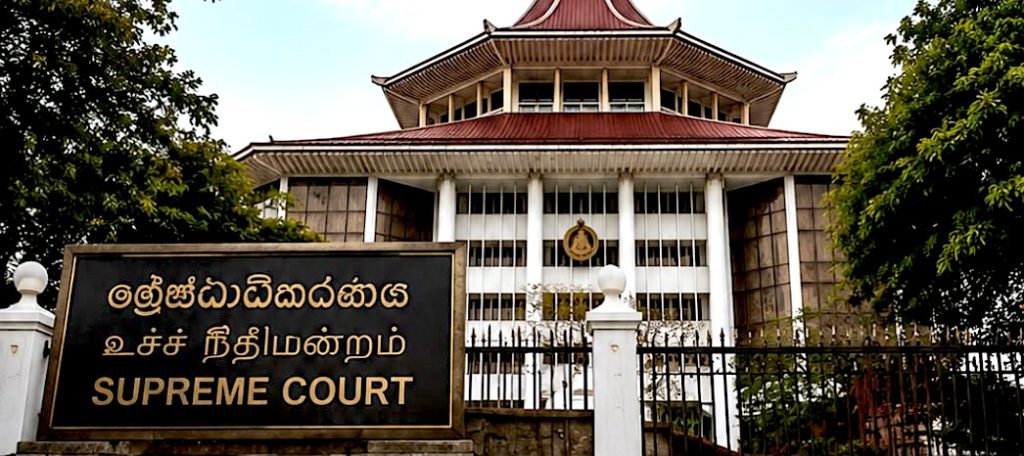
Photo courtesy of Ceylon Independent
The Supreme Court determined that the proposed 22nd Amendment does not require a referendum and can be passed by parliament with a special majority. This article examines the major legal arguments from both sides in light of the court’s determination.
The 22nd Amendment to the constitution, together with the proposed amendment to the Judicature Act, became among the most widely debated legislative proposals in Sri Lanka’s constitutional history. The Minister of Justice gazetted the Bill on August 7 and its first reading took place on August 18. Notably, the 22nd Amendment Bill received the highest number of petitions ever filed against a constitutional amendment Bill with a record 67. The Chief Justice appointed a five judge bench to determine the petitions on August 31 and the Supreme Court hearings concluded on September 2. Following the Solicitor General’s submissions on the second day of the hearing, the court directed the parties to file written submissions concerning the petitions. The speaker formally announced the Supreme Court’s determination in parliament on September 22.
Full court bench for the special determination
The petitioners provided that, under Section 49(3) of the Judicature Act, where a judge is a party to, or personally interested in, a matter, it must be heard by other judges. Since the Bills concerned the retirement age of judges, they argued that all Supreme Court judges were interested in the matter. Therefore, the case should be heard by a full court consisting of the Chief Justice and all 12 other judges or alternatively by all judges except the Chief Justice, since the Chief Justice would be the first beneficiary of the proposed extension by receiving a further two year term.
The court unanimously rejected the application for a full court. The court held that Articles 132(1) and 132(2) establish that the court’s jurisdiction is ordinarily exercised by not less than three judges sitting together, subject to Article 132(3), which gives the Chief Justice discretion to direct a five or more judge bench where a matter is of general and public importance.
The court also raised administrative considerations, including the fact that a separate three judge bench was simultaneously hearing petitions relating to the Anti-Corruption (Amendment) Bill and all thirteen judges are not necessarily available in any given week due to leave, illness, and other circumstances. Therefore, only the Chief Justice has knowledge of the judges’ availability. The court also noted that other litigants are equally entitled to have their cases heard expeditiously before the ordinary benches.
Conflict of interest in hearing the case
The petitioners provided that, as the amendments would provide a direct financial and tenure benefit to all sitting judges, the judges hearing the case had a personal interest in its outcome. They further argued that if the judges proceeded to determine the constitutionality of the Bills despite this interest, they could potentially be liable for prosecution under the Anti-Corruption Act, No. 9 of 2023. This argument was further supported by Section 49(3) of the Judicature Act. The petitioners therefore suggested that a referendum would be an elegant solution to avoid the alleged conflict of interest.
The Solicitor General and intervenient petitioners provided that the principle of nemo judex in causa sua applies only where the decision maker has a direct, personal and case-specific interest rather than a generalised institutional interest shared by an entire branch of government in legislation regulating that branch.
They further provided that the subject of the challenge was a decision of the court rather than a decision concerning the court itself and therefore the principle did not strictly apply. Even if a personal interest existed, they submitted that the Rule of Necessity would require the judges to sit, since otherwise litigants would be denied any forum at all. They argued that a generalised institutional interest could not disqualify a court from reviewing legislation concerning judicial salaries, retirement or contempt powers.
The court rejected petitioners arguments, describing the submission as having absolutely no merit and finding no basis for potential prosecution liability. The court held that Section 49 of the Judicature Act is intended to prevent a judge from hearing his or her own case where the judge is a named party or has a direct personal stake in a particular dispute. It does not disqualify judges from performing their constitutional duty to determine the constitutionality of a Bill. The court also warned against vexatious petitions that misuse Section 49 and called for a purposive interpretation of the provision. Citing Visuvalingam v Liyanage, where a similar objection was raised concerning judges determining their own legal status, the court referred to Abdul Cader’s observation that it is the court that decides it.
The court held that the capacity in which judges hold office must give way to the court’s constitutional duty to determine the issue. It further stated that a referendum does not determine the constitutionality of a Bill, that responsibility lies exclusively with the court and that refusing to perform this duty would itself violate the constitution.
Independence of the judiciary and the sovereignty of the people
The petitioners provided that the independence of the judiciary forms an essential part of the sovereignty of the people protected by Article 3. Therefore they contended that any Bill affecting judicial independence would be inconsistent with Article 3 and under Article 83 would require a referendum in addition to a two-thirds parliamentary majority.
Petitioners relied on the Supreme Court’s earlier statement in the Special Determination of the Inland Revenue (Amendment) Bill, which stated that “any Constitutional amendment to the retirement age or the period of office impacting on the incumbent judges, whether directly or indirectly, will impinge on the independence of the judiciary and is violative of Article 3 which requires a Referendum.” In Justice Alliance of South Africa v President of the Republic of South Africa, where the South African Constitutional Court struck down a provision giving the president discretion to extend the Chief Justice’s tenure to age 75.
The petitioners further cited David Landau’s academic article, Abusive Constitutionalism, arguing that the Bills formed part of a broader project of abusive constitutionalism involving court capture through court packing, that is, filling or locking in a court perceived to be favourable to the government.
The court rejected all grounds advanced by the petitioners and accepted the Solicitor General’s submissions in this context. Regarding the Inland Revenue Bill, the court held that the petitioners had cited the above statement out of context and sought to misrepresent what was actually stated. It reproduced the surrounding passage to demonstrate that the statement concerned targeted reductions in judicial tenure rather than a general and non-discriminatory increase.
The court also examined the Justice Alliance of South Africa case and found that it supported the impugned Bills rather than the petitioners’ argument. According to the court, the South African decision concerned an unconstitutional delegation of individual discretion to the president over a particular Chief Justice while recognising that parliament could validly extend judicial tenure through legislation of general application. Therefore, court held in the Sri Lankan context, amendments were non-discriminatory as it applied to all sitting judges without any special treatment.
The court also rejected outright the allegations of court capture or court packing. It observed that the incumbent judges had served under successive governments and therefore extending their tenure could not serve to pack the court with judges ideologically aligned with the present government. If anything, the court reasoned that the extension would prevent opportunities for such future packing. The court criticised the reliance on David Landau’s article as “disparaging our country to advance an argument at the expense of our national reputation”, describing it as unfortunate and regrettable.
The court further noted Sri Lankan constitutional history regarding increasement the retirement age of Supreme Court Judges: 62 years under the 1946 Soulbury Constitution, 63 years under the 1972 First Republican Constitution and 65 years under the 1978 Second Republican Constitution. The court clarified that Article 107(5) neither prohibits nor restricts a further increase while Article 108(2) only prohibits a reduction of judicial salaries as a safeguard for judicial independence.
On judicial fortitude in the face of criticism, the court cited Hettiarachchi v Seneviratne, quoting Deuteronomy and Lord Denning in ex parte Blackburn, “Exposed as we are to the winds of criticism, nothing which is said by this person or that, nothing which is written by this pen or that, will deter us from doing what we believe is right.”
Regarding public perception, the court emphasised that legal disputes are not decided by the court of public opinion. It also invoked the principle in Hettiarachchi case, together with the observations of Lord Denning and Dame Victoria Sharp, that judges should not be deterred by public criticism from doing what they believe to be right.
On the question of consultation, the court held that there is no legal requirement for stakeholder consultation before a Bill is gazetted. It also referred to Article 124, which prevents any court, tribunal or institution other than those exercising jurisdiction under Articles 120-122 from inquiring into whether a Bill has complied with the legislative process.
Proviso limiting the Chief Justice’s term to six years
The petitioners provided that the proviso limiting the tenure of a Chief Justice to a maximum of six years or until the age of 67, whichever occurs earlier, could amount to a reduction of tenure where a relatively young person is appointed Chief Justice with more than six years remaining before reaching the retirement age. They argued that such a reduction would violate the constitutional safeguards protecting security of tenure under Article 107.
In his submission, the Solicitor General provided that the provision operates prospectively only. It applies to future appointees who accept the office subject to that condition; a person appointed under this rule is, by law, appointed only for that fixed period, analogous to any post with a defined retirement age. This does not constitute a reduction as no existing entitlement is being taken away.
The court agreed with the Solicitor General that the proviso is prospective and therefore does not offend Article 3. It will apply only to persons appointed as Chief Justice after the Bill’s enactment, meaning that those appointed in the future would accept the office subject to that condition.
However, the court exercised its power under Article 123(2) to recommend an amendment at the committee stage. It recommended inserting a second proviso to Clause 2: “Provided further that the term limit of six years set out in the first proviso will not apply to any person holding the office of Chief Justice as at the date of coming into operation of this Act.” The court also recommended a drafting correction to the Sinhala text of the first proviso, replacing the phrase “හැට හතට එළඹෙන දිනය” with “හැට හත සම්පූර්ණ කළදිනය” for greater clarity.
Under Article 80(1), once a Bill has been passed by parliament, the speaker endorses a certificate confirming that the Bill has been duly passed by parliament. Article 80(2) further provides that, upon the endorsement of the speaker’s certificate, no court or tribunal may question the validity of the Act or legislation.