
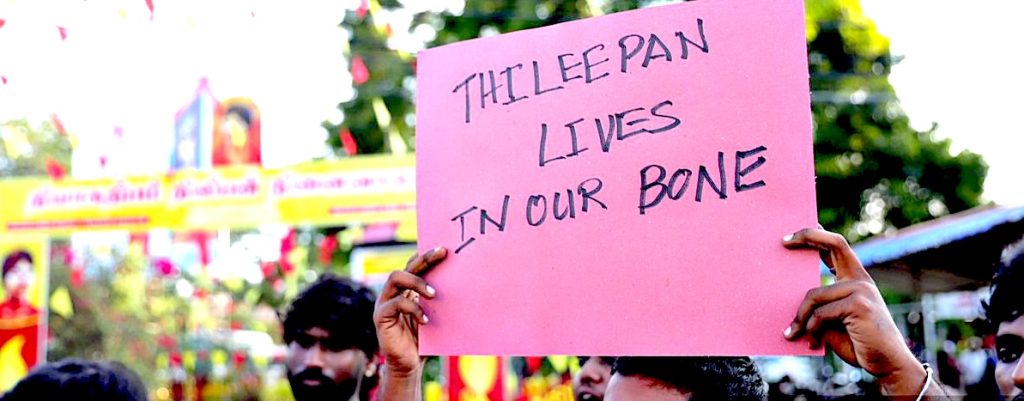
Photo courtesy of Kumanan
In the early hours of September 27, over 20 Sri Lankan police officers, including Jaffna’s Officer in Charge, arrived at the Nallur memorial to Lt. Col. Thileepan and swiftly removed the statue. The bronze figure had been unveiled on September 15 to mark 39 years since Thileepan began the fast that ended in his death. It was taken down just one day after hundreds of Tamils gathered at the site to remember him.
The memorial stands where Thileepan began his hunger strike in 1987, a protest appealing to the Indian government to honour the pledges it had made to the Tamil people. Its history is a history of repeated erasure. The first memorial built the year after his death was destroyed by the Army after it captured Jaffna in 1996. It was reconstructed during the ceasefire, destroyed again in 2007 and its remnants were demolished further in. The removal of the statue is only the latest chapter.
Tamils have responded in the way they usually do. A board now stands where the statue once stood, reading “We strongly condemn the Sinhala Buddhist Anura government that removed the bronze statue,” signed off in the name of the Tamil people. Mourners continue to arrive with flowers and garlands for a statue that is no longer there.
A pattern not an incident
The Nallur removal does not stand alone. In November 2025, police in Tellippalai confiscated sound equipment at the Mallakam junction for playing Maaveerar Naal songs and registered the speakers at the station as evidence. Similar seizures, threats and interrogations were reported that week in Valvettithurai, Polikandi, Kilinochchi and Mullaitivu. In October 2025, army personnel at the Visuvamadu cemetery in Theravil objected to the installation of fence posts while local volunteers cleaned the grounds.
President Anura Kumara Dissanayake came to power promising an era of change. On memorialisation, the state’s conduct has not meaningfully changed. Tamils are still watched, obstructed and punished for grieving in public.
Remembrance is not terrorism
The state’s defenders will say that honouring LTTE cadres glorifies a proscribed terrorist organisation. That argument deserves a serious answer and the answer is that mourning is not endorsement of every act committed in a movement’s name. Commentator Chaminda Dias made this point in a tweet after the removal of the Thileepan statue. While condemning the “Horrific things” the LTTE did, Dias observed that Thileepan’s “Final act was one of nonviolent resistance.” He engaged in a hunger strike, refusing food and water and followed through with the courage of his convictions. “Why shouldn’t he remain a symbol?” Dias asked.
Dias also named the obvious double standard. The JVP, the party at the core of President Dissanayake’s government, has its own bloody history as does the state’s response to it. Yet the JVP openly commemorates both its fallen heroes and its founder, Rohana Wijeweera, whose organisation killed thousands of Sinhalese during the insurrections he led against the government. “Why should Tamil Sri Lankans be afforded any less space to remember their dead?” Dias asked. He described the removal as “Fragile ego and state insecurity on display” accompanied by “a healthy dose of majoritarian rule.”
The right to mourn is also grounded in law. Sri Lanka is a party to the International Covenant on Civil and Political Rights, which protects freedom of expression, peaceful assembly, and the right of minorities to enjoy their own culture. The then UN Special Rapporteur in the field of cultural rights, Farida Shaheed, criticized the failure to memorialise sites of atrocity despite survivors’ requests and the obstruction of commemorative activities while cautioning against mono-ethnic memorialisation and endorsing a proposed national memorial to all victims of war.
Address the causes not the symptoms
If the government is so disturbed by Tamils commemorating fallen LTTE fighters and displaying LTTE symbols, it should ask why these acts continue 17 years after the war ended. The answer does not lie in statues or speakers; it lies in the grievances of Tamils the state has not resolved.
Politically, Tamils are still waiting for a meaningful devolution of power that would give them a real say over their own affairs. They are still waiting for accountability for the mass atrocities of the war’s final stages and for answers from the state about the thousands of people who disappeared, a number of them after surrendering to the army. The families of the disappeared have protested for years and are still waiting. Tamils also continue to live under the draconian Prevention of Terrorism Act (PTA), a law President Dissanayake’s government pledged to repeal.
Economically, the North-East remains militarised. Land that Tamil families farmed and lived on for generations is still held by the armed forces, including the cemeteries where fighters were buried. Livelihoods are constrained by occupation, surveillance and the steady expansion of military enterprises into civilian economic life.
Socially and culturally, Tamils watched as Buddhist structures were erected in Tamil majority areas under the banner of archaeology, as place names change and as their own sites of memory are bulldozed and rebuilt only to be bulldozed again. To a community that has experienced all of this, the removal of a statue is not a minor administrative act; it is further confirmation that its identity and history are under threat of erasure.
People do not cling to symbols of resistance when they feel secure. They do so when they believe that no one else will remember their dead, speak for their losses or protect their place in the country’s story. Every seizure of a speaker and every demolished memorial deepen that belief. Suppression does not end remembrance; it makes remembrance an act of defiance.
The path forward is clear: return occupied lands, account for the disappeared, repeal the PTA as promised, deliver genuine power sharing and pursue credible accountability for wartime crimes committed by all sides. A government that did these things would give Tamils reason to feel that their future, their history and their dignity are safe within the state. Tamils who feel secure in their identity would have far less reason to look to the symbols of an armed movement to affirm it.
The flowers and garlands still being laid at an empty plinth in Nallur are a reminder that grief cannot be removed by a police order.