
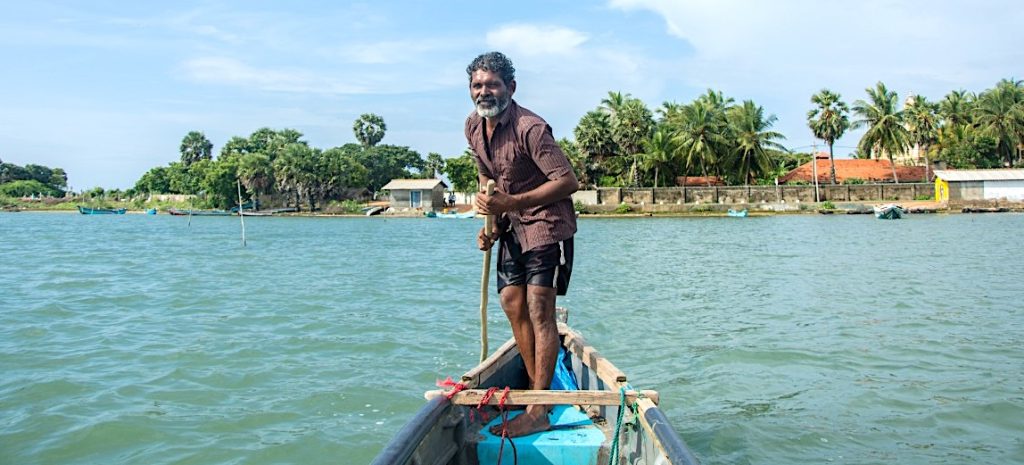
Photo courtesy of Roar Media
Many columnists have elaborated at great length on the existential crisis that people on Mannar Island face in their struggle against the wind power farms and the planned sand mining project which are threatening their livelihoods, even the habitability of the peninsula.
Due to the perseverance of civil society actors, the Catholic church of Mannar, environmental activists and some journalists, the struggle continues. From the outset of the crisis, the community’s concerns hardly mattered to the government or the opposition parties, regardless of their stance on the wind power farm. Despite coming to power by capitalising on the political momentum of the 2022 popular uprising that rejected old elitist politics, the NPP’s attitudes towards the people of Mannar Island call into question its bona fides. The case also raises questions about the commitment to justice of the Catholic church’s leadership in the island and especially of the “Sinhalese” church. Commitment to the victims of the Easter Sunday attack is not matched by solidarity with the struggles of the Catholics in Mannar diocese. The struggle over Mannar Island is thus not simply a local political phenomenon but raises more fundamental questions of the rule of the NPP and the ecclesial politics of the Catholic church.
Life in the margin of margins
Mannar Island is inhabited by about 70,000 people. The majority Tamil Catholic community shares the island with a sizable group of Muslims and a relatively small group of Tamil Hindus. The overwhelming majority of the island’s inhabitants are fishermen or have livelihoods related to the fishing industry while others depend on small scale agriculture or government jobs. During the decades-long civil war, the people on the islands suffered immensely. The Muslims were forced by the LTTE to leave the island in 1990. Many of them have never returned. Tamil fishermen who lived on the island had to bear numerous restrictions on their fishing business and were subject to harassment by security forces and the LTTE. During those difficult times, the Catholic church in Mannar under the leadership of its outspoken Bishop Rayappu Joseph became a central political actor to help people in their plights and to negotiate for them with the security forces and the LTTE.
Even today, many people on Mannar Island feel that they are marginalised politically and that the Mannar District is a neglected periphery, not seen by the central state nor the provincial government. Nevertheless, the Muslim community in Mannar District, but not necessarily on the island itself, enjoyed various forms of state patronage such as jobs, land and housing as their political leaders joined successive governments. The majority Tamil Catholics on the island do not have a representative in parliament to negotiate with the central government or even the opposition parties to secure their interests. Therefore, the Catholic church in Mannar still plays an important role to represent the struggles of these people on the island and many of its priests fight against the injustices the community faces.
The feeling of marginalisation also structures how people of Mannar Island see the current windmill park and the sandmining project. They believe that the island must have been chosen for green energy projects not only because of the availability of strong wind patterns throughout the year and its closeness to the market – Mannar Island is closer to a line that connects with the national grid and also closer to the Indian energy market – but also because of their political weakness. A development project of this magnitude that could result in mass displacement would not have started, people believe, if they had political clout like other communities who are represented by strong politicians or civil society groups. As a point of proof, they claim that other similar projects have been dismantled quickly after local protests gained political clout but that was not the case in Mannar Island.
The crisis: economic, moral and existential
The wind power project planned by the Sri Lanka Sustainable Energy Authority and Ceylon Electricity Board with the Asian Development Bank threatens the community’s livelihood and the island’s rich biodiversity. The government’s plan for the heavy mineral sand mining project doubled worries about the island’s habitability and the community’s future.
Fr. Santhiyoga Marcus, the President of the Mannar Citizens’ Committee emphasises that unless urgently addressed, the crisis could develop beyond economic and moral concerns into an existential crisis for the people of Mannar Island. The planned wind power farm is expected to occupy 53% of the island’s total land area. Destruction of the fishing industry and agriculture, along with frequent inundation of their lands, would make the island uninhabitable for most communities. This could worsen if the government approves the proposed mining project.
Some of the environmental impacts can be felt already today. Since the wind power turbines were erected, fishermen complain that their income has declined considerably. Echoing what biologists have warned, the community claims that the breeding grounds for fish, shrimp, and crabs – salt marshes and mangrove forests – have started to disappear due to the destruction of ecosystems by the construction of wind power plants. This decline in fishing is significant beyond Mannar: According to the People’s Alliance to Right to Land (PARL), Mannar Island is considered the second largest fishing area in the Northern Province and its annual average fish harvest is about 17,500 metric tons.
In addition to the fishing industry, people are also involved in small scale agricultural farming, which has also been badly affected. The construction of the wind power projects has blocked the natural drainage system, resulting in flooding throughout the years. According to poor farmers, frequent flooding has made them and their animals more susceptible to disease. What makes matters more ironic is that the green energy produced at the cost of people’s livelihoods and health has failed to stop frequent electricity blackouts on the island.
The Mannar Island’s “clean” energy also threatens the island’s biodiversity. Mannar Island is a biodiversity hotspot and bottleneck on the Central Asian Flyway for millions of migratory birds. Sri Lankan avian ecologists have warned that the loss or fragmentation of its habitats would leave lasting impacts on this migratory route. The seas around the island, its marshes, seagrass beds and coastal wetlands support hundreds of species. The wind power plants at current capacity have already started damaging the ecosystems and expanding the project could only aggravate the damage.
The struggle and betrayals
Successive governments since 2019, including the current NNP government, have prioritised clean energy for the nation at the cost of local community wellbeing and ecology. In 2020 Mahinda Rajapaksa, as the Prime Minister of the Gotabaya Rajapaksa government, inaugurated Sri Lanka’s first large scale wind farm, the Thambapavani wind farm. Civil society groups accused that government of implementing the project without consulting the people on the island. As Shreen Saroor, the founder of the Mannar Women’s Development Federation, says, “During the COVID-19 lockdown, the government at the time allowed private interests to extract soil and erect windmills on an ad-hoc basis without any proper planning or consultation with the people”.
From the outset, the wind power farm project lacked transparency. After launching the first phase with a loan from the Asian Development Bank, the Gotabaya Rajapaksa government signed an agreement with Adani Green for a $500 million, 500 MW wind power project. The government approved the investment without a competitive bid, triggering many questions. However in 2023, in the context of a severe financial crisis, the Ranil Wickremesinghe government also cleared the wind power project in Mannar and Pooneryn. The NPP government, when it came to power, continued the wind power projects already initiated although it had criticised it when in opposition and had promised otherwise in the election campaign.
Successive governments in power seem to see green energy not only as a clean source but as a way to attract much needed foreign direct investment. The same seems to apply to the opposition parties, who were primarily concerned about the problematic bidding process of the Mannar wind power project during the Rajapaksa era and worried about the financial terms agreed with the investor. The JVP protested the wind power project on the grounds of energy sovereignty when the government signed an unfair deal with the controversial Indian conglomerate, the Adani Group. Only a few parliamentarians from the Vanni echoed the grave concerns of the people of Mannar Island.
Although the new NPP government promised good and participatory governance in their election agenda, police forces brutally attacked people who gathered in Mannar town in the night of September 26, 2025 to peacefully resist the efforts of the authorities who tried to clandestinely transport parts of the wind power turbines in the middle of the night despite the government’s repeated assurances of dialogue and transparency before advancing the project. The police also employed force against Catholic priests who had gathered with the people. That incidence upset the local population even more: even the LTTE or the military during the war had refrained from publicly assaulting Catholic priests because of the high respect they enjoy in the community. Following this incident, youth, civil society organisations, priests and imams and people from the island and beyond waged a 105-day continuous protest until the NPP government agreed to halt new wind power and mineral mining projects on Mannar Island without local consent. However, the government seems to have broken its promises and continues to build the wind power plants already started.
The reaction to the demands of the Mannar Islanders is testimony to the NPP’s lack of capacity and resolve for system change. The people voted the NPP into power with an unprecedented majority to transform the old political system. Even many minority voters from the Vanni chose NPP over their minority parties – the first time in Sri Lanka’s post-independence history. People across the country rejected corruption, dynastic politics and authoritarianism and their vote gave voice to the aspiration of a democracy that delivers substantive outcomes, rather than a regime that looks after the interests of the rich and capitalist classes without protecting the less privileged segments of society. While the NPP government may be prioritising the country’s economic stability, its current commitment to neoliberal economic architecture and the continuity of the economic projects of previous regimes not only blurs the difference between the NPP and the regimes people rejected but also betrays their voters who dreamt of change.
The balance looks not much better for the Catholic church’s Sinhalese leadership. In Mannar, for decades, the Catholic church played a critical role in representing the community’s voices against the harassments of government officials, security forces, business corporations or the LTTE. At the height of the war, priests played a heroic role in defending the community’s human rights at great personal risk. During and after the war, the Sinhalese leaders of the Catholic church had been indifferent to the plight and struggle of the Catholics in the North and East. When the Easter Sunday attacks happened, which led to the killing of hundreds of Christian worshipers on Easter Sunday, the church demanded full solidarity for the victims but its leaders still did not find words to acknowledge the suffering of Tamil Catholics (and Hindus) in the North and East. Even worse, the ecclesial leadership continues to obstruct the work of Sinhalese clergy who side with their Tamil brothers and sisters in the Mannar struggle as much as in commemorating the suffering of the war and in accounting for the disappeared.
The struggle of people in Mannar – that peripheral island – thus is not only a local story of government malpractice and community protest. The struggle brings into sharp focus a crisis of legitimacy of the new NPP government and of the leadership of the Catholic church.