
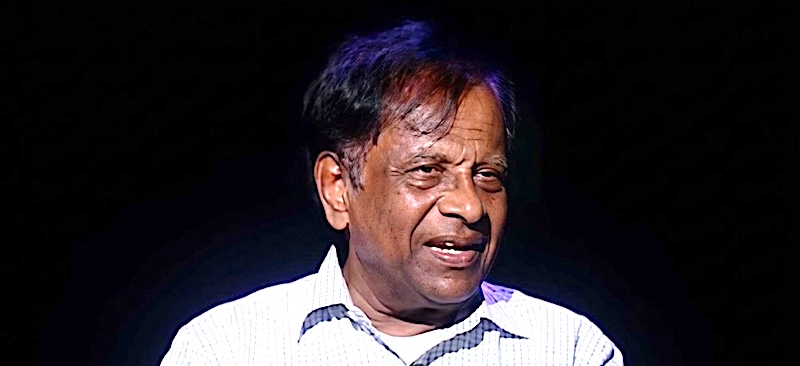
Photo courtesy of Lanka Leader
Lionel Bopage has spent his career as an independent and passionate activist, fighting to advance and defend the rights to equality and non-discrimination. At the heart of this work has been a commitment to challenging prejudice and injustice in all their forms, whether directed at individuals or communities on the basis of race, gender, belief, age or sexual orientation.
He served as General Secretary of the JVP for several years until February 1984. As a Politburo member, he oversaw party operations in the North and East during the height of the civil war and concurrently served on the Central Committee of the Socialist Workers’ Union, the JVP’s trade union arm. During his incarceration alongside JVP leader Rohana Wijeweera, he helped formulate the JVP’s policy on the national question. He was among the first JVP members elected to the District Development Councils (DDCs) where he led the opposition in the Galle DDC. In February 1984, following irreconcilable ideological disagreements with the JVP leadership, he resigned from all positions within the party.
After relocating to Australia in 1989 due to death threats to his family and himself, Lionel co-founded Friends for Peace in Sri Lanka (FPSL) in Canberra – the only organisation among Sri Lankan expatriates to unite Sinhalese and Tamils in a shared pursuit of peace and democracy. He chaired the Torture Rehabilitation and Network Services Act, which supported asylum seekers settling in Canberra.
Groundviews spoke to Lionel during his recent visit to Sri Lanka where he answered questions on whether the JVP was still a leftist party, if it has come to terms with it violent past and why he remains engaged in the politics of his home country.
Do you consider the JVP as still leftist or has it abandoned leftism and any long term social transformation?
No. From my point of view, the government came to power on a reform agenda rather than a socialist agenda. And also because it came to power through elections it will be very difficult for it to move beyond that framework and go to a revolutionary agenda and because the government was formed by the NPP, which is a broader front than the JVP. I think NPP is a broader front. The agenda of the JVP was socialist and I believe it still has that same agenda but when you form a broader front, you cannot implement the same agenda so it has to be a bit wider. This government came to power using the aragalaya, which didn’t demand a socialist sort of a framework. What aragalaya demanded was mainly bourgeois reforms like less corruption, less privileges and so on. So in that sense, I consider this government as a progressive government. Whatever the reforms it wants to do within the system, I support it. But still I think it is changing of managers rather than changing the system. It still hasn’t done any changes to the system.
There is criticism that the JVP is the dominant player in the government making the decisions, run by a politbureau that is non-transparent while other parties in the coalition are swallowed up. Is this correct?
I think it is very sad if that has happened. There are news reports said that Lal Wijenayake was asked to keep his mouth shut. I don’t know whether that is true or not. But if it happened, that is not a way to handle things within a coalition. There has to be dialogue, exchange of views, consultation and so on. Only through these means can it settle differences of opinion. Obviously within a broader coalition like the NPP, there will be differences of opinion. The JVP from our days had a socialist agenda and how far it is adhering with that agenda, I don’t know. But still there could be differences of opinion with regard to what it needs to do in terms of policy. Those issues need to be resolved through consultation and dialogue rather than imposing authoritarian ways. The attitude of this government is not different from the previous ones in the sense that it believes it knows everything and is imposing things from the top rather than consulting with the relevant stakeholders and groups. This should be looked at. The government also needs to communicate what it has done in a positive way to the people. It is lacking in communicating among itself because its ministers say different things about the same issue.
Some people, especially in Colombo, are afraid that the JVP is still that old JVP, remembering the violence it perpetrated. How can the JVP counter this perception?
Yes, this is very difficult because the government and the state machinery has painted that picture about us. From my point of view, even in 1971, the incident that happened at the US embassy was led by a group called Maoist Youth Front and the government blamed us and used that as a pretext to proscribe the party. It happened again in 1983, proscribing us although we didn’t have anything to do with the riots. The violence that came from the JVP was a reaction to this. In the 70s, we believed that because of the international interventions by the CIA in other countries, especially those countries that became free from colonialism, their governments were forcibly changed. Openly or covertly, the CIA was involved. We were concerned about that as Maoists; we believed that a revolution, a transformation, cannot be done through peaceful means so we believed in armed struggle. Then we thought when we came up as a political force, the state machinery and those ruling elites will repress us and then ultimately it will be an armed struggle anyway. Now the situation has changed although the US is still involved in Gaza, the West Bank and Ukraine; there are many places where they try to interfere. But at least there is freedom for groups like the JVP or Frontline Socialist Party to engage in politics. They can have their own discussions, meetings and organisations whereas those days, we were not allowed to do that. Even if we had a small discussion, we would be arrested, taken into custody and tortured. In 1988-89 the government was trying to repress both the movement in the South as well as in the North and East. There was the disruption of the DDC in Jaffna where the government used force was used to and the burning of the Jaffna Public Library and so on. In the South, there was a strong nationalist campaign led by Cyril Mathew, one of the ministers of the government, among the JVP base because as JVPers, we came from a rural, Sinhala, Buddhist background. I’m not saying what the JVP did was right or wrong but it was an outcome of the government’s action. In 1983, Velupillai Prabhakaran’s LTTE was a very small group but after the July riots, that group became very strong, leading to the war. I put the main blame on the UNP government and President J.R. Jayewardene for what happened. There are allegations that the JVP was engaged in violence, killings and the destruction of property but in a war that happens. I’m not justifying it but then the issue is that government forces did the same thing and put the blame on the JVP. For example, the collection of ID cards was done by the JVP but the government forces did it and put the blame on the JVP. So, in a war situation, it is very difficult to recognise who did what.
The JVP stance on the ethnic conflict has changed considerably as has its attitude to India. Do you think this change is sincere?
We adopted that concept on India and some of our people interpreted it in a nationalistic way against the plantation workers, which was wrong. After 1984 or so the JVP started conducting a class on Indian expansionism. But the strange thing that happened is that Comrade Somawansa Amarasinghe had to seek protection of the Indian government and flee to India. He used the contacts we had developed before 1983 with the Indian High Commission in Sri Lanka. At his first meeting after coming back to Sri Lanka, he praised the Indian government for the protection he received. But the JVP was not clear as to what policy it should adopt. Now, under pragmatic circumstances, the government has to balance competing political forces in the Indian Ocean, especially China, India, Pakistan and the US. It is doing it in a sensible way. I consider this as a positive development. The positive aspect is that previously, especially after 1983, there was a position taken by the JVP and the nationalist forces that they mobilised to form Deshapremi Janatha Vyaparaya (DJV). They said there are no specific problems for the Tamil people just because they were Tamils, which was a pretty horrible thing to say. Now I think they agree that Tamil people have their own issues that need to be addressed; that is an advancement in its position.
But at the same time it doesn’t accept the 13th Amendment. But I hope under the provisions it will hold Provincial Council elections. During a discussion with Comrade Tilvin Silva, I asked about the change of constitution and the 13th Amendment. His answer was that the government is still working towards a new constitution that it will adopt. It sees the 13th amendment as a negative. It is trying to find an alternative. If I summarise, the government agrees that there are grievances of Tamil people and it wants to address them but not through the Indo-Lanka Accord and the Provincial Councils. It is developing its own mechanisms. That will be good so long as it can provide equal opportunities for all the communities to live with dignity, I will be happy.
Are there signs of ethnic minority voter disillusionment due to non-fulfilment of elections promises such repealing repressive legislation, the failure to hold Provincial Council elections, the lack of progress of disappearances cases and the delay in presenting a new constitution?
Yes and no. I was in in the North recently. From the discussions I had with people on the street, they still have good regard for the government, especially for Comrade Anura Kumara Dissanayake. But the educated people who are more aware of the political issues are unhappy about the current developments, especially with regard to the Prevention of Terrorism Act (PTA) being replaced with another act as well the legislation being developed on NGOs. I believe the government will reconsider its opinion; it needs to consult with the groups who have issues in regard to these matters. But I am more concerned about the lack of communication and lack of consultation.
Is it possible that the government is not repealing the PTA and Online Safety Act so they can be used to stifle any future dissent?
There is that feeling too. If the international community is asking that we should have some sort of anti-terror laws, they should be framed with a very narrow definition of terrorism and used specific for the purpose. But the way this Act is designed, it is very broad and it could be applied to anything. I was held under PTA for six months in 1985 so I understand the situation and why people are worried. My advice to the government is to go for consultations with those groups who have concerns about these developments and then develop a dialogue and work on that basis rather than imposing it from the top.
Is the diaspora is beginning to play a new political role and therefore should it be given voting rights?
I think people who want to vote should have the right to vote. I am for granting voting rights to the people overseas but at the same time the government should be aware that there are extreme political forces in the expatriate community. It is the duty and responsibility of the government to develop a dialogue to make the expatriate community understand that its views, if they are extreme, will not help Sri Lanka to progress. After this government came to power in 2024, there was strong interest within the expatriate community to engage by making investments, by coming to Sri Lanka and settling down here but the government didn’t take the initiative or consider it a priority If it had, we could have attracted much more investment, especially to the North and East. The Tamil community was willing to come and invest even in the South. I think still there are chances for the government to restart the process. There are community organisations who are willing to help Sri Lanka – Sinhalese, Tamil and Muslim; they are all interested in building a better Sri Lanka. The government should take the initiative and invite them to invest, probably even ask individuals to work here because they have much more experience. The majority of the people involved in those organisations don’t think have bad intentions. The government has to come down to the ground level and talk to people. That way it will gain much more credit and people will appreciate it.
What is the political vision that motivates your current engagement with Sri Lankan politics?
I started my political work with the Sri Lankan National Students’ Association. That was the student union of the Communist Party and I was associated with it. Since then I have evolved through the Soviet/China split. Then we became independent and we followed what we called the Lanka Line, not adopting the policies of other blocs but adopting Marxist policies to suit the situation in Sri Lanka. But then I had to leave Sri Lanka because there were assassination attempts on our lives. We didn’t leave because we wanted to leave; we were forced to leave. We were in exile and that is one of the reasons we are still interested in what is happening in Sri Lanka. I keep in close contact with developments. I write and I discuss. Although I don’t belong to any particular organization, I still hold my views about what is happening and present them.