
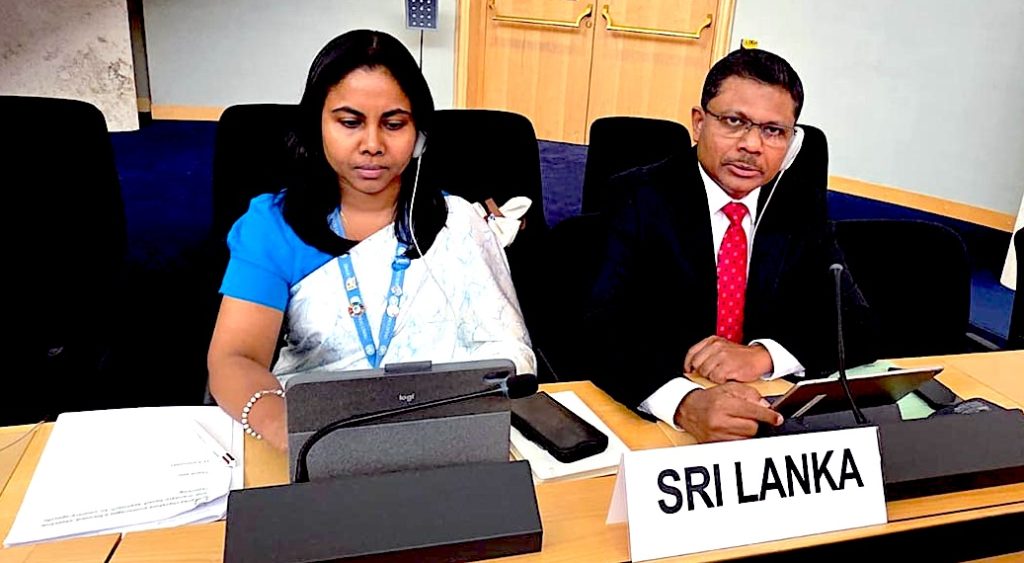
Photo courtesy of Onlanka
As the UN Human Rights Council (HRC) met in September, the situation in Sri Lanka was on the agenda as the state again tried to fend off concerns about its patchy record. The government was also represented at the UN General Assembly, which met amid stark tensions between leaders of superpowers, along with countries under their patronage, and much of the rest of the international community. It made occasional useful points, yet sent out mixed messages. Meanwhile, Sri Lankan ministers made some changes in response to serious local concerns which were echoed elsewhere in the world, including at the HRC but fell short of ending violations of core constitutional values and respecting justice for all.
In the two years since the NPP government took over, it has faced tough economic and political challenges, including IMF demands and now the conflict in West Asia. Avoiding economic meltdown, reining in corruption and organised crime, minimising the risk of being undermined by the powerful in the country and abroad and steering clear of the most blatant forms of racism are understandable concerns which require attention. Groups and parties which protest about abuses of civil liberties when in opposition often shift their stance when in charge themselves.
Yet shortfalls in tackling discrimination and economic inequality, failure to protect basic freedoms and properly address past abuses are likely to get in the way even of ministers’ own priorities and ability to satisfy the public. This includes preventing damaging scandals and escalation of violence and strengthening community safety for members of majority as well as minority communities. In time, new and ongoing repressive measures and practices are likely to be turned against NPP leaders and supporters when no longer in power. As the government again missed opportunities to adjust its course so as to be more consistent on rights, this dented its credibility abroad and, more importantly, let down Sri Lankans, creating a more precarious future.
Abuses and accountability, past and present
When the HRC began its 63rd session in Geneva, a written update on Sri Lanka was one of the first items on the agenda, followed by a debate. In the run up, a number of organisations raised concerns about past and present shortcomings while a report by the Office of the High Commissioner for Human Rights (OHCHR), Volker Türk, described progress which was, at best, patchy. In the government’s written comments, it had claimed to be cooperating with the UN, yet it sidestepped problems, claiming that “The GoSL does not accept the proposition that the absence of immediate resolution of longstanding and highly complex issues constitutes a failure of commitment to reform. Many of these issues have accumulated over several decades and require sustained institutional, legislative and judicial processes” (although it did admit that the credibility of its reform agenda will ultimately depend upon measurable results). It was also preparing for a session of UN General Assembly starting not long afterwards in New York, although had a far less prominent role there, perhaps to a surprising degree.
Meanwhile the UN and other international institutions and those who worked for them had come under forcible attack by US president Donald Trump, impatient with the notion of any earthly constraint on his power, and his ally Benjamin Netanyahu of Israel.
When HRC delegates had gathered, High Commissioner Türk warned that “The past years have been marked by a growing number of armed conflicts, and diminishing respect for international human rights and humanitarian law, and the United Nations Charter itself.” He took issue with the actions of the leaders of superpowers the US, Russia and China, and of Israel, among others, pledging that his office would continue to denounce all attempts to disregard international human rights and humanitarian law and seek ways to break cycles of violence.
Other actions would include to “step up our analysis and advocacy around the colossal business and economic interests that fuel wars,” “support States to advance comprehensive transitional justice, looking at all perpetrators, and centred on victims” and address harms connected with artificial intelligence, fossil fuel use and ruthless pursuit of profit. He criticised imposing crippling tariffs on countries already under severe stress from the climate crisis, debt burdens, and inequitable tax rule. Yet “Human rights are carriers of hope. They are a compass in turbulent times, and they offer concrete solutions to our challenges.”
When the situation in Sri Lanka was discussed following earlier circulation of the written update, Deputy High Commissioner for Human Rights Awa Dabo recognised that “There have been some important steps towards investigation and prosecution, in a few emblematic cases of alleged political killings and enforced disappearances.” And the government had “has taken steps to tackle corruption, and we welcome the recent ratification of the International Labour Organization Convention on freedom from violence and harassment in the workplace, including gender-based abuses. The President has repeatedly denounced racism and sectarian politics.”
But serious gaps remained. The “promise of deeper legal and institutional reforms appears to be stalling. There has been no progress towards broader recognition, and accountability, for crimes under international law and gross violations committed by State security forces or the Liberation Tigers of Tamil Eelam during decades of armed conflict,” with “continued intimidation of victims and witnesses.” What happened to tens of thousands of disappeared persons remains unknown.
And violations continued, with frequent reports of torture, and deaths in custody. The government continued to rely on the repressive Prevention of Terrorism Act while its planned replacement, a Protection of the State from Terrorism Bill (PSTB) continued to pose a risk to fundamental freedoms, including due process and fair trial guarantees and effective judicial oversight.
“Human rights defenders and victims still face surveillance and intimidation by state intelligence services, particularly in northern and eastern Sri Lanka. A draft proposal on the registration and supervision of non-governmental organizations raises serious concerns about disproportionate and overbroad executive powers; excessive and burdensome requirements; and the restrictions on civil society groups’ autonomy, independence and access to funding,” Dabo said.
She acknowledged the impact of the burden of international debt and the urgent need for more development assistance. “More broadly, it is vital that the momentum for change which swept the nation two years ago is not lost,” she said. “Our Office is eager to assist Sri Lanka in advancing legal and institutional reforms, including initiatives to ensure genuine accountability, justice, and country-wide reconciliation.”
Defensiveness and limited flexibility
The response of the UN permanent representative, Ambassador Sumith Dassanayake, was to downplay ongoing concerns and imply that the UN should focus on more pressing concerns, ending monitoring of the state’s treatment of its people, focusing instead on more pressing concerns. Country-specific mandates “should be subject to periodic review against defined objectives and measurable outcomes,” he declared. “Where a country demonstrates progress through national processes, dialogue, cooperation and technical assistance, there should be a credible pathway to concluding the mandate.”
Yet in Sri Lanka there was some movement on concerns picked up at the UN, although inadequate. The proposed PSTB was amended so that terrorism was defined in a way closer to that recommended by the UN Special Rapporteur on Human Rights and Counter Terrorism’s model definition, although with a regrettable exception. A broad range of acts were still included such as damage to public property and acts that create risk to public health, which could include relatively trivial offences. And police officers and members of the armed forces would still wield huge power to seize people and lock them up for two months even if a court were shown no convincing evidence, although repeatedly lengthy detention has led to abuse and false confessions. The president would also have sweeping powers to proscribe organisations.
Police and soldiers would still be able to ban gatherings with flimsy reasons, seize items such as phones and laptops with no warrant. Those who allegedly failed to inform on family members, friends or neighbours for breaking this law could be locked up too for years.
The official watchdog, the Human Rights Commission of Sri Lanka, pointed out flaws in the proposals and reiterated its longstanding position that the Prevention of Terrorism Act, No. 48 of 1979, should be repealed and recommended that offences relating to terrorism be addressed through general law. It further highlighted that legislative reform should be accompanied by meaningful institutional and security-sector reforms.
It was disappointing that, even when the government made changes, these were inadequate. Indeed, as in the past, such a law is likely to fuel rather than prevent terrorism by reducing opportunities for peaceful dissent, embittering large swathes of the population and clogging up the system through police or army overreach, leaving less capacity to investigate genuinely dangerous activities. It can also be easily misused to pursue private grudges or silence witnesses to, or victims of, misconduct by police officers or soldiers.
Another much-criticised piece of proposed legislation, a draft Non‑Governmental Organisations (Registration and Supervision) Act, had been put on hold after a meeting with community and voluntary sector representatives. Yet whether the government will amend this enough to be fit for purpose and meets basic human rights standards remains uncertain. It is supposed to help Sri Lanka to meet international Financial Action Task Force standards, meant to tackle misuse of the financial system for money laundering, terrorism or the proliferation of weapons of mass destruction. Yet it goes far beyond what is required and may actually enable the crimes it is meant to prevent and imposes tight controls on a wide range of organisations; indeed any group of five or more people getting together to serve the general public and engage in any voluntary social service or non-profit oriented activity.
These are required to register, let a state regulator or police enter their premises without a warrant and give these considerable power to interfere with, suspend or shut down their activities. This would not only enable the politicians in charge, now and in the future, to silence dissidents (which, by reducing freedom to protest peacefully, may encourage violence) but also have a range of additional damaging effects. For instance, if a dozen residents in a neighbourhood facing a natural disaster wanted to organise swiftly to protect local people, such a law could make this very risky. What is more, ironically, it might mean that so much energy was given to overseeing small organisations with minimal funds that major malpractice went unnoticed. If money launderers had a tame police officer in their pocket or someone in authority were involved in planning or covering up an actual terrorist offence, as has allegedly happened in the not-too-distant past, an Act of this kind could be used to silence citizens who were trying to stop or expose this.
Mixed signals and missed opportunities
As the UN General Assembly met, in addition to promoting government achievements, Sri Lankan representatives made some useful points. For example, at a meeting on pandemic prevention, preparedness and response on September 25, the UN ambassador called for reforms to the international financial system to address debt sustainability and health security financing.
Foreign Minister Vijitha Herath, speaking on September 28, highlighted “the enormous human and economic costs of climate change. Sadly, its harshest consequences continue to be borne by countries that have contributed least to global emissions… Climate justice must become an urgent reality.”
He also expressed sadness at the developments in Gaza and the Occupied Palestinian territories and urged, that international law, including International Humanitarian Law, be adhered to and respected by all parties. He said that Sri Lanka continues to support the inalienable rights of the Palestinian people, including their right to self-determination. “We are among the countries that first recognised Palestine as a distinct State in the 1980s…. We welcome the resolution of the Security Council on a ceasefire in Gaza and urge all parties to uphold it. Humanitarian assistance must reach civilians without obstruction. The recovery and reconstruction of Gaza must be an urgent priority.”
Yet at the same time, the government pushed ahead with plans to send 10,000 construction and other workers to Israel where withdrawal of work permits from Palestinians has caused labour shortages, and this may be expanded further. This is despite ongoing concerns about both safety and morality amid ethnic cleansing by the Israeli authorities and genocide in the Occupied Territories.
While rhetoric by Sri Lanka’s leaders is impressive and there has been progress on some fronts, the reality does not always match this. UN gatherings might have been a prompt to change course, setting an example in a world facing widespread cruelty and abuses of rights with the threat of violence on an even larger scale. But the opportunity was missed.