
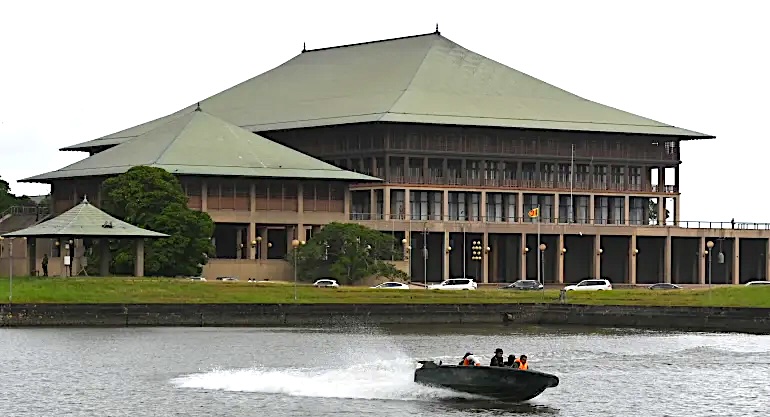
Photo courtesy of Al Jazeera
A bill intended to strengthen Sri Lanka’s anti-corruption efforts has instead raised a broader question about the limits of state power. As parliament considers the Bill on October 8, it will have to determine how to proceed with the provisions the Supreme Court has flagged on constitutional grounds.
Sri Lanka enacted the Anti-Corruption Act No. 9 of 2023 to strengthen the country’s institutional and legal framework for combating corruption and expand the role and powers of the Commission to Investigate Allegations of Bribery or Corruption (CIABOC). Among its central reforms was the introduction of stronger asset and liability declaration requirements for public officials, alongside expanded mechanisms for investigation, prosecution and accountability.
The Anti-Corruption (Amendment) Bill presented to parliament in August seeks to address practical and legal issues that have arisen in the implementation of the 2023 Act. The bill proposes amendments concerning asset declaration, conflicts of interest, the investigative and prosecutorial functions of the Commission, post-retirement obligations and the scope of persons subject to the act. The bill further introduces provisions governing the disclosure and use of redacted asset declarations and extends and brings certain media sector actors and large trade unions within its regulatory framework.
On its face, the amendments may have appeared to be largely technical. Ultimately, it became a constitutional question about the limits of state power.
The Anti-Corruption Act No. 9 of 2023 was meant to give the commission real power. Cabinet approved a set of essential amendments in January 2026 and the result is the Anti-Corruption (Amendment) Bill No. 78 with 19 clauses.
A good part of it is sensible. Clause 3 lets the Director-General withdraw Magistrate’s Court charges, not just High Court indictments, matching his existing power under section 65 to file charge sheets. Clause 16 imposes a mandatory penalty tied to the proceeds of corruption or the loss to the state and makes any appointment or advantage obtained through corruption unlawful from the date of conviction. Clauses 6(4) and 6(5) narrow who must declare assets, limiting trade union executives to unions with more than 1,000 members and raising the state shareholding threshold for company directors from 25 to 50 per cent.
The trouble is that a few clauses do more than simply refine the existing law.
Why a reform bill became a constitutional dispute
Fifteen petitions reached the Supreme Court, including from Transparency International Sri Lanka (TISL), the Centre for Policy Alternatives, the Media Law Forum and Prof. G.L. Peiris. After hearing arguments on September 3 and 4, a three judge bench rejected most of the challenges. The speaker presented the determination to parliament on September 22.
The court cleared most of the bill. Clauses 3, 4, 6(4), 6(5), 11(1) and 11(2) are consistent with the constitution and can pass by a simple majority. However, three clauses were not cleared. Clause 6(7), which determines which media actors must declare their assets, breaches Articles 12(1) and 14(1)(a). Clause 7, which removes the duty to declare a cohabiting partner’s assets, breaches Article 12(1), and the court said it should be withdrawn. Both clauses require a two-third majority to pass. Clause 17, which restricts bail, conflicts with Article 4(c) read with Article 3 and therefore requires both a two-thirds majority and approval at a referendum.[1]
Where the constitution draws the line
Two different lines are in play.
Equality and expression: Article 12(1) does not prohibit legislative classification, provided that the distinction has a rational link to the law’s purpose. Clause 7 fails that test, particularly when the bill states that repealing section 81(e) protects total strangers to the person making the declaration. The court found that premise fundamentally flawed. Section 81(e) reaches only a person who has lived with the declarant in a shared household for at least six months and shares mutual rights and obligations with them. A spouse’s assets stay declarable, but an equivalent partner’s would not and the court found no rational basis for that. TISL warned the same change opens a route for hiding illicit wealth behind a partner.
Clause 6(7) changes the media category from editors and members of the editorial staff to proprietors, chairmen and directors. The court held that this removes the people with direct influence over what is published, singles out one class of media actors and weakens accountability in a way that offends both Article 12(1) and Article 14(1)(a). The court also treated disclosure by media figures as a support for public trust in the press, not a threat to free expression.
Privacy versus scrutiny: The court accepted clause 11(2), which prohibits the use of a redacted asset declaration in a manner that breaches another person’s privacy. The court reasoned that Article 14(A) recognises privacy as a constitutional right and that parliament may protect the privacy of people whose finances the state compels them to disclose. This could have implications for press freedom. A journalist who reports an apparent mismatch in a senior official’s declaration will be arguing that public interest outweighs privacy. The court held that there would be no automatic answer; each case would have to be considered on its own facts
Can the state restrict liberty to fight corruption?
This is the question Clause 17 raises. The court’s answer is yes but not by removing the judge.
Section 149(1) treats bribery offences as non-bailable but lets a magistrate release a suspect in exceptional circumstances even where the Director-General certifies the case. Clause 17 changes this. Where a bribe is Rs. 100,000 or more or the alleged loss or gain is Rs. 500,000 or more (a committee stage amendment will raise this to Rs. 2.5 million) and the Director-General certifies the value, bail may be granted only by the High Court and only in exceptional circumstances.
The court’s concern was not the stricter test. It was what happens at the first hearing. A magistrate has no power to release the suspect so the suspect stays in remand until a separate application reaches the High Court. In the court’s words, custody then follows from the statute and not from a judge’s assessment. This is grounded in a line of authority that has evolved over a decade. In the 1984 Poisons, Opium and Dangerous Drugs (Amendment) Bill determination, the court held that making bail depend on the Attorney-General’s sanction fettered judicial power. In the 1998 Prohibition of Ragging determination, it said, “What Parliament cannot do directly, it cannot do indirectly.” Article 13(2) requires that custody follow an order of a judge and Article 13(5) preserves the presumption of innocence.
The court also pointed to a comparison. The Offences Against Public Property Act carries sentences of up to 20 years and has its own strict bail regime yet it leaves the decision with the judicial officer. The Anti-Corruption Act’s already provides for a maximum sentence of 10 years. Against that backdrop, it is therefore unclear why corruption suspects should face a more severe penalty.
International standards point the same way. Article 9(3) of the ICCPR, which Sri Lanka has domesticated through the ICCPR Act, says detention pending trial should not be the general rule and the Human Rights Committee’s General Comment No. 35 says it should not be mandatory for everyone charged with a category of offence regardless of individual circumstances. The principle is the same one the Sri Lankan court applied: parliament can tighten bail but a judge has to be able to decide.
What happens if there is no referendum?
The government has said it will pass the special majority provisions with a two-thirds vote and will not seek a referendum. It says the offending provision could instead be amended at the committee stage and sent to the Attorney-General for approval or removed.
That matters because of how the constitution works. The speaker may certify a bill needing a special majority only if it has passed with that majority and where a provision requires a referendum, the certificate must state it will not become law until the people approve it. So a two-thirds vote alone cannot make Clause 17 law. If a defective clause were certified anyway, Article 80(3) says no court or tribunal may question the validity of an act once it becomes law on certification. Pre-enactment review is the only check there is, which is why the next two days matter.
A referendum is slow, costly and a blunt instrument for a bail rule. The government’s reluctance is understandable. But the referendum requirement exists to protect the sovereignty of the people under Article 3 and that includes judicial power.
The choices before parliament
- Seek a referendum. This is constitutionally cleanest and politically ruled out.
- Cure the defect. The court said the inconsistency would cease if the discretion to remand or release stays with a judicial officer. A cure means giving the magistrate back real discretion, for example by restoring the exceptional-circumstances release power in the current section 149(1). Raising the threshold to Rs. 2.5 million does not do this. The court said that the amendment narrows the cases affected but leaves the structure unchanged.
- Drop Clause 17. The existing section 149 stays, with its strict test and a magistrate who still decides. Given that this is the version parliament adopted in 2023 after an earlier determination, it is not a retreat on enforcement.
For Clauses 6(7) and 7, a two-thirds vote is lawful. But a special majority makes a provision valid, not justified, and the court has already said what it thinks of the reasoning for Clause 7. Withdrawing it, as the court suggested, would cost the government nothing it needs.
Anti-corruption reform should ultimately be measured not only by the strength of the law but by whether it produces prosecutions that withstand scrutiny and survive appeal and a law that people can credibly say shields politicians’ partners thins out scrutiny of the media and jails suspects by statute works against that. Parliament can take the more cautious route. The question is whether it will.
[1] In the matter of an application under Article 121(1) of the Constitution against the Bill titled ‘Anti-Corruption (Amendment)’, SC (SD) 49/2026 and connected applications (Supreme Court of Sri Lanka, 2026), Summary of the Determination, pp 70-71; Anti-Corruption (Amendment) Bill (Bill No 78) 2026, cls 3, 4, 6, 7, 11 and 17.