
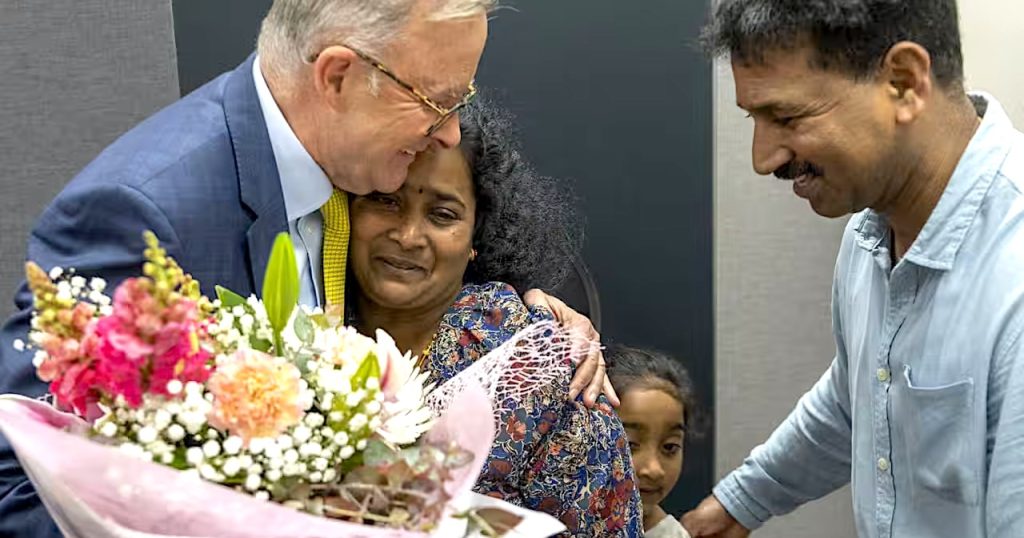
Photograph courtesy of SBS News
Reverse emigration is not a topic often discussed in Sri Lanka as people are currently more concerned about the loss of so many professionals in the mass emigration from the island in recent years. Not many seem to return or describe their impressions of the country they come back to. It is a fluid, ongoing experience, recalibrating our cultural identity. When people ask a returnee, “So which country is better? Have you decided?”, the answers do not come easily. Both countries on either side of the equation are going through such a lot of change.
Many so called First World countries assume superior status to those countries from which immigrants travel to apply for citizenship with them. There is an insulting and ignorant general belief that people from Asia and Africa and countries termed Third World are clamouring to come in to Australia, Britain, Canada and the US and a complete disregard and disrespect shown for the historical and cultural backgrounds from which the immigrants come.
Anyone emigrating to a historically colonised country from Asia, Africa or the Middle East should be aware that they are entering a landscape in which today they would be classified as lesser, or as a threat, based on the colour of their skin or the difficulty in pronouncing their names. These are democratic countries but they are also currently undergoing a backlash against progressive politics, and diversity, inclusion and equity policies. Differences between people are tolerated today and often suspected rather than celebrated. Political correctness is a superficial and external controlling policy and many resent having to conform to it. As a person of colour, many immigrants seem indistinguishable from each other to a racist or threatened eye.
As climate change increases its impact, as economic resources previously taken for granted are seen as non- renewable or diminishing, countries which were previously open and welcoming now look differently on their immigrant citizens and question their right to be here, their conformity to law and custom and their contribution to the country. This is entirely predictable. It is up to each country what rules they apply to incoming immigrants and what standards they enforce. From language and communication, to visual self-presentation, to knowledge of the political and civic processes of the country, immigrants need to be prepared.
It’s an opportunity cost on each side. Not emigrating means fear of missing out, career blockages or delays, frustrations of various kinds and lower income. But immigrants often experience precariousness of a cultural kind: outsider status, not belonging, not fitting in, not being fully accepted and not being recognised. Living expenses, utilities and taxation levels are high; no household help is readily affordable the way it is in Sri Lanka; and two incomes are needed to maintain a stable life.
The hard work required to maintain the good life immigrants desire means long working hours and sustained stress and very little time for family life and the vibrant social activity many enjoy in Sri Lanka. This level of social connectedness we are used to via our close knit cousin groups and extended families is not possible to sustain in such a work-oriented economy.
In 1971, my family emigrated from Sri Lanka to Australia and in 2001, they returned. A lot happened, before and after. In the late 1960s, both my parents had been postgraduate students in England. This was during the Enoch Powell days when, in April 1968, the British MP predicted that immigration would result in the downfall of Britain as immigrants from Commonwealth countries seeking citizenship in Britain would “threaten the cultural and national identity of Britain”. He also expressed the view that anti-discrimination legislation (The Race Relations Act of 1968) would unfairly advantage immigrants and disadvantage the Anglo-European majority of the population.
This racist mindset disqualified Britain as an attractive destination to anyone who had other options. The gun violence in the US did not present a picture that appealed to a couple in their late twenties with two young children. The violent history of slavery would also yield violent fruit. Australia, despite its own colonial settler history, seemed like a better prospect.
While Enoch Powell was making his dire predictions, in Australia in contrast, the White Australia Policy was in the process of being overturned. Australia previously had a policy of promoting British and European immigrants for citizenship status and discouraging those from other countries. But in the 1970s, educated immigrants from South Asia, with a shared colonial history and good ability to speak English, were welcomed into a prosperous economy.
To look back on the developments of the last decades is to see how open minded and progressive. Australian culture was in the 1970s and 1980s and 1990s. Multiculturalism became a policy during the Labour government years of Prime Ministers Bob Hawke and Paul Keating during the 1980s and 1990s. This broad embrace was made possible because in the 1970s Prime Minister Gough Whitlam’s multicultural perspective also had bipartisan support from the Liberal Prime Minister Malcolm Fraser who succeeded him.
Australia in those years was a meritocracy. Immigrants who entered with a positive mindset and a will to contribute to the community flourished. Immigrants were recognised for their contributions with national honours and very few senior appointments were seen as tokenistic. The quality and value of the cultural contributions of immigrants were recognised. Even everyday micro-aggressions such as verbal harassment were relatively rarely experienced.
However, with a history of forcible colonial settlement and the infamous treatment of indigenous people, as the Bicentennial in 1988 and the big Millennium Year 2000 when Sydney was to proudly host the Olympics drew near, racial and ethnic issues began to come into public discourse. A game called Spot the Aussie was being semi-jokingly referred to in the 1980s in Melbourne where many diverse communities had settled. The first wave of immigrants were from Europe in the 1950s. The second were from people displaced by war in the 1970s and 80s. All were attracted by economic security and social stability. The prospect of experiencing racist attitudes did not deter them.
In 1996, a flame-haired individual called Pauline Hanson entered Australian politics on a platform of distrust of outsiders, although when asked if she was xenophobic she famously said “Please explain.” The interviewer, a queenly educated blonde, was accused of elitism and condescension towards an uneducated working class ordinary Australian. Hanson is an opportunistic racist. She started by claiming Aborigines were welfare parasites and had smaller brains than the European settlers who colonised the country in 1788. After 9/11, as anti-Muslim feeling rose globally due to identification of the terrorists as Muslims, she performed Islamophobia, saying people whose faces cannot be seen cannot be trusted. In 2026, with Indians being the largest immigrant group in Australia, she has Asians as her target. Tapping into the underlying racism and bigotry of Anglo-European Australians who are feeling threatened that they are losing their place in their own country, Hanson aims to contest the next Federal election on a platform advocating monoculturalism.
Hanson emerged in a context. In 1994, the famous Australian soprano Joan Sutherland had complained, during a speech at an Australians for Constitutional Monarchy meeting, that when she renewed her Australian passport she found it ludicrous being interviewed by a Chinese or an Indian.
During the 2000 Olympics, held in Sydney, Cathy Freeman, an outstanding Australian athlete of indigenous ancestry, won the Gold Medal in her event and chose to perform her victory lap of the stadium carrying the Aboriginal flag. She was criticised for identifying as Aboriginal instead of only Australian as if her indigenous heritage should be folded into her Australian identity.
Elected in 2001, John Howard had opportunistically used the underlying fear of many Australians of being flooded with refugees to gain popular support for his Liberal National government during the Tampa Crisis, also known as The Children Overboard incident, where it was claimed that illegal immigrants were throwing their children into the sea in a manipulative ploy to gain sympathy and asylum in Australia. Australia’s history as a dumping ground for British convicts was informing this anxiety.
In Sri Lanka, a similar anxiety about territory invasion, given our history of colonisation, is raising concerns about the entitled conduct of certain Israeli visitors, who may not even have permanent residency status, attempting to buy up and dominate coastal towns.
Elected with a large mandate, in 2001, Howard’s government set about dismantling the benefits of the Mabo Case that had legally established indigenous land rights. He also said that those accusing the colonising settlers of genocide had a black armband view of history. Empathy that had risen for indigenous people with the growing awareness of the Stolen Generation policies by which indigenous communities were forcibly separated and severed from their traditions was eroded by the portrayal of them as welfare parasites and an alcohol and drug abusing underclass. Their generational physical segregation and otherisation from mainstream society did not assist the process of reconciliation.
Sri Lanka meanwhile was involved in the 26-year Civil War, which had begun in 1983 and only ended in 2009. The violence in the 1980s and 1990s created a huge exodus that formed the Sri Lankan diaspora who are achieving fame and success as professionals, athletes, artists and actors. Each has an individual history and relationship to their country of origin. Part of progress towards peace and reconciliation is recognising that people emigrate and reverse emigrate for individual reasons. Those returning often find meaningful work opportunities to uplift and support others, which are not available or needed in more developed societies. The society here is one in which the direct impact of a small number of people can be felt quickly.
The famous soprano Kishani Jayasinghe evoked a storm of reprisal when she sang the song Danno Budunge in a European style on the National Day in 2016. It’s important to note that the Sri Lankans who wrote more than 500,000 emails of hate to Jayasinghe at that time were attacking not a foreign-born immigrant but one of their own citizens who was born and educated in Sri Lanka.
A year later, on Anzac Day in 2017, a former Young Australian Of The Year Yassmin Abdel-Magied, a young woman of Sudanese ancestry, was furiously criticised for publishing a seven word social media post. Lest We Forget is the deeply respected phrase associated with the soldiers who defended Australia in international wars, especially commemorated on Anzac Day. She added four names, including detention camps and ongoing conflict zones, suggesting that Australia should recognise the significance of these as well – Manus, Nauru, Syria and Palestine. She was drummed out of the country. The racism evident in the anger expressed against her was overt. She had made herself an enemy in the minds of many with her perceived disrespect. Migrants are supposed to be grateful, not critical.
These incidents show the development of exclusionary concepts of national identity in both countries: who is regarded as authorised to be representative of the country or worthy of being honored by a country, who decides the manner in which they represent the country, who is entitled to speak and innovate and criticise and who is not. Nationalist majoritarian politics, which Australia is recently manifesting, has created havoc in Sri Lanka for 70 years and splinters the community. If the people of this country learn not to fall prey to opportunistic race-baiting and respect the histories of all communities and actively engage in social upliftment and protection of the vulnerable, Sri Lanka can step out of the cycles that hold us back. What happens in Australia remains to be seen.
In Sri Lanka after the 2019 Easter attacks, hundreds of instances of hate speech against Muslims were orchestrated on social media. In fact, the whole of the 2010s and 2020s have seen the normalisation of vitriolic attacks, cyber bullying and harassment on the rise with minority ethnic and religious communities and women being most often the targets of hate speech and disrespect by a majoritarian sector.
Subsequent years from 2020 to 2024 saw the Covid crisis, the multi-faceted economic crisis and political disruption emerge in the country, interspersed with floods and cyclone destruction. The Covid chaos exposed the weaknesses and shortfalls in the infrastructure of many countries in the world, especially the so called First World countries of England, the US, Canada, Australia and Europe. Led by its 45th and 47th President, the US blamed China for the outbreak of the Covid virus and the whole global crisis became politicised via racism.
It is important to note that England, Spain, Portugal, Holland and France created colonial empires in the 17th, 18th and 19th centuries that were designed to aggressively extract resources from Asia and Africa. It is now approaching 80 years since South Asian countries gained independence from Britain and a sense of sovereignty is emerging at last. Like the US, Australia and Canada, Sri Lanka was the colonised rather than the coloniser. However, unlike these other nations, we did not build an extractive materialistic culture on the genocide of an indigenous people. The rivers of blood referred to by Enoch Powell in 1968 as his terrible prediction for Britain were unfortunately created in this country by our own people turning on ourselves and othering our minority communities.
There has in recent times been a rise of emigration from Australia to Asia due to Australia’s expensive housing and lifestyle costs. In an age where birthright citizenship may be enforced by white supremacist right wing regimes and immigrants forcibly told to go back to where they came from, a home country’s relatively affordable life becomes very attractive except in times of natural disaster or political and economic chaos.
The West is not the stable and orderly civilised sphere it likes to portray itself as being. So called First World countries are rife with substandard municipal government, outdated infrastructure and decaying health and education systems and the gap between social classes is sharply increasing. In Sri Lanka, partly due to the disruptions the country has experienced, there is active involvement by citizens in demanding accountability and improvements in government performance. All generations have their say on social media. Citizens’ voices and opinions and quest for justice are robust. A large part of the current social media engagement is trivial and malicious but if this is changed and social media intentionally used for education and awareness rather than political panhandling and personal venting, positive outcomes will result.
In Sri Lanka, the societal issues which hold back our progress: entrenched misogyny, including internalised misogyny – which is pernicious in Sri Lanka – corruption, cronyism, nepotism, colourism, apathy, normalisation of violence, elitism and abuse of privilege and false entitlement are often a reaction to residual colonialism and feudalism and societal frustration as a response to stagnancy. Awareness of best practice in business and politics and of moral awareness and ethics in personal and professional relationships, are needed. Sex education and especially education about rights and responsibilities regarding consent is very much needed. This recommendation is not conceding to Westernisation. Australia’s rates of domestic violence are also disturbing and unsettling despite sex education and reproductive awareness being mandatory in middle school classrooms.
Australia is fully connected with the First World because of its insistence on recognising and using the English language. The nationalistic replacement of English with Sinhala in Sri Lanka had its origin in protest against centuries of brutal oppression. Understandable as that is, ignorance of English as an international link language is a real deficit in terms of employment options and access today. To become fully postcolonial and deal with the modern world with sovereignty and awareness instead of victimhood and grievance, the Sri Lankan citizenry need to equip themselves with education, pragmatism and a growth mindset. We need to apply a humanitarian lens, not merely an economic and commercial one, to ourselves. We need to refrain from exploiting and depleting our own natural resources as well as preventing others from doing so.
We are not a minor character on a world stage created by European empire builders. By dealing openly and boldly with our own issues, we can take and hold our own place in the sun. All we have to do is improve our own internal infrastructure and respect and value our internal diversity and strengths. Civil society has a great role to play in this.