
Photo courtesy of USNI
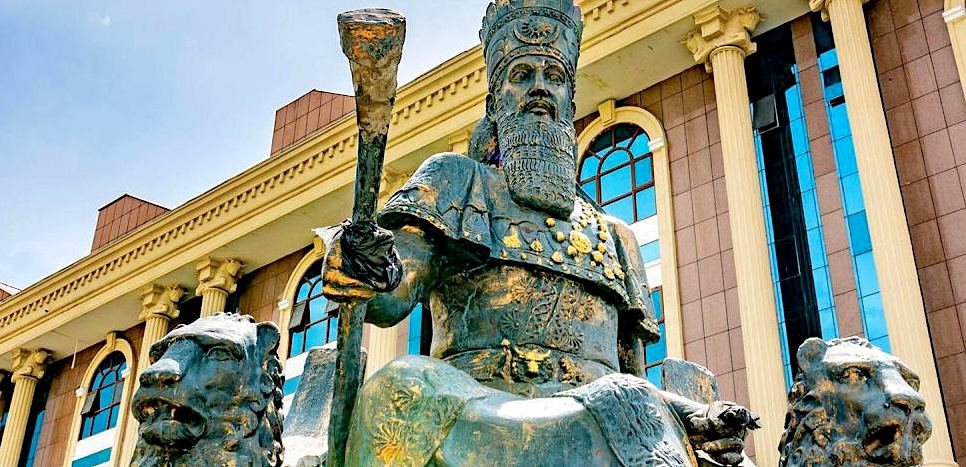
Centuries ago the intervention of a Persian king restored a degree of balance of power in the West Asian region. In 600 BCE, Cyrus the Great of Persia put a stop to the aggressive expansionism of the Babylonian empire and set the exiled Jews free.
After Cyrus’s death, his successor Darius was made aware of his predecessors’ plans to do even more. Commissioning some competent Jews, he fulfilled Cyrus’s intentions by restoring the ravaged city of Jerusalem and its venerated temple.
The Jews were overwhelmed. They would remember the valiant one who revived the essence of their nationhood. So the story of Cyrus the Persian, acknowledged as the anointed deliverer and the Messiah, came to be etched in the Jewish scriptures.
This stirring story impacted Christianity as well. As former Jews, the earliest Christians were familiar with the hardship experienced under Babylonian imperialism. This led to the secret identification of the then brutal Roman Empire as Babylon. The pseudonym worked so well that some Christian writings and communities applied it to other marauding forces that crushed peoples and looted their lands.
Today the world witnesses an ironic alliance of relentless bullying between the progeny of Babylon and Jew. Together the US and Israel do to others what Babylon did to the Jews and what their book tells the Jews they are never to do to others.
The alliance’s agenda is straightforward. While one randomly ridicules and threatens sovereign nations, the other is quick to fabricate evidence that leads to the decimation of infants, children and unarmed civilians, all on the pretext of self-defence. Thereafter, security zones carved out on other people’s property mock what is left of international law, friendly nations are intimidated into buying killing devices at thumping profits and military bases emerge on these territories in exchange for protection. The war with Iran, Cyrus’ Persia of today, is integral to this agenda.
Iran, one of the most ancient and advanced civilisations of the world, has since its Islamic revolution of 1979 come under a despotic theocratic governance. It has crushed internal dissent and the clamour for participatory governance among its own people, prevented the growth of democratic institutions, trained and financed para-military forces to resist Israel’s settler colonialism and challenged the influx of western interests in the region. In return Iran has been relentlessly caricatured as global villain and subject to the wrath of the western mindset and its propaganda industry.
The campaign to demonise Iran has been so clever that many of her neighbours who share a long cultural history stand shoulder to shoulder today with vain intruders bent on crushing the only nation it cannot subdue in a region they have no business to meddle in.
Wars do strange things. They slaughter good men and women on all sides, cause chaos and misery wherever it spreads and never stops to explain to the children who survive that this madness was simply to satisfy the egos of the vain.
But wars also change human perception. And there are signs that the current war on Iran (it must never be the Iranian war) is changing global perception.
Slowly, the devious stereotype of global saviours versus regional villain is being redefined. While good governance must remain to haunt and transform Iran, the villain is now being acknowledged, however grudgingly, as the one nation that refused to back down in the face of global bullying. This too at tremendous personal cost to the lives of its people, infrastructure and future stability. In a world of cowardly political expediency, costly resistance attracts attention, even admiration.
There is more. The resilience of the vilified villain in the current war appears to have strengthened the nerve of the repeatedly humiliated European and British allies of the alliance, who at last learnt to say no to an order to join an unprovoked and senseless far away war, backed with a second no when pressed to police the Strait of Hormuz. Typical of handling the playground bully, all it takes is for one little girl to hold her ground.
It does not stop here. Sheer desperation at Iran’s unsettling tenacity shamelessly drove Babylon into the arms of other neutral powers that it repeatedly ridicules and badgers with threats of tariffs and more tariffs. Regardless of a sudden demonstration of charming diplomacy, these nations would have no part in twisting Iran’s arm. Some instead seized the opportunity to address Babylon on its arbitrary violation of International Law and warned it to refrain from global bullying. Since then there have been less threats on the annexation of Greenland and interference in Cuba’s internal affairs.
Like war does, resistance to war also does strange things. While the refusal to yield stimulates active defiance among some, and strongly worded objections from others, the outcome of the current conflict is hugely unpredictable. An independent, safe and stable region made up of independent, safe and stable nations is many, many courageous interventions and many, many wise negotiations away.
But one thing is clear. Isolated from its traditional allies, subject to straight talk from neutral nations and under growing pressure from saner elements at home, the vain find themselves uncomfortably seated as equals at one table. Here, Iranian geopolitical strategies, coupled with a measured readiness to return to arms in the event that table agreements are violated, will hold them but only for a while.
Given this footpath to a balance of power that Cyrus’s Persia of today has paved, it is now left to all who value the sovereignty and dignity of all nations, theirs included, and the indispensability of International Law, to step out and help steer this momentum.
In the event that this happens, dismantling the visible acts of global bullying alone will not be enough. The impulse of this crime, flourishing brazenly in the big businesses and assembly halls in the big cities of the world, and more subtly tucked away in the fabric of reputed places of learning, religiosity and leisure, will also have to be called out and neutralised.
Meanwhile, a humanitarian crisis looms over Sri Lanka’s southern seas. Historically renowned for its spontaneous hospitality even in the worst of times, the country finds itself constrained from responding to the desperate cries for water, food and fuel from a stranded fleet of commercial ships simply because they fly the Iranian flag. Regrettably, Babylon’s typical threat of sanctions appears to be driving our economically vulnerable nation to the brink of compromising our time tested right to be humane.
With peace and blessings to all.