
Photo courtesy of The Guardian
Many of us came here with little more than hope. We came from Colombo and Chennai, from Kabul and Khartoum, from Beirut and Hanoi. We cleaned offices before dawn and drove taxis through the night. We nursed other people’s parents, sat exams in a second language and started again at the bottom of professions we once led. We helped build this country on land that was stolen from its First Peoples and never ceded.
Today a heavy weight is settling over our homes. Rents rise faster than wages. The weekly shop has become a reckoning. Young people who did everything asked of them cannot imagine owning a home. And as the strain grows, a familiar voice grows louder, telling Australians that the cause of their hardship is us – migrants.
It is not. We must say so clearly, firmly and together before Victoria votes on November 28.
Partners in other people’s wars
We are told that AUKUS, a trilateral security partnership between Australia, the UK and the US, is about defence, not war. Our history says otherwise. Australia has joined almost every major US-led war of the past sixty years: Vietnam, the 1991 Gulf War, Afghanistan and the 2003 invasion of Iraq, launched on false claims of weapons of mass destruction. Each was sold as protecting us. Each left devastation in countries many of our families came from.
The pattern continues. When the US and Israel struck Iran on February 28 this year, the Anthony Albanese government described Australia’s role as purely defensive yet it sent a Wedgetail surveillance aircraft and air to air missiles to the Gulf and in May joined a naval mission in the Strait of Hormuz. Defensive or not, it placed Australia inside a war it did not start.
AUKUS deepens that bond. Signed by the Scott Morrison government in 2021 and embraced by Labour, it may cost up to A$368 billion over three decades. The Liberals walked us onto this path wide awake; Labour now sleepwalks along it.
Then there is Gaza. In September 2025, a United Nations Commission of Inquiry found that Israel had committed genocide there. Canberra has since recognised a Palestinian state yet Australia still supplies parts to the global F-35 programme. For those of us who fled war, occupation and mass killing, this is not abstract. We know the cost.
Israelis voted on October 27. Early counting give neither Benjamin Netanyahu’s bloc nor its challengers a majority. Turnout was the highest in decades and the Arab parties gained ground. These figures may shift when counting ends later this week, especially for parties near the threshold. Whatever the final count the leading challenger, former army chief Gadi Eisenkot, has vowed no Palestinian state, “not now, not in the next government.” A new face in Jerusalem may not mean a new course in Gaza. That is why pressure from outside, including from Canberra, still matters.
Who really caused the crisis?
We are told prices rise because of global inflation and interest rates as if these were weather. They are not. They are choices made by people and systems with names.
The war on Iran shut the Strait of Hormuz, which normally carries a fifth of the world’s oil. The World Bank called it the largest oil supply disruption in recorded history and forecast energy prices to rise 24 per cent this year. Its chief economist warned of the sequence that follows: dearer fuel, then dearer food, then inflation and higher interest rates. Every rate rise and every petrol bill since February carries the cost of a war Australians never voted for.
Housing tells a similar story. In 1999 the John Howard government introduced a 50 percent discount on capital gains tax. Combined with negative gearing it turned homes into investment products. For a quarter of a century both major parties defended these settings. Labour dropped its reform plans after 2019 and promised voters in 2025 it would not touch them.
Only this May did Labour begin to wind them back gradually: existing investors are protected and new builds keep the old concessions. The coalition has vowed to repeal even that. The speculation that priced our children out of a home was not caused by migrants. It was driven by government policy and backed by property speculators.
One Nation: what the record shows
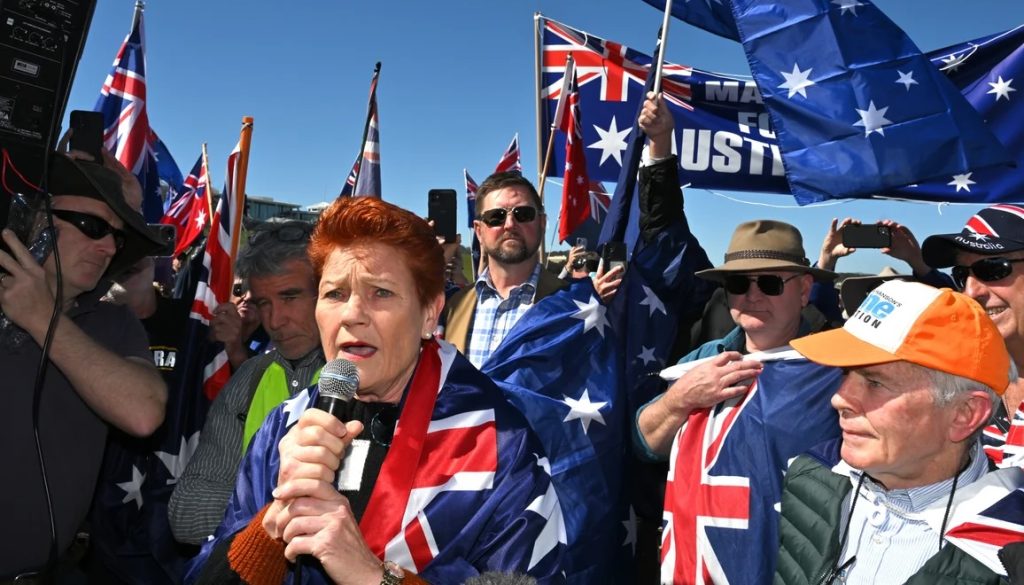
Into this discontent has stepped Pauline Hanson’s One Nation. Four years ago, it won barely 8,000 lower house votes in Victoria. This year it has polled above 20 per cent here and in some surveys has led the primary vote.
Its defenders say its concern is numbers, not people. The record says otherwise. In her first speech to Parliament in 1996, Hanson warned that Australia was in danger of being swamped by Asians. Twenty years later, in her first Senate speech, she claimed we were being swamped by Muslims. She has twice worn a burqa into the Senate chamber as a stunt, most recently in 2025, earning a suspension. In 2018 she moved the slogan “It’s OK to be white” as a Senate motion. This is not a debate about population planning. It is about who belongs.
Nor has One Nation stood with working families. In 2017 it pledged its votes to company tax cuts for big business, backing away only in 2018, the same year it voted through the Malcolm Turnbull government’s income tax package whose largest benefits flowed to high earners. A party that blames migrants for your rent while voting for the wealthy is not on your side.
The Liberals drift, Labour hesitates
The Victorian Liberals, rather than drawing a line, have drifted towards One Nation. At the Nepean by-election in May, they preferenced One Nation above an independent and One Nation returned the favour. Former premier Jeff Kennett has urged an anti-Labour partnership. Opposition Leader Jess Wilson has ruled out a formal alliance but not the preference flows that could deliver one in all but name.
Victorian Labour, now led by Premier Ben Carroll, has offered no bold counter-vision. It answers with the same managerial caution that has already driven so many voters elsewhere.
A word to our own communities
Some of us, including voices in the Sri Lankan and Indian communities, have been drawn to the right, hoping that hard work, family values and small business will be rewarded there. The instinct is understandable but history offers a sober lesson.
A politics built on blaming newcomers never stops at the newcomers it names first. Today it is too many migrants. Tomorrow it may be your cousin’s visa, your temple or mosque or your accent at a job interview. No amount of loyalty buys an exemption from a politics that needs someone to blame.
And none of the major parties will fix the cost of living crisis because they support the very policies that caused it.
Lessons from Belgrade and Brasília
Change is not impossible. On October 25 in Serbia, a movement born of student protests after the Novi Sad station disaster won an outright majority, ending 14 years of rule by Aleksandar Vučić’s right wing populist party.
On the same day, Brazilians re-elected Luiz Inácio Lula da Silva with almost 52 percent of the vote. He defeated Flávio Bolsonaro, son of the far right former president, despite trailing him in the first round. In France, high school students have filled the streets over underfunded schools and workers have joined them over soaring prices.
None of this was handed down from above. It was organised, door by door, by ordinary people who refused to accept that nothing could change.
Wake up Australia, wake up migrants
Migrants are not the enemy of the Australian people. Aboriginal and Torres Strait Islander peoples are not the enemy. The real danger is an outdated and inequitable economic model and a foreign policy that together hand ever more to the top one percent while everyone else is told to fight over what remains.
On November 28, Victorians will vote. Check your enrollment. Read the record, not the slogans. Ask every candidate what they will do about rent, wages, and public services and where they stand on AUKUS, Hormuz and Gaza. Talk to your elders, your children and your congregations.
We came here to build, not to be blamed. Let us remember that and vote accordingly.