
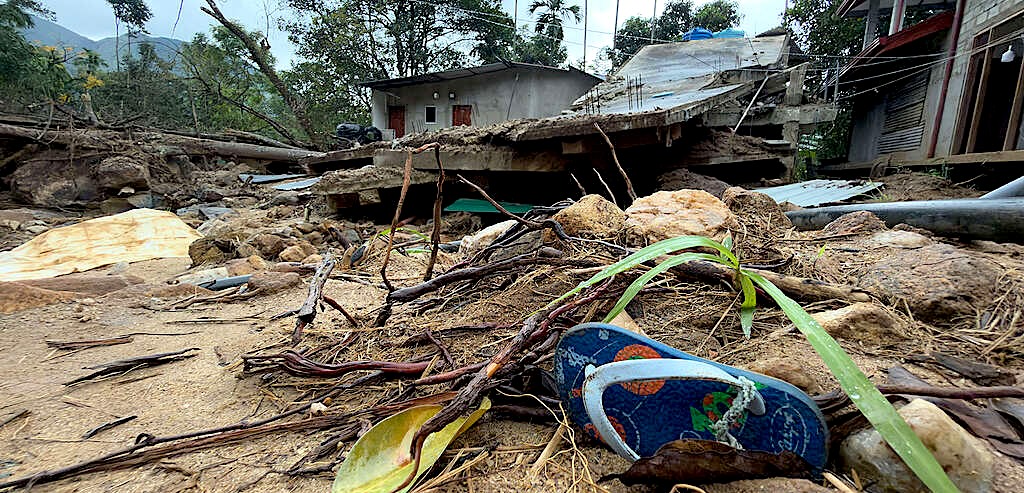
Photo courtesy of Greenpeace
Island nations like Sri Lanka stand at the frontline of the accelerating climate crisis. Navigating a severe economic crisis and complex sovereign debt restructuring, Sri Lanka faces compounding environmental vulnerabilities with marginalized agrarian and plantation communities experiencing intensifying droughts, catastrophic landslides and erratic weather patterns.
This article evaluates the efficacy of targeted financial mechanisms under the United Nations Framework Convention on Climate Change (UNFCCC) and the Paris Agreement strictly focusing on the Global Environment Facility (GEF) and the Green Climate Fund (GCF) in securing local climate justice. Employing a Critical Institutionalist framework drawn from International Relations theory, the research explores how structural power asymmetries and geopolitical donor competition impede local resilience.
The findings reveal that existing international funding architectures are heavily constrained by hegemonic interests and macroeconomic austerity conditionalities, systematically excluding grassroots actors from direct financial access. The article concludes that achieving true climate justice necessitates decolonizing multilateral climate governance, establishing direct access financial pipelines that respect Global South sovereignty and prioritizing rights-based, community-level resilience over geopolitical donor agendas.
The global climate crisis represents an existential threat to developing island nations with Sri Lanka serving as a primary empirical locus of compounding socioeconomic, political and environmental vulnerabilities. Positioned within the strategically vital and ecologically fragile Indian Ocean region, Sri Lanka is increasingly subjected to severe hydrometeorological disruptions. Over the past decade, the island has witnessed a dramatic escalation in extreme weather events ranging from protracted, multi-season droughts across the northern and eastern dry zones to catastrophic landslides, flash floods and severe soil erosion in the central highlands. These ecological shocks do not occur in a vacuum nor do they impact all segments of society equally; rather, their severity is deeply mediated by historical economic marginalization, structural class inequalities and uneven geographic development. Plantation workers in the central hill country who have historically endured systemic disenfranchisement and smallholder agrarian communities reliant on seasonal rainfall bear the disproportionate brunt of this environmental degradation. For these marginalized groups, the climate crisis is not a distant theoretical projection but an immediate, lived reality that undermines food security, destroys precarious livelihoods and threatens basic human security.
Currently, Sri Lanka is navigating the most severe macroeconomic and sovereign debt crisis in its post independence history. The sovereign debt default of 2022, precipitated by structural fiscal deficits, external shocks and foreign exchange depletion, forced the state into complex restructuring negotiations with international financial institutions (IFIs) and bilateral creditors. Ensuing economic stabilization programs have imposed stringent austerity measures, resulting in currency devaluation, hyperinflation and a contraction of public expenditure. Within this tightly constrained national landscape, domestic budgetary allocations for environmental protection, disaster risk reduction, and long term climate adaptation have been drastically curtailed. Consequently, Sri Lanka is structurally dependent on the international climate finance architecture, specifically multilateral funding mechanisms established under global environmental governance conventions to bridge the immense fiscal gap required for national resilience.
However, a profound disconnect persists between the rhetorical commitments of high level international climate diplomacy and the tangible delivery of protective resources to vulnerable local populations. Despite pledges made at successive Conferences of the Parties (COPs) to mobilize billions of dollars for developing nations, adaptation finance flowing into Sri Lanka remains fragmented, bureaucratic and largely insufficient. This article addresses the central research question: how do structural power asymmetries within international climate governance and geopolitical donor competition impede the delivery of local climate justice for the most vulnerable populations?
The analytical scope of this article is strictly bounded to an evaluation of financial mechanisms operating under the UNFCCC and the Paris Agreement, focusing specifically on the Global GEF and the GCF. Existing studies frequently treat multilateral environmental funds as neutral administrative conduits, analyzing their limitations through the lens of institutional inefficiency or bureaucratic oversight. What is systematically overlooked is how geopolitical competition among dominant donor nations, specifically the US, the European Union, China and India actively shapes the governance architecture, funding priorities and disbursement modalities of these institutions.
Furthermore, within the contemporary Sri Lankan context, there is an acute lack of scholarly inquiry into the intersection between international climate finance conditionalities and macroeconomic debt restructuring agreements enforced by international financial institutions (World Bank, 2023; Central Bank of Sri Lanka, 2024). When global financial institutions demand fiscal austerity and structural consolidation as prerequisites for economic stabilization, environmental resilience is routinely subordinated to debt servicing. This article directly addresses this critical problem, investigating how hegemonic donor interests, geopolitical rivalries in the Indian Ocean and bureaucratic fragmentation converge to perpetuate structural climate injustice for rural agrarian and plantation communities.
Theoretical foundations
To transcend a purely technical evaluation of climate finance efficiency, this analysis is anchored in a Critical Institutionalist framework derived from international relations and global political economy theories (Keohane, 1984; Andreatta, 2019). Conventional neoliberal institutionalism often conceptualizes multilateral organizations as cooperative arenas established to overcome market failures and manage global public goods efficiently. In contrast, Critical Institutionalism posits that multilateral institutions are neither politically neutral arbiters nor merely technocratic administrators. Instead, they function as arenas of structural power that reflect, institutionalize and reproduce the historical hierarchies and power asymmetries between hegemonic state actors and marginalized developing nations (Collier & Venables, 2012).
When applied to the global climate finance architecture, Critical Institutionalism illuminates how the governance structures of the GEF and GCF are inherently shaped by donor dominance. While the GCF was designed with a nominally balanced representation between developed and developing nations on its Board, decision making power remains heavily contingent on financial contributions. Major financial contributors primarily the US, the European Union and Japan exercise disproportionate influence over institutional strategies, accreditation criteria and project approval pipelines. Consequently, rather than operating as objective mechanisms responding purely to ecological vulnerability and historical carbon indebtedness, these funds become instruments of hegemonic preservation. Donor states utilize multilateral climate finance to export their preferred economic models, enforce market based environmental solutions and secure diplomatic leverage over recipient nations in the Global South.
Geopolitical rivalries in the Indian Ocean
In Sri Lanka, these multilateral power asymmetries are further intensified by acute geopolitical competition among major regional and global powers, specifically the US, China, India and the European Union. Sri Lanka’s strategic geographic positioning along primary maritime trade routes in the Indian Ocean has transformed the island into a contested focal point for superpower rivalries. Within this geopolitical theater, international climate finance and environmental aid are increasingly weaponized as instruments of soft power and strategic footprint expansion.
Traditional Western donors and multilateral institutions heavily influenced by Western capital (such as the World Bank and Asian Development Bank, acting as accredited entities for the GEF and GCF) channel climate finance through strict normative frameworks. These frameworks emphasize regulatory compliance, market liberalization and transparency standards that align with Western strategic interests. Conversely, China has rapidly expanded its bilateral environmental footprint in Sri Lanka through the Belt and Road Initiative’s Green Silk Road framework, offering infrastructural loans and climate adaptation grants with alternative conditionalities that prioritize state to state agreements and infrastructure construction. Simultaneously, India utilizes regional climate diplomacy and emergency financial assistance under its Neighborhood First policy to counterbalance Chinese influence and maintain its historical hegemony over the South Asian maritime domain.
For Sri Lanka, navigating this competitive donor landscape results in severe institutional fragmentation. Rather than adhering to a cohesive, national adaptation plan driven by localized ecological priorities, domestic ministries are compelled to align project proposals with the shifting strategic interests of competing bilateral and multilateral donors. Climate finance projects are frequently approved not solely on the basis of their protective efficacy for marginalized communities but due to their alignment with the geopolitical objectives of the sponsoring donor state, turning climate adaptation into a proxy battlefield for diplomatic influence.
Macroeconomic debt distress and neoliberal conditionalities
The structural barriers to climate justice in Sri Lanka are compounded by the intersection of international climate finance conditionalities with the nation’s ongoing sovereign debt crisis. Following the 2022 debt default, Sri Lanka entered into a stringent Extended Fund Facility (EFF) agreement with the IMF requiring radical macroeconomic adjustments, including primary surplus targets, subsidy removal and comprehensive SOE privatization (Central Bank of Sri Lanka, 2024).
Within this macro policy framework, Critical Institutionalist analysis reveals a profound contradiction: while multilateral environmental conventions urge developing nations to invest heavily in climate resilience, global financial institutions simultaneously enforce fiscal austerity by dismantling the state’s capacity to do so. Multilateral funds like the GEF and GCF frequently mandate significant co financing contributions from recipient governments as a prerequisite for project approval. In a debt distressed economy where foreign exchange reserves are depleted and public spending is strictly capped by IMF conditionalities, the state is structurally incapable of meeting these co-financing requirements.
Consequently, climate finance allocations are increasingly skewed toward revenue generating mitigation projects or large scale, capital intensive infrastructure works that can attract private sector co-investment, rather than urgent, non revenue generating adaptation needs. Furthermore, the removal of agricultural and energy subsidies mandated by macroeconomic stabilization programs has escalated costs for rural farmers, making climate adaptive agricultural inputs economically unattainable. When international funding mechanisms operate in isolation from or in subservience to neoliberal austerity regimes, they actively exacerbate the socioeconomic vulnerability of populations they are chartered to protect.
Bureaucratic fragmentation, intermediary rents and access barriers
A primary empirical finding of this article is the pervasive bureaucratic fragmentation and the systemic failure of direct-access funding modalities within Sri Lanka’s climate finance architecture. The Green Climate Fund established Direct Access Entities (DAEs) to allow national and sub national organizations in developing countries to receive funding directly without routing through international intermediaries. However, the institutional reality demonstrates that this mechanism is heavily obstructed by rigid, Eurocentric fiduciary standards, complex social and environmental safeguard appraisals, and exhaustive documentation requirements.
Domestic institutions weakened by administrative austerity and structural economic distress lack the specialized legal, accounting and technical capacity required to navigate the convoluted accreditation procedures of the GCF and GEF. To date, direct access remains virtually nonexistent for localized civil society groups or provincial authorities. Consequently, the overwhelming majority of climate finance flowing into Sri Lanka is mediated through Multilateral Implementing Entities such as the United Nations Development Programme, the Food and Agriculture Organization and the World Bank.
This reliance on international intermediaries generates significant structural inefficiencies:
- Administrative rent seeking:international intermediaries absorb substantial portions of allocated funds through overhead costs, international consultancy fees and administrative management charges, significantly depleting the capital that reaches grassroots resilience projects.
- Top down project design: multilateral intermediaries tend to apply standardized, globalized project templates that prioritize quantitative reporting metrics over localized, context specific ecological needs.
- Institutional dependency: by channeling funds exclusively through external international agencies, the multilateral architecture actively prevents the institutional capacity building of domestic organizations, perpetuating a structural dependency on foreign technical expertise.
Grassroots exclusion
The ultimate consequence of these geopolitical, economic, and bureaucratic barriers is the systematic exclusion of the most vulnerable populations from meaningful climate protection, precipitating a severe human security crisis. To illustrate this dynamic, this article evaluates the impact of multilateral climate finance on two distinctly vulnerable demographic groups: smallholder farmers in the dry zone and tea plantation workers in the central highlands.
In the rural dry zone provinces (e.g., Anuradhapura, Polonnaruwa, and Monaragala), smallholder agrarian communities depend entirely on seasonal rainfall and ancient irrigation networks for paddy cultivation. Intensifying droughts and shifting monsoon patterns have disrupted the agricultural harvesting season leading to widespread crop failures and compounding rural indebtedness. Despite the deployment of GEF and GCF projects aimed at climate resilient water management, empirical evaluations reveal that project execution is largely confined to bureaucratic state agencies. Local farmers’ organizations and indigenous communal labor networks are rarely consulted as empowered stakeholders in project formulation. Instead, they are treated as passive recipients of external technical interventions. When project implementation delays occur due to bureaucratic bottlenecks between international implementing agencies and central government ministries, critical adaptation infrastructure such as rehabilitated irrigation tanks or solar powered drip irrigation fails to materialize during drought cycles, leaving agrarian households exposed to severe famine and livelihood collapse.
Similarly, in the central highlands (e.g., Nuwara Eliya and Badulla districts), Tamil plantation workers occupy one of the most structurally marginalized socioeconomic tiers in Sri Lanka. Residing in colonial-era line rooms on steep, geologically unstable hillsides, these communities face acute risks from climate induced landslides, intense rainfall and soil degradation. Despite their profound vulnerability, plantation communities are almost entirely invisible within international climate finance allocations. Because plantation lands are largely leased to private Regional Plantation Companies (or managed by state estates, multilateral funds routed through central government ministries rarely prioritize the housing relocation, disaster early warning systems or soil stabilization infrastructure required to protect these workers.
Language barriers, lack of land ownership rights and historical political disenfranchisement of plantation workers prevent them from articulating their resilience needs within national climate policy forums. By failing to incorporate rights based, gender sensitive and socially inclusive criteria that actively target structural marginalization, multilateral funding mechanisms inadvertently reinforce existing social hierarchies. When climate finance is captured by centralized bureaucracies and international consultants while frontline plantation workers and subsistence farmers remain defenseless against environmental shocks, the multilateral governance system actively reproduces climate injustice.
To transcend these systemic barriers and achieve genuine climate justice, a fundamental, structural transformation of global environmental governance is required. Incremental administrative adjustments will remain inadequate as long as climate finance is tied to geopolitical competition and neoliberal economic orthodoxy. International climate diplomacy must be democratized and decolonized to decouple adaptation finance from superpower rivalries. This necessitates the restructuring of multilateral funds to establish decentralized, direct access financial pipelines that respect the sovereignty of Global South nations, eliminate restrictive co-financing barriers for debt distressed states and empower grassroots community organizations as primary decision-makers. Only by prioritizing rights based, bottom up resilience over donor agendas can international funding mechanisms fulfill their statutory mandate and safeguard the human security of vulnerable populations at the frontline of the climate crisis.