
Photo courtesy of Hayleys Agriculture
Think of a customer ringing Sri Lanka Telecom with a complaint. Until recently, the person who took that call had to log into one system after another to find the answers. Now AI agents at the back end gather that information in seconds. “The cycle time that we take to resolve an issue for the customer has improved,” Ishari Siriwardane, the company’s deputy chief transformation officer, said.
She was also frank about the people. The average employee at the 169 year-old company is over 45. The hard part, she said, is “Moving away from this fear factor that AI is going to take my job.” SLT plans to train more than 3,500 staff and about half had finished by October.
I find that scene more useful than any forecast. It shows where the change begins. It begins at a desk, with a headset, during an ordinary shift.
The wider picture is sobering. In October, the Sunday Times reported that 43 percent of young graduates between 24 and 27 years old are jobless and that about 17,000 graduates join the job market each year. The jobs named as most exposed to AI were administration, bookkeeping, clerical work and customer service. Anura Warnakulasuriya of the National Chamber of Commerce told the paper that companies would not lay people off although fewer leavers would be replaced. Dhananath Fernando of Advocata put it plainly. Industry “cannot say no to it,” he said and added, “Must see how we manage to find jobs for them.”
My job is in software automation. Most weeks, the speed of it still surprises me. Call centres will change almost completely and the people in them deserve time and real support to move. Many entry level roles may disappear from the first job on a call centre floor to the newest junior at a law firm. Demand is moving toward specialists who already understand AI systems and know how to run them.
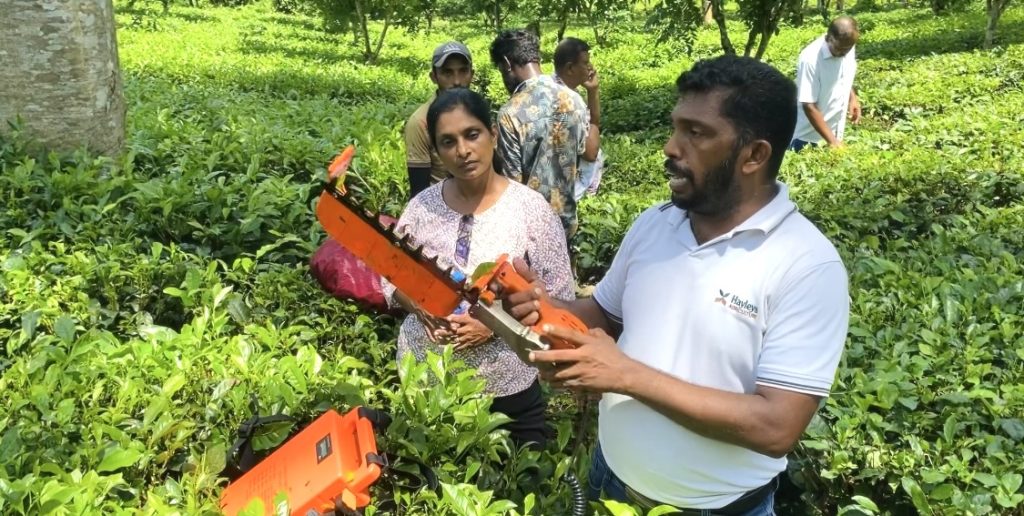
Go up into the hills and you see it too. Agarapatana Plantations bought 451 harvesting machines from Japan. At first many pluckers were afraid they would lose their jobs. Then the women were trained to run the machines themselves. By the company’s own account, operators now earn over Rs. 2,000 a day in the cropping season and the work brings greater dignity and job satisfaction. That is how the company tells it. The workers’ own view is harder to find. Over at Hatton Plantations, women used to finish the day with cracked hands and fingers. On its 13 estates they now carry handheld machines.
Then there is TeaAI, a Sri Lankan firm whose cameras grade tea auction samples. The firm says it wants tea tasters to have more time for blends and for buyers. A few lines further down, a report on it mentions an exporter who now gets by with significantly fewer staff. Both sentences are in the same article.
Plenty of Sri Lankans have taught themselves a trade at home. One of them a Fiverr designer, Thilina Madushanka, posted about his start years ago. He said he had been bad at design when he joined. “Even now, I only know Photoshop,” he wrote. “Now I am learning new stuff little by little.” Two years of savings later, he bought a vehicle.
Thilina’s way, little by little, while the job still pays, is something any worker can borrow. Someone on a call centre floor today could start edging toward another field now. My hope is that each person whose job changes can see about three possible paths, each with training attached.
Free, open courses on using AI systems would make that path wider. So would free courses for creative people where writers, designers and musicians learn to use AI to deepen their own work. And I hope young people drawn to research and invention will learn about AI or superintelligence early in their schooling.
Something bigger has started too. In Sri Lanka, some government payments can already go through the banking and fintech apps people use every day. The system is called GovPay and LankaPay runs it under the Central Bank. One government app is planned with many state services coming into it bit by bit and a new digital identity on the way. That shift will count for a lot in how well the country competes in the long run.
People come back to such apps when they are easy, secure and reliable. But I have seen a government app that made life harder for the people it was meant to serve. Since then I pay close attention to how simple the handling is.
I also see it in my own family. Some older relatives find new technology tiring and every extra screen makes it harder. When I picture how it could work, it comes down to a few plain steps. A QR code would download the app and walk the user through the whole task. A photo of the identity card would fill in the data automatically. Logging in can stay simple with a onetime code sent by SMS that older users can type in without trouble. It helps when the camera and a QR code are enough to get in. Printed leaflets written for older readers would help too. I have noticed that when a system works for my older relatives, it tends to work for everyone. For me that has become a quiet test of any digital service and I hope the new ones in Sri Lanka will pass it at every age.
Back in the late 1950s, a Colombo schoolteacher named A. T. Ariyaratne took his pupils out to a poor village. They dug latrines with the villagers, planted gardens and cut a road. Out of that grew Sarvodaya Shramadana. Its stated mission is the sharing of one’s time, thought and energy for the welfare of all.
That idea still fits. A worker at SLT learning a new tool, a plucker learning a machine and a freelancer learning Photoshop are all doing the same thing. They are finding a way to stay useful to others. AI can take over tasks. The wish to contribute stays with people.
Krisztián Galánthai Fekete, PhD, works in software automation as an integration engineer, where he sees every day how fast AI is changing work, and what people need beyond new skills to keep their footing.