
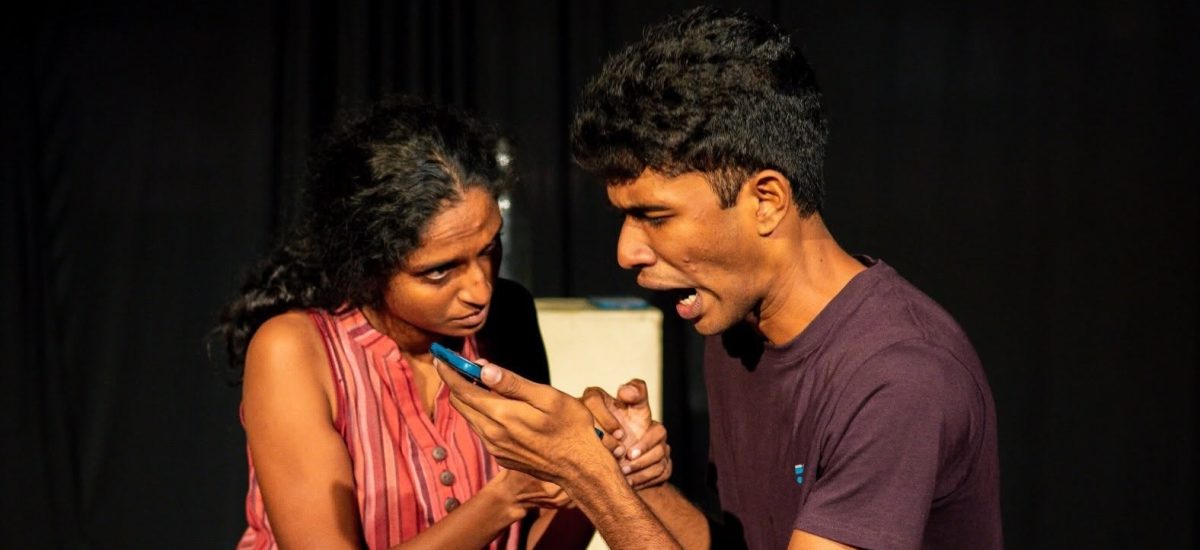

Photo courtesy of Stages Theatre Group
Some silences are so ordinary that we stop noticing them. The pause before a person who stammers finishes a sentence, a pause that is too often filled by an impatient listener. The quiet that settles over a family when a diagnosis arrives. Katawaha, an original play by the Stages Youth Ensemble, directed by Ruwanthie de Chickera, steps into those silences and asks its audience to stay in them a while.
The story is deceptively simple. A closely knit family is already navigating one child’s debilitating stutter when the other child is diagnosed with throat cancer. Behind it lies 20 months of research, development and devising by more than 70 young artists, performed in two languages, Sinhala and English, by two separate casts and experienced by a small audience who followed the actors from space to space, watching the most private moments of a family’s life. What follows is the story of how it came to be, told by the director and the cast themselves.
Two true stories mirrored
Katawaha grew from the lived experiences of two young ensemble members: Visura Padeniya, who lives with a pronounced stutter and Mashika “Mashi” Methmini, a survivor of cancer. Visura once put his place in the world plainly. “I can neither speak properly but I’m not mute either.” Mashi’s words are just as sharp. “Surviving is more confusing than living.”
Their stories, Ruwanthie explains, were never the only ones on the table. “Their stories were two amongst many. And all the stories were touching because they were true.” But truth alone does not make a play. “Truth does not, alone, make a good story. There have to be other things as well like structure, concept and impact,” she says. What tipped the balance was how the two stories echoed one another. One girl, one boy, one physical challenge and one emotional challenge, both dealing with voice and so physically and metaphorically the challenge of not being heard.
That echo became the play’s architecture. Two siblings, Ruvin and Vindya, travel through parallel worlds that mirror each other at every turn. When one meets her friends, the other meets his. When Ruvin meets the coach, Vindya meets the doctor. Asked whether Mashi’s line about surviving changed how she shaped the story, Ruwanthie’s answer was short. “It didn’t.” The characters, she says, are people who live loving, talking, fighting, caring. The line matters for what comes after the final scene when we imagine how the family is changed. “This is how we break people in society, isn’t it? We take the drive, the fight, the fire and the conviction out of them and turn them into faded carbon copies of themselves.”
Writing a story that belongs to someone else
Turning real lives into a script was, by Ruwanthie’s account, among the most demanding work of her career. The play grew from long conversations, writing tasks and improvised scenes that were recorded, studied and written up. And, she says, “This story, more than any story that I had ever written before needed to be crafted. It was a very, very technical script to write because scenes had to be timed to match the parallel world.” Visura chose to be part of the writing process from the start, one of three young writers who worked alongside her. In the end, she says, “I was writing the play with the very valuable assistance of the other three young writers, especially Visura. This balance is reflected in the credits.”
Mashi chose a different path. She shared her story at the beginning, then stepped back from the writing room. So Ruvin’s story came out of deep conversation while Vindya’s came from wider research, many voices and visits to the cancer hospital. The lesson Ruwanthie took from this was one of humility. “When dealing with true stories, you really have to allow the person whose story it is, to share it in the way that works for them.”
Visura, for his part, describes the finished play as something larger than his own experience. He says it brings out the depth of stammering and the internalised self-hate shaped by society and it is the collective creation that has sparked from the collaboration between the writing, directing, acting with each element bringing a power of its own to create something so new yet so relatable. Mashi’s hope was similar, that the writers would get the human side of these experiences right so that audiences would connect with the person behind the experience and understand that there is so much more to someone’s story than what they’re going through.
Following the story through the space
Katawaha was not conceived as immersive theatre. Ruwanthie is clear that form followed story. “The form of any story should be allowed to emerge,” she says. First came two stories, then the idea of presenting them in parallel, then the mirrored structure and suddenly you are already dividing your audience up and having them walk around. Her advice to any storyteller is, “All you need to do is follow the story. It will take you to the best way to tell it.”
The venue arrived by a stroke of luck. When the original, more traditional venue pulled out two weeks before opening night, the production had to postpone and search again. “I felt like the biblical family looking for a room to birth a child. And everyone way saying to me that there was no room.” A phone call changed everything and Hatch Works, a flexible co-working space, offered itself as a venue partner. The result, Ruwanthie says, brought true magic into the play and many audience members didn’t feel the three and a half hours pass at all.
For the actors, performing with an audience close enough to touch changed the work itself. Hirupa Kithmina, who plays Ruvin in the Sinhala version, says, “For me, the audience is a part of the performance. Since it’s an immersive show, we can feel their presence and energy and that energy becomes a part of our performance too. It’s not just about what we bring to the stage; it’s also about what we receive from the audience.” Taleetha Wambeck notes that, “Even when you’re not speaking, you’re still performing” and that closeness brings a certain vulnerability to the performance. Mashi puts it simply. “You can’t really hide behind big gestures or exaggerated expressions. Even the smallest reaction can be noticed.” Murthaaz Abdul Barry adds that in an immersive show the audience’s energy is more palpable.
One play, two languages
Performing Katawaha in both Sinhala and English was a deliberate choice and a demanding one. Ruwanthie believes that Sri Lankan artists should be not just bilingual but trilingual with true ownership and mastery of language. Working in more than one language, she says, expands the nuances of each language and each performance through a lot of cross-fertilisation of idiom, expression and situation.
Inside the company, the two casts became each other’s teachers. Hirupa watches his counterpart in the English cast who plays the same character. “Watching his performance has really helped me understand my character better and explore the story we’re both a part of. It’s interesting to see how another actor approaches the same character and it gives me a different perspective on the role,” he says. Anouk Abeywickrema says the actors watch each other every time, not only out of support but because something always new or interesting comes alive during their performance. Partners also serve as a second pair of eyes, giving an accurate breakdown of their performance since a person who knows the character inside out is best placed to say how it went.
Mashi who plays Thilini, Ruvin’s girlfriend, in the Sinhala version and belongs to both casts, calls the support like having your own personal coach and bodyguard watching your back and says that although the two casts perform in different languages, they are all part of the same story and want each other to do well.
Playing a person, not an illness
The heart of the cast’s work was a shared rule – never imitate a condition when you can inhabit a person. Mashi says it best. “The first thing is understanding that you’re playing a person not an illness or a disability.” Anjaani Perera, who plays Vindya, studied the real young woman behind the character, how she reacted to her diagnosis and what she went through and then realised that imagining her own reaction was not enough. “I had to separate my own personality and emotions from those of the character,” she points out.
For the actors playing Ruvin, imitation gave way to something more honest. Avlok Wignaraja admits he began by copying Visura’s habits and by watching videos of different people’s mannerisms. Then Visura told him that stammers develop differently in different people so Avlok built one that was purely unique to him and let it be fed by the emotion he is feeling in each scene. Visura describes how the company worked with him for weeks on where a stammer originates, where it is felt and how the shape of it changes based on mood and situation until the actors could capture stammering not as a trait but as a lived experience.
The warmth behind the scenes
A story this heavy was built by people who also laughed, celebrated and leaned on each other. Mashi remembers a scene performed when one of the Thilinis was missing. The remaining Thilini would sit on a bench doing both Thilinis’ lines in both languages. There were birthdays, rehearsals and plenty of time spent together. The devising process, she adds, was a little hectic so the audience definitely missed out on some of that chaos.
Some moments were harder. Visura says that scenes with the mother are always dreadful because they spur so much emotion while the final scene is one he can’t wait for. “It is truly a magical moment I don’t think I’ll ever come across again in my life,” he says. The play also reached into the cast’s own lives. Anouk says it showed her how families could sit down, talk through their disagreements and actively work towards understanding one another and taught her to look at her own parents with a little more understanding. For Mashi, the lesson was gratitude. “I don’t think I’d be here without them”, she says.
For the people who know it best
Some audience members arrive knowing far more about illness than any script can. Mashi is clear about this. “There were people in the audience who have gone through something similar or someone who has watched a person they love go through it.” Hasini Perera agrees, saying the awareness makes her approach the character with more sensitivity and that the hope is to create a space where they feel seen and understood.
The production worked hard to make sure those audiences could attend. Raising 12 million to cover its costs, including payment for all the 80-plus artists involved, freed the company from relying on ticket sales. More than 40 per cent of tickets were free or heavily subsidised. There were dedicated shows for doctors, nurses and patients curated by the Indira Cancer Trust, for families and caregivers connected to the Sunera Foundation and for the stuttering community on International Stuttering Awareness Day. Ruwanthie ties this to a founding principle that access to the arts is a right and not a privilege.
Some of the strongest reactions came from the hospital scenes. The character people talked about most was the nurse. “Many people came to me after the show and told me they hated the nurse because she reminded them of their own experiences in hospitals; some people came up to me and said they didn’t like her but they understood why she might turn out like that,” Ruwanthie says.
What they hope you take home
Asked what they want audiences to stop assuming, the company answered with one voice. Visura offered the shortest answer. “Stop assuming and start asking. You’d be surprised how much of it you’ve gotten wrong,” he says. Taleetha asks people to stop believing that a difference in speech reflects a difference in thought and to become more conscious of the difference between listening to respond and listening to understand. Dulina Chandrasiri points to the way stammering is so often played for laughs in film and media and hopes the audience leaves with newfound empathy for not just those who stutter but anybody with a condition that they don’t fully understand. Mashi, speaking from the other side of the story, makes a similar plea about illness. “People going through cancer are still people.” She asks us to be a little kinder, especially when we do not fully understand what someone is facing. “You don’t always have to find the perfect words or know exactly what to say. Sometimes, just being there and listening is enough,” she points out.
Ruwanthie turns the idea on its head. “Speed in speaking is overrated. Spaces between words allows for thoughts to settle. Choosing one’s words carefully, not taking words for granted, is a super power. Ruvin learns this at the end of his journey. I hope more people begin to see the world like this too,” she says.
A conversation that continues
Katawaha is not an easy play and it never set out to be one. It asks its audiences to listen where they would normally interrupt, to be curious where they would normally assume and to notice the person where they would normally see only the condition. Mashi hopes viewers will ask, “What do you wish people understood about you?” The play’s greatest gift may be that it makes the question feel natural. Long after the lights went down at Hatch Works, that question is still worth asking at home, at school, in hospital waiting rooms and in every conversation where someone is working hard to be heard.