
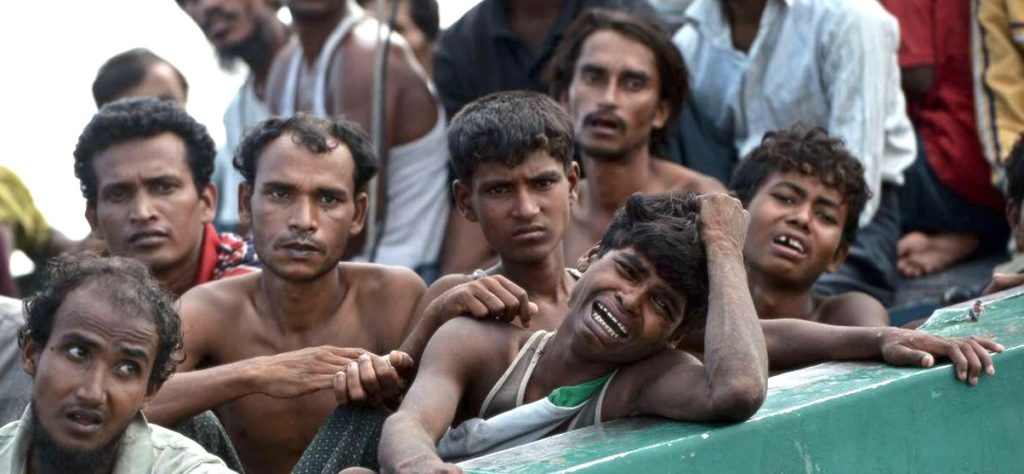
Photo courtesy of The Globe Post
On November 19, in a 191 page judgement, the International Court of Justice (ICJ) found that Myanmar had committed genocide against the Rohingya population in Rakhine state and that it had not prevented and punished genocide. These were found to be violations of Myanmar’s obligations under the Convention on the Prevention and Punishment of the Crime of Genocide. The court also found that Myanmar had not taken effective measures to prevent the destruction and ensure the preservation of evidence related to allegations of genocide as ordered in court’s provisional measures in January 2020.
The court decided that Myanmar must cease any ongoing violations by enacting laws to give full effect to its obligations under the convention, take steps to investigate all persons reasonably suspected of having committed acts related to genocide and if warranted to prosecute and punish them, provide assurances and guarantees of non-repetition of the violations and prevent similar violations from occurring in the future. The court also decided that Myanmar must adopt restitution measures, compensate Rohingyas as a group and members for damages caused if not provided for by restitution.
After nearly 80 years of the Genocide Convention and the ICJ (the UN’s primary judicial body, sometimes referred to as the World Court), this is the first judgment that a country had committed genocide violating the convention’s obligations. It comes seven years after Gambia filed a case at the ICJ accusing Myanmar of violating the Genocide Convention through acts committed during so-called clearance operations carried out by the Myanmar military around 2017. The case was against Myanmar and not individuals.
The convention’s article II defines genocide to mean acts such as killings, serious bodily or mental harm, deliberately inflicting on a group conditions of life calculated to bring about its physical destruction in whole or in part, imposing measures intended to prevent births within the group and forcibly transferring children or the group to another group committed with intent to destroy, in whole or in part, a national, ethnical, racial or religious group. Article III says genocide, conspiracy to commit genocide, direct and public incitement to commit genocide, attempts to commit genocide and complicity in genocide shall be punishable.
Gambia’s case and the ICJ judgement used evidence gathered by the UN Human Rights Council’s Independent Investigative Mechanism for Myanmar (IIMM) established in 2018 and operationalised in 2019 and the council’s 2017 Independent International Fact Finding Mission on Myanmar. In 2018, the Fact Finding Mission had said it had reasonable grounds to conclude that serious crimes under international law, including genocide, had been committed and that criminal investigation and prosecution was warranted, focusing on the top Myanmar military generals for genocide, crimes against humanity and war crimes. In September 2019, the UN mission said the threat of genocide continues for the Rohingyas remaining in Myanmar. The three member mission included Dr. Radhika Coomaraswamy from Sri Lanka.
Who are the Rohingyas?
Rohingyas are a predominantly Muslim ethnic and religious minority from Myanmar’s Rakhine State. They are among Myanmar’s indigenous peoples. But Myanmar law excludes them from the list of recognised national races. Since the 1982 Citizenship Law, they have been denied citizenship. Without full citizenship rights, the Rohingyas have endured entrenched discrimination, arbitrary confiscation of property and severe restrictions on movement, education, healthcare and employment. The genocidal clearance operations of 2017 by Myanmar’s military marked the most recent and devastating wave of violence against Rohingyas, the effects of which persist. Today, the Rohingyas continue to face persecution and are denied basic rights, protection and recognition of citizenship, both in Myanmar and in exile.
The UN High Commissioner for Refugees (UNHCR) recognises Rohingyas as stateless. UNHCR figures as of December 2025 indicates 519,647 Rohingyas as displaced within Myanmar and 1,329,000 living as refugees across the world with Bangladesh hosting more than 1.1 million and about 240 in Sri Lanka.
Refugees, asylum seekers and UNHCR in Sri Lanka
The 2005 agreement between UNHCR and the Sri Lankan government facilitates UNHCR’s international protection and humanitarian assistance functions in favour of refugees and asylum seekers. The government agreed to grant UNHCR unimpeded access to such people at all times. The terms of reference offered by the government to UNHCR in May 2006 in relation to asylum seekers and refugees allowed UNHCR to issue asylum certificates, giving opportunity to the government to object entry of specific individuals based on grounds such as national security or public security.
UNHCR closed its Sri Lankan office in December 2024, stopping the facilitating of permanent resettlement for refugees. In December 2023, UNHCR had stopped the monthly living allowance and educational support offered to refugees. UNHCR’s presence is now reduced to a liaison officer based in office of the UN Resident Coordinator. This has created a situation of uncertainty, stress and desperation for about 500 refugees and asylum seekers, the majority of whom, numbering about 240, are Rohingya genocide survivors. Out of these, 119 Rohingya genocide survivors who are asylum seekers are being detained for nearly two years.
Rohingya genocide survivors as asylum seekers and refugees in Sri Lanka
Several hundred Rohingya asylum seekers and refugees have come to Sri Lanka and many have already left for permanent resettlement in other countries, leaving about 120 by end of November 2024. In December 2024, 116 Rohingya genocide survivors came ashore near Mullivaikkal in the Mullaitivu district. This number increased to 119 by October 2026 with one death and four births. Mullivaikkal is a small Tamil village where the civil war came to a bloody end in 2009 with thousands of Tamils being killed or subjected to enforced disappearances after surrendering to the Army on the last days of the war. Most Mullivaikkal survivors were detained behind barbed wire detention camps for several years. Mullivaikkal is where Tamils gather in large numbers every year on May18, the day the war ended in 2009, remembering, grieving and demanding justice for wartime atrocities they suffered, which many Tamils, including the Northern Provincial Council and Tamil Catholic Bishops, refer to as genocide. It has led to terms such as Mullivaikkal Tamil Genocide Remembrance Week.
Mullaitivu fishermen who survived mass war time atrocities, possibly genocide survivors, were the first to visit and assist the Rohingyas when their boat was still sea. They pleaded with the Navy to bring them ashore and categorically stated that the government should take care of them. They recalled their own painful wartime experiences of trying to escape bombing, shelling, being in bunkers, displacement and starvation and said their experiences help them understand the plight of Rohingyas and motivates them to empathise and help the Rohingyas. Local journalists who visited the boat and gave sympathetic coverage also remembered their own wartime experiences.
This group of Rohingyas had been at sea for about 16 days. They faced storms and two of the three boats sunk, killing six people, and their bodies were thrown to the sea. Their testimonies captured by local journalists few days after landing in Sri Lanka refers to killing of family members, aerial strikes, bombings, burning of houses, lack of freedom of movement, lack of communication, large scale displacement and lack of access to UN and other aid agencies. These testimonies indicate they are asylum seekers fleeing well-founded fear of persecution (now found to be genocide) rather than those being trafficked or engaged in illegal migration.
Mullivaikkal people’s sensitivity, kindness and willingness to welcome and help genocide survivors who came to their shores should have been an example for government politicians, state officials and all citizens to follow but this was not to be.
In the days and weeks after the arrival of Rohingyas, the Deputy Minister of Foreign Affairs said that the group of Rohingyas will be considered as illegal migrants and the Minister of Public Security was quoted in the media as saying they might be deported to Myanmar and that the government had even shared their details with the Myanmar government. The minister was quoted in media saying that investigations and intelligence information received as of then clearly shows that it is a human trafficking scandal and that they are not asylum seekers or refugees. The minister also stated intelligence reports indicated up to 100,000 maybe brought to Sri Lanka, which has not happened. The statement is likely to have been made to cause fears amongst public about an influx of asylum seekers and refugees.
These statements led to criticism and questioning by the opposition leader and other opposition MPs and protests by concerned civic groups. In January 2025, government ministers assured parliament that no decision has been taken to deport the Rohingyas and that the government would act humanely and in accordance with national and international laws. Significantly, the Minister of Justicealso recognised the persecution and displacement faced by Rohingyas in parliament.
The Human Rights Commission’s position on detained Rohingya asylum seekers
The Human Rights Commission of Sri Lanka was initially denied access to detained Rohingya asylum seekers in violation of existing laws but it was later allowed to visit after it expressed concern in a letter to the president and summoned senior government officials to the commission. The commission visited the detained asylum seekers several times in 2025 and 2026. In January 2025, a report was made public with observations and recommendations and in May 2025 the commission issued a media release that noted the importance of addressing the specific needs and vulnerabilities of children and infants at the detention centre and made a series of recommendations to enhance the protection and welfare of female detainees and children. The October 2026 report by the commission found that detention conditions fall short of domestic law and international human rights standards, including prolonged arbitrary detention without procedural clarity. It also concluded that immediate state interventions were needed for severe language isolation, heat discomfort, structural security risks for women and the denial of basic rights to children. Although the Department of Immigration and Emigration had informed the commission in 2025 that a focal point to receive aid from concerned persons and groups had been appointed, there has been no positive response by the department to offers to deliver assistance. In 2026, the department denied access to at least two groups offering to deliver humanitarian aid to detainees. The department also rejected the commission’s proposal to allow access to journalists.
The commission stated that the use of the term illegal migrants in contrast to asylum seekers and the claim that the persons detained were not asylum seekers because they may have entered Sri Lanka illegally reflects a misunderstanding of the concept of asylum seeker and that any person who seeks asylum in another country may be appropriately termed an asylum seeker. The commission urged the department facilitate UNHCR’s access the asylum seekers, which is yet to happen.
Challenges to Sri Lanka after ICJ’s genocide judgement
Sri Lanka is a party to the Genocide Convention since 1950. The ICJ judgement reminds Sri Lanka and all countries that are parties to the convention legal obligations in relation to genocide. This includes duty to enact domestic legislation to give effect to the provisions of the convention including to provide for effective penalties for persons guilty of genocide or any of the other acts mentioned in Article 3 of the convention. Sri Lanka or any other party may call upon the competent organs of the UN to take action under the UN charter to prevent and suppress acts of genocide or any of the other acts in Article 3. Disputes between parties to the convention, including those relating to the responsibility of a country for genocide or for any of the other acts in Article 3, shall also be submitted to the ICJ at the request of any of the parties to the dispute, which is what Gambia has done, the first time a country without direct connection to genocide had brought a case before the ICJ.
Ms. Yasmin Ullah, a young Rohingya genocide survivor and a member of Gambia’s delegation at the ICJ, recalls that the man in charge of Myanmar’s genocidal killing machine, Min Aung Hlaing, sits at the top of a genocidal state having stolen the presidency through sham elections and called it democracy. She calls on governments to sanction Min Aung Hlaing, sanction the generals’ economy, cut off the military machine that did this and make Myanmar pay reparations to the people it destroyed.
A Rohingya genocide survivor who is a refugee in Sri Lanka said Sri Lanka did not cause this genocide but that it has the rare chance to be part of the healing. He referred to the detained Rohingya asylum seekers as “Survivors of genocide, mothers holding frightened children, old men who have lost everything, young girls who have already seen more horror than any human being should ever see”. He says that to keep them behind barbed wire after the genocide verdict is a contradiction Sri Lanka cannot afford. He also emphasised the need for a permanent solution for all refugees and asylum seekers, including the Rohingyas, such as a legal identity card that allows refugees to live without fear of arrest, to access hospitals and schools and to work legally and contribute to the economy instead of being a burden.
The ICJ’s genocide judgement must prompt us Sri Lankans, especially the government, to care for the small number of vulnerable and traumatised genocide survivors. To start with, the government must stop referring to Rohingya asylum seekers as illegal immigrants, release those detained and until such time, grant them access to UNHCR, lawyers, journalists and aid workers. The government must also implement recommendations of the Human Rights Commission in its reports of 2025 and 2026 related to detained Rohingya asylum seekers.
Sri Lanka must also ensure asylum seekers and refugees will be entitled to fundamental rights guaranteed to citizens such as non-discrimination, right to information, freedoms of expression, assembly, association and not to be arbitrarily arrested. The country must ratify the 1951 Refugee Convention and its optional protocols and enact domestic legislature to facilitate the granting of refugee status and permanent resettlement to refugees as part of Sri Lanka’s commitment to address global refugee crisis, including the consequences of genocides.
The ICJ’s genocide judgement must make UNHCR, which has closed its office in Sri Lanka, to reconsider its approach to dealing with Rohingya asylum seekers and refugees. It must find ways to fulfil its unique role in refugee status determination and facilitating permanent resettlement and if needed, get reinforcements from regional and international offices. The UN country team must play a more proactive role to protect and support asylum seekers and refugees, especially in terms of housing, food, education and healthcare. Countries must offer permanent resettlement to Rohingya genocide survivors in Sri Lanka and elsewhere, including through schemes such as private sponsorship programmes.
The significant genocide judgement will be meaningful to genocide survivors living as refugees and asylum seekers if governments and societies, including Sri Lanka, offer better care and support to them in the short term and the long term until conditions allow their safe and dignified return as citizens of Myanmar. Given that the ICJ verdict doesn’t punish those responsible for genocide, Min Aung Hlaing and others most responsible for the genocide must be sanctioned by governments like Sri Lanka and held criminally accountable.
While this article focuses on ICJ’s Rohingya genocide judgement against Myanmar, I hope that others will also examine allegations related to genocide in Sri Lanka and other countries such as South Africa’s pending case at the ICJ against Israel.