
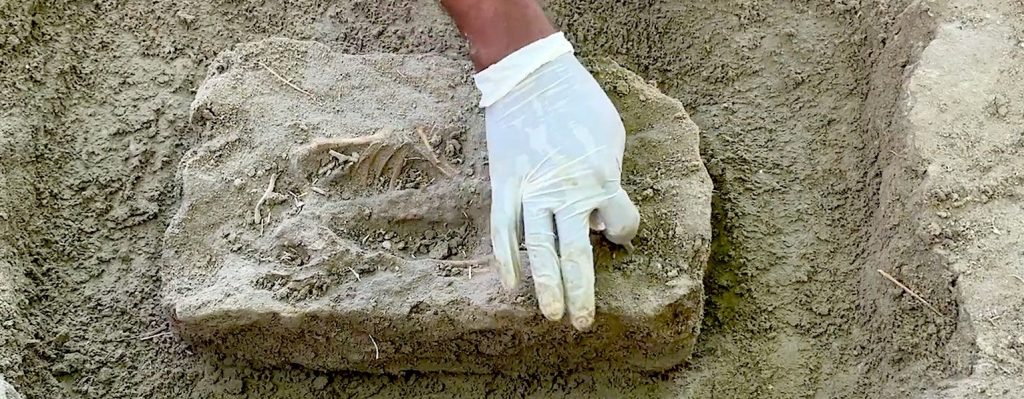
Photo courtesy of CNN
In my earlier article published on Groundviews, I examined the third interim archaeological report on the Chemmani mass grave and argued that scientific uncertainty must never become an excuse for abandoning the search for truth.
I emphasised that archaeological observations, however professionally prepared, cannot establish the cause of death, identify the victims or determine whether unlawful killings occurred. I also cautioned against accepting an epidemic or natural disaster as an explanation without supporting scientific evidence.
The developments reported on November 19 and 21 have brought those concerns into sharper focus. According to reporting by Jaffna Monitor, the Jaffna Magistrate’s Court determined that it was unnecessary to rely on Professor Raj Somadeva’s disputed interim archaeological report when deciding how the excavation should proceed. The court reportedly questioned the absence of a reasonable explanation for differences between the latest report and earlier assessments.
Justice Minister Harshana Nanayakkara told parliament that no stakeholder had formally requested an independent international investigation through the court. He nevertheless indicated that the government was prepared to seek international technical and forensic assistance where necessary.
These developments raise fundamental questions. Will the judicial process now move decisively towards establishing the identities and causes of death of those buried at Chemmani? Will the government provide the resources and international expertise necessary for a credible investigation? Will the families of the disappeared finally receive the answers they have sought for decades?
These questions concern not only the Tamil community but also the rule of law, the credibility of institutions and the willingness to confront unresolved allegations of serious human rights violations.
The court’s decision: an important judicial safeguard
The court’s reported decision is significant but its meaning must not be exaggerated. The magistrate did not conclusively reject the archaeological report nor did the court establish that the remains belonged to victims of extrajudicial killings. Rather, the court determined that it was unnecessary to rely on the disputed report when deciding the next stage of the investigation.
This distinction matters. Professor Somadeva’s report described burial patterns that could resemble formal burial practices and raised an epidemic or natural disaster as a possible explanation for the concentration of remains.
However a hypothesis is not a scientific conclusion. Without reliable dating, medical examination, historical corroboration and forensic analysis, neither an epidemic nor a natural disaster can be accepted as the explanation for hundreds of human remains. Equally, the discovery of a mass grave does not automatically establish the identity of perpetrators or the circumstances of every death. The judicial process must examine all credible possibilities through independently verifiable evidence.
The court’s approach therefore offers an opportunity to strengthen confidence in the investigation, provided that its directions are followed by meaningful scientific work.
International assistance is not the same as an independent international investigation
The Justice Minister stated that no stakeholder had formally requested an independent international investigation before the court. He also indicated that the government was willing to obtain international assistance for DNA testing, identification and other forensic examinations depending on judicial requirements.
There is an important distinction between these two positions. International technical assistance may involve foreign forensic laboratories, DNA specialists, forensic anthropologists and other scientific experts supporting a domestic judicial investigation. An independent international investigation raises wider questions about investigative authority, institutional independence, access to evidence, witness protection and accountability. One cannot automatically substitute for the other.
For months, families of the disappeared, civil society organisations and Tamil political representatives have publicly demanded international involvement. Their demands have been expressed through demonstrations, media statements and parliamentary interventions. Lawyers representing families have also reportedly sought external forensic assistance through the judicial process. Whether a specific application for an independent international investigation has formally been submitted to the court is a procedural question that should be clarified through the court record.
However, the absence of such an application, if established, does not remove the government’s responsibility to ensure an effective, impartial and credible investigation. If existing procedures require formal applications for particular forms of international involvement, the government should explain those procedures clearly. It should also clarify whether it is prepared to facilitate independent international forensic participation under judicial supervision. The central question should not be who first requested international involvement but whether the investigation has the independence, expertise and resources necessary to establish the truth.
Hundreds of remains demand answers
The scale of the Chemmani discovery should prevent the investigation from becoming an ordinary disagreement between experts. The archaeological report records a minimum of 574 individuals, while subsequent excavation updates have referred to 583 sets of remains. Preliminary assessments suggest that a substantial proportion were infants and children. These figures require specialist verification, including clear explanations of the methods used to estimate age.
They also demand a human response. Who were these children? Where were their families? How did they die? Why were so many individuals buried in this location? No responsible government should be satisfied until every reasonable effort has been made to answer these questions.
The history of Chemmani makes the investigation particularly sensitive. Allegations concerning disappearances and secret burials emerged during the 1998 proceedings relating to the rape and murder of Krishanthi Kumaraswamy and the killings of her mother, brother and a neighbour. Those allegations form an important part of Chemmani’s history. They cannot, however, establish that every set of remains discovered during the present excavation belongs to a victim of the same alleged crimes.
Neither can that history be ignored. The Human Rights Commission of Sri Lanka, in its September 2025 findings, identified grounds for concern about possible unlawful burials connected to extrajudicial killings and called for stronger forensic capacity and international expertise. That assessment provides an important basis for further investigation, not a substitute for establishing the facts surrounding individual deaths.
Scientific investigation must take priority
The latest judicial proceedings provide an opportunity to move beyond the controversy surrounding the archaeological report. The immediate priority must be a comprehensive medico-legal investigation supported by qualified forensic specialists. DNA comparison with voluntarily provided samples from relatives could assist in identifying remains. However, DNA identification alone cannot ordinarily establish how or when a person died.
Radiocarbon dating may help estimate the age of remains, subject to the suitability of samples and the limitations of the method. Forensic anthropology and pathology may reveal evidence of skeletal trauma or disease although some causes of death leave no identifiable traces in bone. Historical records, witness testimony, disappearance documentation and relevant official records must therefore be examined alongside the scientific findings.
No single test will necessarily resolve the entire investigation. What is required is an integrated forensic strategy, developed by qualified specialists, subject to judicial oversight and open to independent scientific scrutiny. Investigators must also remain open to the possibility that individuals buried at the site died at different times or under different circumstances. Scientific integrity requires the evidence to determine the conclusions, not the conclusions to determine how the evidence is interpreted.
The Justice Minister’s assurance must become measurable action
The Justice Minister’s declaration that the government wants truth and justice is welcome. His distinction between archaeological and medico-legal evidence is also important. An archaeological report cannot independently determine the cause and manner of death.
However, public assurances alone cannot restore confidence. The government should now demonstrate its commitment through practical measures.
First, adequate resources must be made available to the judicial medical team, including access to accredited international laboratories where domestic facilities are insufficient. Second, a transparent framework should be established for international forensic participation, including independent verification of scientific procedures and findings. Third, evidence must be securely preserved, documented and protected against contamination, loss or interference. Fourth, effective safeguards must be available for witnesses and families who provide information or voluntarily submit DNA samples. Finally, families should receive regular, accurate information in Tamil and other relevant languages without compromising the integrity of judicial proceedings. These measures would strengthen both the investigation and public confidence in Sri Lanka’s judicial institutions.
Demanding justice is not political exploitation
The Justice Minister has urged parliamentarians not to use Chemmani to inflame ethnic tensions. That concern deserves consideration. An investigation into possible mass killings should not become a platform for collective accusations against an entire ethnic or religious community.
However, there is an equally important distinction between exploiting a tragedy for political advantage and demanding accountability for alleged human rights violations. Families asking what happened to their missing relatives are not creating ethnic division. Lawyers challenging an archaeological interpretation are exercising their professional responsibilities. Parliamentarians questioning the independence and adequacy of an investigation are performing a legitimate democratic function. Their concerns should be examined on their merits rather than dismissed as political.
At the same time, those seeking justice must avoid presenting contested allegations as established facts before the evidence has been properly examined. Accountability requires fairness, due process and a willingness to accept credible scientific findings even when those findings challenge strongly held assumptions. Justice must neither be obstructed in the name of national unity nor prejudged in the name of accountability. The government’s responsibility is to create the conditions in which the truth can be established without fear, favour or political interference.
Why international credibility matters
Sri Lanka has experienced decades of conflict, disappearances, allegations of unlawful killings and incomplete accountability processes. For many families in the North and East, distrust of domestic institutions did not emerge from a single archaeological report; it developed through years of unanswered questions and repeated disappointments. This historical experience helps explain why international involvement has become such a central demand. The government may prefer to retain the investigation within the domestic judicial framework. That is a position it can explain and defend.
But the legitimacy of an investigation cannot rest solely on the government’s confidence in its own institutions. It must also be earned through demonstrable independence, scientific competence, procedural fairness and meaningful participation by affected families. International expertise does not automatically guarantee justice. Nor does domestic judicial supervision automatically prevent it. A constructive approach would combine the legal authority of the Jaffna court with credible international forensic participation and independent scientific scrutiny. Such cooperation could strengthen rather than undermine judicial institutions. It could also demonstrate that the government is prepared to investigate difficult allegations without attempting to control the outcome.
The next phase must deliver more than another report
The immediate challenge is to ensure that the judicial process produces a coordinated scientific investigation rather than another prolonged dispute over competing interpretations. The next phase should establish which examinations are required, which laboratories are qualified to undertake them, how evidence will be preserved and transferred and how families will be informed.
There must also be clarity about the relationship between archaeological findings, medical examinations, genetic identification and the wider criminal investigation. Where reliable evidence supports an explanation, it should be accepted. Where evidence is insufficient, further investigation should follow. Where credible evidence indicates criminal conduct, the responsible authorities must pursue accountability through lawful procedures. The investigation must not be forced into a predetermined narrative, whether that narrative concerns natural deaths, an epidemic, a disaster or unlawful killings.
Every credible explanation must be tested against the available evidence. The objective should not be to vindicate one report, political position or institution. It should be to establish what happened.
Chemmani must not become another unfinished investigation
Inconclusive findings must not become the final answer for the people of the North. The latest court proceedings and parliamentary statements reinforce that position. The Jaffna court has demonstrated the importance of critically examining expert evidence. The Justice Minister has acknowledged the limits of archaeological findings and expressed willingness to obtain international forensic assistance. Both developments offer an opportunity for progress but neither constitutes justice.
Justice will require identifying the dead wherever possible, determining the circumstances of their deaths, examining allegations of unlawful killing and pursuing accountability where the evidence justifies it. It will require the government to move beyond statements of goodwill and provide the resources, expertise and institutional independence necessary to complete the investigation. Above all, it will require respect for the families who have spent years searching for their loved ones.
The Chemmani investigation is not a contest between Tamil and Sinhala communities, nor should it become a contest between the government and the opposition. It is a test of whether Sri Lanka can investigate its own painful history with courage, impartiality and respect for human dignity.
The question is no longer simply whether international assistance has been formally requested. The question is whether the government will do everything reasonably necessary to ensure that the truth can be established and justice delivered. The families deserve answers supported by evidence, not competing political narratives. Sri Lanka deserves institutions capable of delivering those answers. Truth cannot be negotiated. Scientific evidence cannot be replaced by political reassurance. Justice must not be postponed indefinitely.