
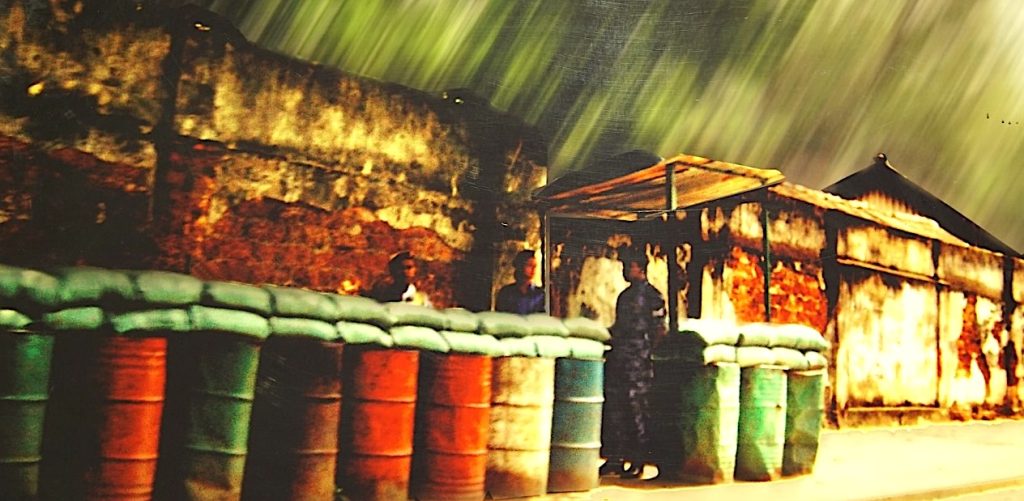
Photo courtesy Anoma Wijewardene
What does it mean to repair a world we have repeatedly helped to break? In Sri Lanka, the language of reconciliation has outlived several governments while families of the disappeared continue to ask what happened to those they lost. Beyond the island, wars enter our homes through screens while climate change is discussed in targets and pledges even as its consequences fall hardest on those with the fewest means of escape. We do not lack the language of repair. We lack the willingness to accept its demands.
Anoma Wijewardene’s Quest and Deliverance, brought together under In Search of Horizon, approach this failure from different directions. The first confronts humanity’s capacity for violence; the second considers the damage it is doing to the natural systems that sustain life. These are not interchangeable histories. War is not a tsunami and ecological destruction is not ethnic persecution. Yet both ask what remains after devastation, who must live with its consequences and what future is possible when the past has not been adequately faced.
Neither project is simply a collection of paintings. Both developed as ambitious, interdisciplinary productions, bringing together writers, researchers, filmmakers, video editors, actors, composers and specialists from different fields. Quest took four years to develop while Deliverance required two. Their eventual forms emerged through sustained collaboration with literary, visual and scientific contributions extending the questions raised by the artworks beyond the canvas. The quotations and texts accompanying the images are particularly significant. They introduce possibilities of peace, hope, reconciliation and ecological responsibility into compositions that might otherwise be understood only through their depictions of destruction.
Quest emerged from a particular and unsettled moment in Sri Lanka. In 2002, during the ceasefire, Anoma travelled to the North, a journey that helped set the project in motion. The ceasefire had opened a possibility but possibility should not be confused with peace. The guns had fallen quiet, temporarily, while the political questions beneath the conflict remained unresolved. By 2004, the demands of the project had become so difficult that Anoma considered abandoning it. She credits Paikiasothy Saravanamuttu and Stefan Marhdt of Deutsche Bank with encouraging her to continue. Their involvement, alongside that of the wider team of collaborators, helped transform the initial inquiry into a much larger undertaking.
Quest was not conceived from the distance of a settled history. It developed while the country was still negotiating its divisions. Anoma encountered landscapes where violence remained visible in damaged buildings, military presence, warning signs and the memories attached to ordinary places. Although her journey to the North provided the initial impetus, the work was never confined to it. Its visual sequences also draw on images from Colombo and the South, including bomb damaged buildings, checkpoints and the physical traces of violence in places far removed from the Northern battlefield. The project moves across these geographies, suggesting that conflict leaves its mark on a country in ways that cannot be contained within a single region.
Anoma describes the camera, initially, as an instrument of listening. She was not approaching the North as a photojournalist attempting to assemble a definitive record nor did she want to reproduce the photographs as straightforward documentary evidence. She returned with images that stayed with her, entering her dreams and nightmares. She considered painting them but resisted simply repeating what the camera had already captured. Through digital manipulation, the photographs became something less easily classified: neither documentary images nor paintings, but constructed encounters with the instability of memory and perception.
“We are brutalized by so much imagery,” Anoma observes. Images of war now move across screens with a speed that can make atrocity seem continuous and, paradoxically, ordinary. The destruction of homes and the displacement of families arrive beside advertisements and celebrity updates. Exposure is mistaken for understanding, witnessing for action. Viewers may feel overwhelmed while the machinery producing the suffering remains intact.
Anoma hopes that an artwork can reach the heart in a way that a straightforward photograph might reach the intellect. Yet artistic transformation does not automatically make suffering more meaningful. Beauty can deepen attention but it can also make pain easier to consume. Quest is strongest when it refuses that comfort. Its images ask us to look without pretending that looking is enough.
Juxtaposition is central to this unsettled visual language. In one work, a car bears a sticker reading “Son of a gun” while two armed soldiers stand nearby. The phrase was already there. Anoma encountered it in a taxi she had hired to travel around the area, initially disliked it, and later recognised the unsettling correspondence it established with the soldiers. An everyday expression is placed beside the instruments of violence, and its casual familiarity begins to look less innocent. The work suggests how conflict enters ordinary life not only through explosions and military operations, but through language, habits, signs and the gradual normalisation of what should remain disturbing.
Other works bring together militarised landscapes, damaged buildings and roads and memories of people burned with tyres. In some of the compositions, white paper doves appear against these landscapes. Their presence is not a digital intervention. Anoma physically took paper cutouts of doves to the North, giving them to children to play with in a church and placing them in other locations, including cemeteries. In photographs of children playing among the remains of a bombed building, the doves are part of the encounter itself. Their small, fragile forms introduce an unexpected gesture of play and possibility into places marked by destruction. A dove invokes peace without resolving the scene.
In another composition, a ruined church sits beside a mine warning sign. Faith and danger occupy the same landscape. The war may have formally ended but a declaration from the capital cannot remove a mine from a field or return a displaced family to its home.
The burning of the Jaffna Public Library on May 31, 1981, almost eight years before the outbreak of the civil war, introduces another dimension to the work. The library held irreplaceable books, manuscripts and records central to Tamil cultural life. Its destruction was an assault on the means through which a community encounters its past and imagines its future. In one of Anoma’s compositions, the newly restored library appears in the distance while the ruins in the foreground evoke the memory of its burning. The juxtaposition holds reconstruction and historical memory within the same frame. A building can be restored but the violence inflicted upon what it once contained cannot simply be undone.
The civil war ended in May 2009 but questions of accountability, enforced disappearance, displacement, militarisation and the fate of those who never returned remain unresolved. A war can end without justice. A country can rebuild roads and attract investment while families remain suspended between hope and the possibility of a death never acknowledged.
The question is not whether Sri Lanka has spoken about reconciliation. It has. Governments have established commissions, announced programmes and promised remedies. What have those promises delivered to people who have spent years asking for truth? How many times can a family be asked to trust a process that cannot tell them where a son, husband or father is? What does reconciliation mean when patience is demanded from those who have already borne the loss?
Paikiasothy Saravanamuttu’s reflection on Quest offers a line that holds this difficulty: “We must forgive but we cannot forget.” Forgiveness cannot be issued as a national instruction to people whose grief has not been recognised. It cannot replace investigation, accountability or reparations. For those denied answers, remembering may be the only resistance to a second disappearance: the removal of a person from the public record.
Kirby de Lanerolle, who worked with Anoma on the project, describes Quest as “An act of conscience as much as an exhibition”. Images of suffering sit alongside words about peace drawn from different traditions. Their friction is more useful than any neat resolution. The words do not erase the images; they offer a counterpoint to them, suggesting that the capacity for violence is not the only defining feature of human beings. But a quotation cannot investigate a disappearance, a gallery cannot replace a court and art cannot do the work of a state. It can, however, make the state’s failures harder to ignore.
The 2004 tsunami introduced another register of devastation. Five days after the disaster, Anoma travelled along the southern coastline through Galle and Unawatuna and beyond encountering a landscape that appeared to her as though it had been bombed from the sea. The comparison registered the scale of destruction, not an equivalence between natural disaster and organised violence. A wave does not select victims by ethnicity or allegiance. Yet disaster is never experienced in a social vacuum: housing, income, geography and access to public services determine who is exposed and who can recover.
The image Pam Schmoll, the American anthropologist who worked on Quest, remembers is that of a Buddha and a palm tree standing against a blue sky having survived a landscape reduced to rubble. It is tempting to call this resilience. But survival is not recovery. What remains cannot restore what has been lost. Hope matters only when it acknowledges the scale of that loss.
In Generations, an older and a younger woman look towards an uncertain distance as the landscape dissolves around them. Their gaze offers no guarantee that the future will be better. The younger woman inherits not a clean slate but the consequences of decisions made before she was born and the silences gathered around them.
If Quest asks what people do to one another, Deliverance widens the frame to ask what humanity is doing to the conditions that make life possible. Anoma’s engagement with climate change predates its arrival as a dominant public vocabulary. Her first solo exhibition addressing the subject was held in Sydney in 2005. Her ecological inquiry developed alongside a sustained interest in diversity, unity and the fractured human condition. Deliverance, developed in 2012, extends these concerns beyond the battlefield and the boundaries of the nation.
Here, the earth becomes the protagonist. Human figures are often miniature, establishing a different measure of significance. Against mountains, oceans and geological time, a human lifespan is brief. In The Earth Is Our Raft, the planet becomes a vessel carrying its passengers. Vandana Shiva’s words offer a counterpoint: “You are not Atlas carrying the world on your shoulder. It is good to remember that the planet is carrying you.”
The metaphor is deceptively simple. A raft is not an empire. It cannot be treated as an inexhaustible possession because its vulnerability is shared by everyone aboard it. The passenger who damages the vessel does not escape the consequences by declaring ownership. Pollution, species loss, climate disruption and resource depletion are not external problems. They are damage to the conditions of our own existence. The image turns the idea of human mastery inside out: we are not carrying the earth; we are being carried by it.
Who, in practice, is allowed to behave as though the raft belongs to them? Environmental language often speaks of humanity as one actor as if everyone contributed equally to ecological damage and had equal power to prevent it. They have not. Communities dependent on land, forests, fisheries and coastlines often have the least influence over decisions that degrade them. Those who benefit from extraction are not necessarily those who live beside its waste. Climate change is planetary in scale; exposure and the capacity to adapt are profoundly unequal.
To speak of climate change only as a technical problem is therefore to miss its politics. Who is consulted before land is transformed? Who is compensated when livelihoods disappear? Who has access to safe housing, reliable water and functioning public services when disaster arrives? Who is expected to become resilient, and what does that word mean when the resources required for resilience have been withheld? The language of adaptation can become another way of transferring responsibility from institutions and powerful interests to the people least equipped to carry it.
In Coexistence, floating becomes a way of thinking about dependence. To float is to relinquish the fantasy of complete self-sufficiency. The body must trust the medium that holds it. Yet the gesture is ambiguous: it can suggest release and freedom, but also drift, rootlessness and the absence of secure ground. Water throughout Deliverance carries this uncertainty. It sustains and erodes, gives life and overwhelms, connects places and separates them. It refuses the human desire for permanence.
To paint water is also to paint impermanence. But impermanence should not be confused with helplessness. Human beings cannot command every natural process but they can decide how they build, extract, consume and distribute risk. The distinction between accepting nature’s rhythms and surrendering to preventable destruction is crucial. Anoma’s reference to her father, Ray Wijewardene, and his idea of a fresh paradigm in which human life exists in concurrence with nature rather than in opposition to it, points towards a different understanding of restoration. Repair is not the attempt to freeze nature in an imagined original state. It is the work of allowing damaged relationships to become viable again.
The collaborative foundations of Deliverance are as important as those of Quest. The project brought together literary and environmental perspectives, with the poetry of Ramya Chamalie Jirasinghe accompanying the visual work and scientists, environmental specialists and development practitioners contributing to its wider inquiry. This exchange between artistic and scientific ways of seeing prevents the project from becoming an abstract meditation on a distant ecological crisis. The images, texts and accompanying voices insist that the natural world is not a backdrop to human life, but the condition that makes it possible.
The distinction returns us to post-war Sri Lanka. Reconstruction is visible and measurable in roads, buildings and ceremonies. Repair is harder. It requires confronting the arrangements that made destruction possible, listening to marginalised accounts and changing institutions that failed people. A rebuilt structure may look complete while the history of its destruction remains contested.
Natasha Ginwala brings Quest and Deliverance together around permanence and impermanence, brutality and renewal. In her reading, Anoma’s artistic oeuvre is “A lyrical study of principles of permanence and impermanence, attesting to expressions of brutality and renewal as well as arcs of historical time and circadian rhythms.” Her interpretation draws attention to the way the artist moves beyond the canvas, experimenting with installation, digital techniques and video-based projects while engaging literary and theatrical communities.
Ginwala also recognises the historical and ecological dimensions of the work. Anoma’s compositions, she writes, “Closely observe states of human anguish and incalculable loss in the historical experiences of this island nation” while equally rekindling hope in the ways living ecologies embrace “mystery, ambiguity and repair”. The two projects do not collapse into a single moral lesson. War and ecological destruction have different causes and agents, but both expose systems that treat certain lives, communities or ecosystems as expendable.
“Her layered compositions urge viewers to reckon with all that humankind owes to future generations and multispecies cohabitants of the biosphere. Always in praise of a fragile yet hospitable earth,” she says.
This is where the collection’s title becomes more than a poetic gesture. A horizon is always visible and always receding. It offers direction without guaranteeing arrival. To search for one is to accept that the future cannot be possessed in advance. But there is a danger in allowing the horizon to become an excuse for endless deferral: justice will come eventually; the environment will be protected in time; the next generation will find a solution. The future can become a place to which every difficult obligation is postponed.
Anoma has described herself as an adventurer, exploring without knowing precisely where she is going. That openness remains in the work. It offers no blueprint for political reform or ecological recovery; instead, it unsettles the assumptions through which destruction becomes acceptable. The accompanying words and quotations are not incidental additions to the images. They are part of the work’s moral architecture, insisting that the possibility of peace, coexistence and renewal must remain visible even when the evidence before us suggests otherwise.
The questions cannot remain inside the gallery. What would repair mean without asking survivors to make peace with silence? What would environmental responsibility look like if it began with those most exposed to extraction and climate disruption? Can a country call itself reconciled while the fate of the disappeared remains unresolved?
Sometimes, you simply have to look closely enough.
Anoma Wijewardene’s engagement with climate change did not begin when it became fashionable to speak about it or when it entered the vocabulary of mainstream public discourse. Her first solo exhibition exploring climate change was held in Sydney in 2005. Deliverance followed in 2012, more than a decade before the urgency of many of the questions it raises would become so difficult to ignore.
There is something extraordinary about encountering work conceived so far ahead of its time and recognising, with the benefit of hindsight, just how much of the world it was already beginning to question. But the privilege was not simply in seeing the works. It was in being allowed a glimpse into Anoma’s way of seeing: the connections she was making, the questions she was pursuing and the futures she was attempting to imagine long before they became the conversations we are having today.
Perhaps this is what makes returning to Quest and Deliverance so compelling. It is not simply that the works remain relevant. It is that the present has gradually caught up with questions they were asking decades ago. And that leaves us with a rather uncomfortable question: if these possibilities were already visible in art, why did it take the rest of us so long to recognise them?
As part of the Sri Lanka Design Festival, In Search of Horizon will be open to the public on November 29 at M2M Verandah, 34, W.A.D. Ramanayake Mawatha, Colombo 2. It is potentially the only occasion in which the collection will be open to the public.
Seeking Horizon: A Conversation on Art, Society and Our Collective Future will be held on Sunday, November 29, 11.30 am-1.00 pm at Cinnamon Life.
