
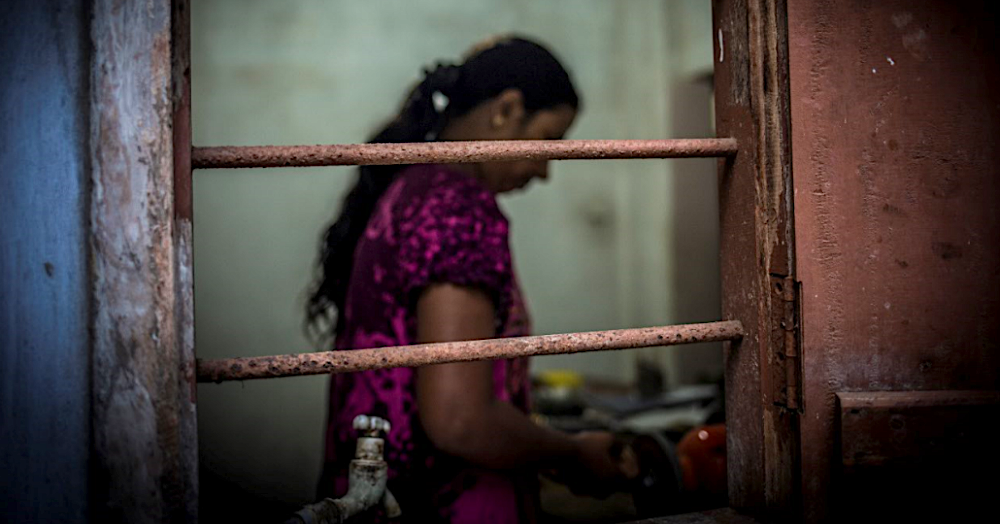
Photo courtesy of We Effect
Today is the start of 16 Days of Activism against Gender-Based Violence
When we talk about violence in the home, we usually picture bruises. Sri Lanka’s own national survey suggests we should also picture a bank book, a salary slip and a woman asking her husband for bus fare.
As the 16 Days of Activism against Gender-Based Violence, this quieter form of abuse deserves a place in the conversation. It leaves no marks, it rarely makes the news and the women living with it often do not have a word for it.
The Women’s Wellbeing Survey 2019 carried out by the Department of Census and Statistics with UNFPA, asked women about five kinds of abuse by a partner. Economic abuse was one of them.
Nearly one in five ever-partnered women, 18.1%, said a partner had abused them economically at some point and 7.7% said it had happened in the past year. That is almost the same share as physical violence (18.9%) and controlling behaviour (19.1%). Current economic abuse was highest among women on the estates (11.5%) and among young women aged 15 to 24 (14.1%), nearly twice the national rate.
The survey counted three acts: a partner taking her earnings against her will, refusing to give her money for household expenses even when he had money for things like alcohol and cigarettes and stopping her from getting a job or earning money. In the past year, being stopped from working was the most common.
Some of the past year figures look small at first glance: 2.9% of women said a partner had refused them money for household expenses and around 1% that he had taken their earnings. But in a country of millions of households, every percentage point stands for a very large number of women and each of them is living it every day, not once.
Economic abuse hides inside ordinary family arrangements. Many couples agree that one person handles the money. Many women are proud to give their wages to the household. None of that is abuse in itself.
The difference is choice and fear. Abuse is when she cannot say no. It is when she must account for every rupee while he spends freely, when her ATM card stays in his wallet, when a job offer is refused for her because people will talk or when money is used as a reward and a punishment.
Because there are no marks, the woman herself often doubts it counts. The survey asked women who had been abused by a partner but did not seek help, why they stayed silent. Among women who had been sexually abused by a partner, the most common reason was not knowing what their options were (37.2%), followed by shame or fear of not being believed (23.9%) and thinking the violence was normal or not serious enough (18.5%). If that is true for sexual violence, imagine how much harder
it is to report a husband who “only” holds the purse.
None of these on its own proves abuse but together they form a pattern worth taking seriously:
She hands over her whole salary and has to ask for it back, item by item; she has no bank account of her own or cannot use the one in her name; she is questioned, mocked or punished over small purchases while his spending is never discussed; her jewellery or savings are sold or pledged without her agreement; loans are taken in her name without her consent; and she is told she may not work, study or keep a job or is made to leave one.
Economic abuse is a slow narrowing of a person’s world. First it narrows her choices: where she can go, what she can buy for her children, whether she can visit her mother. Then it narrows her sense of herself. A woman who has to ask permission for small thingsfor years starts to believe she can’t manage on her own. That belief is exactly what keeps her in place.
Asking itself becomes a source of dread. Each request for money carries the risk of a refusal, an argument or a lecture so she starts to go without, to hide what she needs and to apologise for ordinary expenses. Over time, that constant calculation is exhausting in a way that is hard to explain to anyone outside the house.
It also keeps her trapped in a very practical way. The World Health Organization notes that partner violence can leave women isolated, unable to work and losing wages. A woman with no income, no savings in her name and no work history has far fewer doors to walk through even if every other part of her wants to leave. When people ask “why doesn’t she just leave?”, this is often a large part of the answer.
WHO also links partner violence to depression, anxiety and sleep difficulties. If a woman living under this kind of control feelsconstantly on edge, low or ashamed without quite knowing why, those
are understandable reactions to losing control over her own life, not signs of weakness.
Ask about money the way you would ask about health. “Do you have money of your own if you need it?” is a gentle, practical question that opens a door. Don’t treat control as a private arrangement. If a daughter or sister tells you she isn’t allowed to work or that her salary goes straight to him, take it as seriously as you would a report of shouting or hitting.
Help quietly and safely. A small amount kept for her in a trusted person’s care, copies of her NIC, birth and marriage certificates keptsomewhere safe and knowledge of her own bank account can make a real difference later.
Employers can pay wages into an account in the woman’s own name and let staff know, without judgement, that they can ask for help. Bank staff can notice when a woman’s card is always used by someone else or when she seems frightened at the counter and speak to her privately.
Campaigns against gender-based violence rightly focus on physical and sexual harm. They could do more good by also naming economic abuse plainly so that a woman who recognises herself in the list above knows she is allowed to call it abuse. Counsellors, health workers and community leaders who already ask “Are you safe at home?” could add one more question: “Do you have money of your own and can you use it?” Helplines and awareness posters could say clearly that controlling a woman’s earnings counts.
One in five women is not a small minority. If we only count bruises, we will keep missing a form of abuse that the country’s own statistics put on the same level as physical violence. It is time to say plainly that controlling a woman’s money is controlling the woman and that it is not a private matter.
If you or someone you know is facing any kind of abuse at home, including economic control, the Ministry of Women and Child Affairs runs the 1938 Women Helpline (childwomenmin.gov.lk:
https://www.childwomenmin.gov.lk/). If someone is in immediate danger, call the police.
Dr. Malik Sherjeel Awan is a clinical psychologist based in Makkah and the author of books on psychology and relationships.