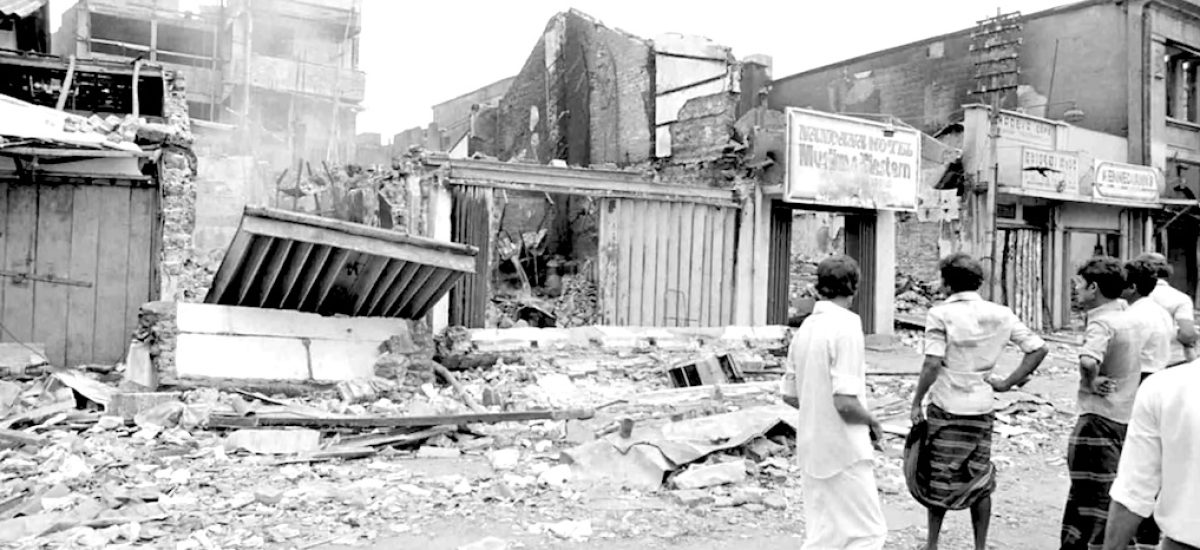

Photo courtesy of Sri Lanka Campaign
When Teardrop Nation premiered, viewers were confronted with a multi-part visual narrative of Sri Lanka’s post-independence history. Moving far beyond traditional textbook timelines, weaving together decades of unseen archival footage, field testimonies and historical context.
Having worked in post-war reconciliation for over a decade, director Sarah Kabir set out to explore a difficult but important question: why does Sri Lanka continue to repeat the mistakes of its past and why do so many people know so little about the events that led the country to conflict?
Groundviews spoke to the core team behind the series, Director Sarah Kabir, Lead Archival Producer Ramla Wahab-Salman, Research Associate and Project Manager Nihara de Alwis and Head of Production Hashan Gunasekara about challenges of researching and piecing together decades of history, working with difficult archival material, translating sensitive accounts and political speeches and bringing different perspectives to a wider audience.
Sarah, what motivated you to pursue this project?
Having worked in reconciliation for over a decade, it became glaringly obvious that Sri Lanka was repeating the same historical mistakes. Following post-war events, including the anti-Muslim violence around 2018, it felt compelling to create a resource that helped people understand how we got here. And it just felt very compelling to me that it was time for us to understand what had happened so we don’t repeat the same mistakes again.
How did you make decisions about what to include and what to cut?
What I’d like people to know is that when I started this I wanted to cover foundational historical markers at a basic level like the Sinhala Only Act, Black July and the burning of the Jaffna Public Library and as we began digging deeper because of the sheer volume of material it blew up from a 90-minute documentary into a multi-part series. At the same time there were practical issues in terms of resources, funding and production. It was Roel Raymond who initially helped me with the research and we had “Conflict Politics” pinned at the top of our workspace wall and if a historical factor directly drove or defined the conflict, it went into that box. That meant making painful exclusions. One example is land policies. Although it played a critical role in post-independence tensions, incorporating land policy alongside language and education reforms would have made the narrative overly confusing for a general viewer. We chose to focus on key contributing factors to maintain clarity. Some academic viewers have critiqued us for leaving out specific topics, we left out certain things not because it is not important but because it would have made it overly complicated. It is an accessible entry point designed to start conversations that never happened post-war. But I do wish that these gaps will be filled by others who are committed to the cause in the future.
How has this experience changed your understanding of history?
There were a lot of things that I simply didn’t know when I started. It was also about understanding the different fault lines, who was involved and the various issues that had unfolded in the country. It really changed how I understood the conflict, including how we often frame it as the LTTE versus the state. Even that narrative was challenged because the conflict really cannot be reduced to two parties fighting each other. I think anyone who watches it might already know 90% of what is covered but there’s always something new that someone takes away from it. That’s because you’re also hearing different people’s perspectives.
How has the feedback been so far?
History isn’t black and white and bringing together these different viewpoints can offer a very different understanding of what happened. Some people who lived through a particular period have told me that it was really valuable to see, alongside their own experiences, what others were going through at the same time, things they hadn’t known despite having lived through those years. Some have told me that I haven’t covered certain topics or that I haven’t explored them in enough depth. And I understand that, particularly from people who know these subjects very well. But I keep telling them that this is really an introduction for a wider audience, for people who don’t necessarily engage with the academic material, because it can be quite heavy. This was a way of getting people to engage with these subjects and starting conversations that, in many ways, never really began post-war.
What made you approach the editing of the series this way because there’s a real sense of urgency and seriousness in how the story unfolds?
It’s the research itself. The way Sri Lanka’s history unfolds is quite something. I remember someone writing a post saying that the series almost plays out like a thriller and I think that’s simply a reflection of how dark our history has been. It wasn’t necessarily something we set out to do intentionally; in a way, the story speaks for itself. But we did make a conscious effort to keep it engaging, through the graphics and the way we presented the material.
Ramla, as lead archival producer, what is the process of tracking down visual evidence?
When I joined this project, Sarah and Roel had mapped out the initial research framework. Our early conversations were about how to unproblematically convey two minutes of historical context. But many years later, here we are with hours of history presentation. The process of research was multifold. So, we verified against numerous academic sources ensuring that a variety of contexts and historiographical debates were brought into question and of course, all our interviewees provided historical perspective. So that is one way about it. I led a trilingual archival research team and we spent years navigating 47 archives across the world. Domestically, we spent countless hours at the Sri Lanka National Archives, the Government Film Unit, presidential libraries and various local media repositories. Internationally, liaising with global repositories was a time-consuming, highly administrative process.
What was the most challenging part of the archival process?
Finding the footage itself wasn’t necessarily the most challenging part. What we found was that a lot of footage existed but there wasn’t always enough context accompanying it. So going back, verifying and cross-checking the material and ensuring we had the correct footage for the right incident and dates took a considerable amount of time. Acquiring permissions and getting clearance to use the footage was another challenge. It’s a time consuming process that involves a lot of communication with different people and institutions. But one thing that surprised me, particularly coming from a background in archival research, was how willing many of the archive custodians were to share their material. I wonder if that’s because there’s a sense of urgency to get these stories out there or perhaps an awareness that physical archival material may not last forever, especially in a humid country like Sri Lanka. It could be a combination of factors, along with a general desire to contribute to making the country’s post-independence history more accessible. We’re very grateful to all the custodians who supported us and helped make this possible.
Were there any specific discoveries that stood out during the archival search?
As the cliché goes, a picture speaks a thousand words. And when you’re working with thousands of images, it really transforms the way you understand history. There were certain events that we never expected to find footage of, particularly those that haven’t been very well documented. For instance, the 1968 Mavidapuram Temple incident. There’s an entire collection of photographs at the National Archives documenting the incident almost frame by frame, which is incredible. Even in places where we thought there might not be much archival material, we found so much. It really goes to show that, throughout the decades, even during periods of hardship, censorship and repression of speech, people were doing the brave and often difficult work of documenting these stories. Our role was, in many ways, to bring that material together and make sure it was properly contextualised. I’d also like to acknowledge everyone who supported us throughout the research process. Their contributions were invaluable in bringing this project together.”
Nihara, how did you go about finding and working through all that material?
It was a lot to digest. It was also quite disturbing at times. There was a large part of Sri Lanka’s history that I hadn’t really been exposed to before. I had only seen a little of the war, particularly its final stages, and even that was largely through the media. So getting into it in much greater detail was quite an experience. Some of the archival material was also very difficult to work through. There were a lot of images, videos and other material that were genuinely hard to look at. At times, you really needed to step away from it all and take a break.
What were the specific challenges of translating sensitive historical testimony into English?
That was one of the things I had to be very conscious of, particularly when translating from Sinhala to English. I had to keep in mind that I wasn’t simply translating text; we were handling deeply personal and emotional accounts and very sensitive personal accounts of events. These were personal experiences, so it was important to be mindful about capturing the speaker’s emotional state without flattening their voice or misrepresenting their meaning.
Could you give an example of a linguistic challenge you encountered during political speech translation?
Political rhetoric relies heavily on cultural resonance and wordplay. During one edit, I remember one particular instance from a speech by President Mahinda Rajapaksa where he refers to Paamankhada and Alimankhada, saying that people were now free to travel to both places. The challenge was how to retain the wordplay he was using in that sentence. We eventually decided to keep the original word and provide the English translation of Alimankhada, Elephant Pass, in brackets. That way, we could retain some of the original tone and meaning rather than lose it in translation.
Hashan, as Head of Production, how did you translate seven years of research into a compelling visual edit?
My role was managing the creative bridge between raw historical data and visual screen production. Sarah and I worked together on the pre-production process, looking at how we would bring the project together, both logistically and creatively. A big part of that was figuring out how to bring the story to life through a combination of archival footage, photographs and other visual material. I worked closely with my team on how we could approach this and translate the research into something that would work on screen. To keep the documentary engaging, especially for younger audiences who might not pick up a history book, we integrated motion graphics, paper-rip document transitions and dynamic pacing.
How did working on the project have an impact on your understanding of history?
Conducting and editing more than 30 field interviews completely reshaped my understanding of the last 30 years. Actually, when I first got involved in this project, most of what I knew about Sri Lanka’s history came from what we were taught in school. Beyond the post-independence period, a lot of what happened wasn’t very clear to me. We had heard stories growing up, through our parents, uncles and other family members, but apart from that we didn’t really know much. Getting involved in this project changed that. We went through more than 30 interviews, listened to people’s experiences and saw things first hand during our field visits. All of that had a real impact on me and changed my perspective on what has happened in this country over the last 30-odd years.
What was the human and emotional cost of editing such graphic historical material over a six year post-production cycle?
One of the more difficult aspects was going through the archival material, particularly the photographs, newspaper articles and other imagery from the past. Some of it was very disturbing and disheartening to look at. I even had editors come up to me and say that they needed to take a break because it was becoming too difficult to work through. The whole process was a long one. Six years is certainly not a short period and a lot of effort went into putting this together. Our intention was to present Sri Lanka’s history as fairly and objectively as possible. I’d really encourage everyone to watch it with an open mind. Look at what you might have missed, what you might learn from it and, hopefully, allow it to challenge or change the way you think about our history
Now that Teardrop Nation is released, what are the next logistical and creative steps for the project?
Sarah: Finishing the four episodes was a major milestone but entering the world of film distribution has presented an entirely new learning curve. We are now navigating how to take the film to wider international and local audiences. History is grey and people hold different versions of the truth. Our hope is that when viewers watch Teardrop Nation, they step away recognising that the narrative they held as absolute truth is not the only version. If we can encourage citizens to confront our past with an open mind, we can help ensure Sri Lanka never repeats the same mistakes again. I guess the last thing I’d say is, just give it a chance. If you’re Sri Lankan, you might know quite a bit about your history or you might not know much at all. Either way, I think it’s worth taking the time to watch and see whether it opens your mind to something new. My hope is that people come away from it questioning the version of history they’ve always held as the absolute truth and recognising that it’s not the only version. There are multiple sides to every story and I think that’s one of the most important things you can take away from trying to understand our history. And hopefully, we can learn from it and avoid making the same mistakes again because Sri Lanka cannot afford another conflict.
Nihara: To ensure the documentary reaches the widest possible local audience, we are currently in the middle of translating and localising the full documentary into Sinhala and Tamil. Our primary goal is to engage younger generations in conversations about post-independence history that were previously closed off.