
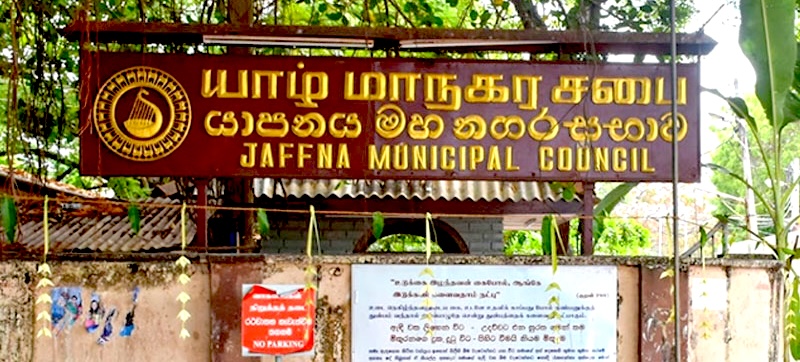
Photo courtesy of Ceylon Today
On the morning of May 17, 1998, two men called at a house near Kailasapillaiyar Kovil in Jaffna and shot dead the woman who lived there. She was 65 years old, a widow and the first woman ever to serve as Mayor of Jaffna. Her name was Sarojini Yogeswaran.
The army had taken Jaffna from the LTTE in 1995. In January 1998, Jaffna held local elections. Sarojini stood as a mayoral candidate for the moderate Tamil United Liberation Front (TULF) and won. The LTTE had murdered her husband, the TULF politician Vettivelu Yogeswaran, in 1989.
She held office for less than four months. The LTTE, which claimed to be the sole representative of the Tamil people, would not tolerate a civil administration in Jaffna and had ordered every councillor to resign. She knew the danger yet refused bodyguards and an army checkpoint near her home. She was killed for trying to give an exhausted people back the ordinary business of civic life.
Out of fear of reprisals by the LTTE, almost no one in Jaffna’s public life spoke for her when she died. Twenty eight years on, her story deserves to be better known.
An ordinary life interrupted
She was born Sarojini Ponnambalam in 1933 and spent her childhood in Malaya where her father worked. After the Second World War the family came home to Nallur. She earned a BA and taught at Vembadi Girls High School. By most measures she was an ordinary middle class Tamil woman. The journalist D.B.S. Jeyaraj noted that substantial inherited property spared her any financial difficulty even after her husband’s death.
Her path into politics ran through her husband who became TULF MP for Jaffna in 1977. The couple had no children. In July 1989 an LTTE delegation came for talks to a house on Bullers Road in Colombo that the Yogeswarans shared with Amirthalingam and other TULF leaders. On Yogeswaran’s instructions, the LTTE visitors were not searched upon arriving at the house. Sarojini served them refreshments. Moments later they shot dead her husband and the TULF leader, A. Amirthalingam, in front of her.
For a while afterwards she was demoralised and alone. Living in Colombo, far from the war, she could have withdrawn into a quiet life. Instead, she came to hate the gun and to believe that Tamils would find redemption only by renouncing violence, returning to democracy and pursuing a negotiated settlement followed by development.
Like the most responsible members of her party, Jeyaraj wrote, she carried a political cross. The TULF had radicalised Tamil politics and fired the young with the vision of Eelam and she had watched where that road led. University Teachers for Human Rights (Jaffna) UTHR(J), a Jaffna human rights organization, later counted her among the TULF members who, seeing that things had got out of control, tried to make amends and paid with their lives. From late 1989 to June 1990, as the LTTE detained TULF members in its camps, Sarojini was among the very few known to be sending word of these abductions abroad.
“That’s my problem”
When local elections were called for January 1998, Sarojini claimed the TULF nomination for the Jaffna municipality. When colleagues worried about her safety, her answer was blunt. “Don’t worry about that. That’s my problem.”
Election officials initially rejected the TULF’s nomination papers on a technicality. The party challenged the decision in court and won but only about two weeks before polling day, leaving Sarojini little time to campaign. She had almost no resources and many wellwishers were afraid to be seen with her. The Sunday Leader called her the invisible candidate because her face, name and symbol were nowhere among the rival parties’ posters on Jaffna’s bullet-riddled walls. By her own count she held only three meetings, the last at the central bus stand. The rest was door to door canvassing and small pocket meetings amid power cuts and broken transport and telephone links. Her campaign office was a room in the rundown Kumaran Tourist Inn with two beds for supporters to sit on, a small table and two chairs. She had no armed guards.
Before the vote, notices in the name of a Sangiliyan Force warned people not to take part. The group, named after Sangiliyan, the last king of Jaffna, had been invoked before for actions against civilians and local people and journalists understood it as an LTTE front. The LTTE journal Liberation Tigers printed a threatening verse that mocked Sarojini as a woman who had lived in luxury in Colpetty and now wanted a throne.
She saw the Jaffna poll as a possible springboard to national politics although Jaffna’s priorities would come first. Sarojini later said she had always meant to contest a national election, as her husband had, and stood for the municipal council only after other candidates withdrew.
One man stood with her openly – S. Namasivayam, a long standing TULF supporter known for his generosity to local causes, who became vice president of the party’s Jaffna branch. She won the first local elections Jaffna had held in 14 years. Turnout was remarkably high. She was sworn in as mayor in March 1998.
An unarmed democracy
Sarojini spoke of restoring an unarmed democracy to Jaffna and she meant it literally. The Sunday Leader’s correspondent wrote that refusing guards and a checkpoint was not bravado but a conviction that only a real farewell to arms could end the self-destruction. The Sunday Times defence correspondent Iqbal Athas reported a practical reason too; she feared they would draw attention to her home in Navalar Road.
Sarojini was under no illusions. Before a national television interview, she asked the journalist Bandula Jayasekera not to put certain questions to her because honest answers would endanger her. Then she said she was moving to Jaffna from Colombo. She knew time was short and that the LTTE would not spare her although she may have hoped they would wait long enough for her to set the council on a course of reconstruction. The knowledge that the chariot of death was drawing near made her impatient. Many around her did not grasp the danger. When a minor accident delayed her return from Colombo, several people complained.
UTHR(J) noted that Sarojini was outspoken about Jaffna’s needs. Her work with NGOs and foreign missions was paying off with money sanctioned and projects committed for Jaffna when she was killed. Days before her death, she told the state news agency Lankapuvath that Jaffna lacked drinking water, electricity and that there wasn’t enough food. No government had given Jaffna the funds it needed and Sarojini pointed out that war and development could not be carried on at the same time. Had President J.R. Jayewardene devolved power properly and funded the north and east, she argued, the situation would never have arisen.
Why she mattered
Once the army took Jaffna, people could speak more openly. What emerged, UTHR(J) wrote, was long accumulated anger against the LTTE among a substantial part of the population and a wish for a life free of terror and of children forced to carry arms. The 1998 elections gave that wish a public form. The results showed the Jaffna people’s desire for peaceful and honourable co-existence with the Sinhalese, according to journalist Ananth Palakidnar. The council under Sarojini was becoming a focus for the revival of democratic life. That made her dangerous to those who claimed to speak for all Tamils. The more Jaffna looked to her elected council, the more it challenged the LTTE’s claim to be its sole voice. UTHR(J) wrote that this alone would have made Sarojini a major figure in Tamil politics and that it took courage that had become extremely rare in Tamil society.
In mid-April 1998, around the time the council held its first sitting, letters in the name of the Sangiliyan Force ordered every councillor to resign.
May 17, 1998
Sunday, May 17 was moving day. Sarojini was leaving Navalar Road for a house on Stanley Road next to the TULF office and some furniture was already outside. At about 10.30 a.m. she was talking indoors when two young men walked in and asked to see the mayor. As she came out, one drew a gun from a bag and opened fire. The killers walked away. She was unarmed and unguarded. A crowd carried her to the hospital where she was pronounced dead on arrival. To the LTTE, the Sunday Leader’s correspondent wrote, any civil administration in Jaffna had to be nipped in the bud and the easiest thing was to gun down an unarmed old woman.
That day a handwritten Tamil note signed by K. Sureshkumar of the Sangiliyan Force reached Nadesapillai Vidyatharan, editor of the Uthayan, whose press stood next door to Sarojini’s house. It said Sarojini had ignored warnings to resign and had been dispatched to the world of Yama – the Hindu god of death and justice – and told the other councillors to take heed. Police hunted two suspected LTTE gunmen and questioned nearly 100 people within a day.
The silence
What followed was a haunting silence. Hardly anyone dared visit her house on the first day. The University of Jaffna and the religious bodies said nothing. Her own party would not name her killers. Asked on the BBC Tamil Service who had killed her, the TULF secretary replied, “I have no authority to say who did it” and other members suggested rival Tamil groups. Only by late June, as a new mayor took office, was the TULF reported to be blaming the LTTE directly.
Reports of public feeling are mixed. Only few people from the town went to her house and Jaffna was very quiet. Athas described spontaneous revulsion with white flags on buildings and black flags of mourning across the peninsula. Her body lay in the Municipal Council where employees and growing crowds paid their respects. Sarojini’s funeral was muted by terror, not indifference.
The one public protest in Jaffna came from Namasivayam. As secretary of the Jaffna Traders’ Association, he had the shops closed and he spoke of raising a statue to her. Soon after, an LTTE letter ordered him out of public life and demanded Rs. 3 million. In June 1998, cycling home for lunch, he was hacked to death with a sword.
Farewell in Colombo
On May 19 her body was flown to Ratmalana and taken to the TULF office where, draped in the party flag, it was received by General Secretary R. Sampanthan and MPs Joseph Pararajasingham and Dr. Neelan Tiruchelvam. V. Anandasangaree said she had entered politics not for self-interest or office but to serve the people.
Sampanthan said, “The death of Sarojini Yogeswaran is a great loss to the Tamil people and particularly to the TULF. Gun culture does not offer solutions to problems.” President Kumaratunga condemned the murder and Prime Minister Sirimavo Bandaranaike called it inhuman. Amnesty International called it a breach of international humanitarian standards and urged the LTTE to condemn it and the US State Department condemned the act of violence.
None of this lifted the fear. By late June at least five Jaffna councillors had resigned and Batticaloa’s local government members asked the president to restore the police protection.
Remembering her
Four months later her successor, Pon Sivapalan, was killed by an LTTE bomb beside Nallur Kandaswamy Kovil with the town commandant, senior police officers, municipal staff and civilians. The bomb is believed to have been hidden in the roof while Sarojini was still mayor.
It would be easy to file Sarojini among the many who died in those years but she was not simply a casualty. She had watched her husband die, she knew who she was facing but she went back to Jaffna anyway, unarmed and unguarded, to try to rebuild a city’s civic life. Her courage was of the quiet, deliberate kind that does not ask for an audience. It deserved one then. It deserves one now.
To remember her honestly is to say plainly who killed her and why and to recall what she stood for: that Tamils had a right to choose their own representatives, to live without the gun and to hope.