
Photo courtesy of Straits Times
Reports of significant public uprisings from Morocco, a country in North Africa, and Madagascar, an island nation on the African continent, have been consistent in recent days. As usual, youth collectives born between 1997 and 2012 (commonly called Gen Z) are the main recognized rioters responsible for the current situation in both countries.
Although the key triggers for the ongoing protests differ, several common factors can be highlighted: mobilization through social media, the dominant participation of young people rather than the elderly, widespread public discontent and grievances toward government corruption and inefficiency, the inability of ruling parties to fulfill basic needs such as food, education and infrastructure, soaring inflation with minimal fiscal support, long underfunded education systems, bleak prospects for graduates, neglect of poverty and inequitable wages. These shared struggles have fueled anti-government uprisings across both nations.
Gen Z 212 in Morocco
At the end of September, the death of eight women during childbirth in a hospital in the coastal city of Agadir in Morocco became the immediate cause of public outrage. Anonymous young people calling themselves Gen Z 212 (212 being their country code) and Morocco Youth Voice emerged from anonymity with the chant, “Stadiums are here but where are hospitals?”
This sentiment arose because King Mohammed VI and his government have poured billions into constructing stadiums for the African Cup of Nations 2025 and the FIFA World Cup 2030 while the country has only 7.7 doctors per 10,000 people and in regions like Agadir the number drops to 4.4 per 10,000, according to the World Health Organization’s annual report.
Initially, protests began in Casablanca, Marrakech and Rabat, but within a few days they spread nationwide. The messaging app Discord, which had been used by protesters in Nepal, became a key tool in organizing Moroccan demonstrations. The hashtag #freekoulch (“free everyone”) serves as their slogan. Their Discord channel, launched on September 18, 2025 now has more than 200,000 followers who use it to discuss their issues, demands and plans.
Young Moroccans have faced a long term unemployment crisis with the youth unemployment rate standing at 35%. During these demonstrations, significant property damage, three deaths and more than 1,000 injuries were reported. Over 500 people have been arrested and cases of arson and deliberate destruction of property have been documented.
In response, the government has taken drastic measures to calm public outrage. A few days later, Prime Minister Aziz Akhannouch addressed the protesters pledging to improve healthcare services and accelerate reforms to create jobs for unemployed youth while enhancing social equality and stability.
Gen Z MADA in Madagascar
Madagascar, located southeast of Morocco across the African continent, is an island nation home to approximately 32 million people. Rich in biodiversity and natural resources, including precious gems and vanilla, the country has recently been shaken by youth-led uprisings over persistent power and water outages. These frustrations have fueled anger and disputes in the capital, Antananarivo.
Although Madagascar has vast arable lands suitable for agriculture, poor planning and lack of government support have left many opportunities untapped. As a result, protests are spreading across cities and villages nationwide. Demonstrations and attempted coups began under the slogan, “We don’t want power, we want light.”
Initially coordinated over social media platforms like Facebook and TikTok, the movement soon transitioned from screen to street – from tapping to toppling.
A leaderless, anonymous group driven by African nationalism and frustration, known as Gen Z MADA, now demands a complete overhaul of the political system. Incidents of stone throwing, rioting, deliberate destruction and road blockades accompanied by arson have been reported consecutively. Nearly 22 people have died and more than 20 others have been injured.
President Andry Rajoelina’s harsh decisions appear to have sparked this public backlash. Ironically, Rajoelina himself came to power in 2009 through a bloodless military coup. On October 11, 2025 several military units publicly sided with the protesters, forcing Rajoelina to flee to Dubai. Shortly after, Col. Michael Randrianirina, commander of the CAPSAT military unit, which had once supported Rajoelina’s rise, was sworn in as transitional president.
A vigilant Madagascan activist, Elliot Randriamandrato, told AFP, “The past few weeks are a half-victory; the real struggle begins now.”
The Contagion Effect of Gen Z Protests
Peru, a South American nation with an unstable political history, having had 11 presidents over the past 15 years, is also becoming part of this wave. Young Peruvians are using the hashtag #everyonemustgo on X (formerly Twitter) to express their frustration, share demands and denounce political apathy and corruption.
Jose Jeri, who has been serving as Peru’s 65th president since October 10, 2025, is refusing to resign amid mass protests sparked by the death of Eduardo Ruiz, a 32 year-old popular rapper, during a demonstration in Lima. Ruiz’s death was the first casualty of a protest that began as a call for better pensions and wages for young people.
The demonstrations and unrest in Lima led to the ouster of former president Dina Boluarte just a week ago, paving the way for Congress President Jose Jeri to be sworn in as the new head of state.
The End of Hardline Monarchies?
Gen Z already knows how to use technology to drive social movements, making it easy to mobilize their ideas across the world. These pragmatic and often anonymous young groups have become the voice of the silenced – the oppressed who once feared raising their hands against authoritarian leaders and corrupt institutions.
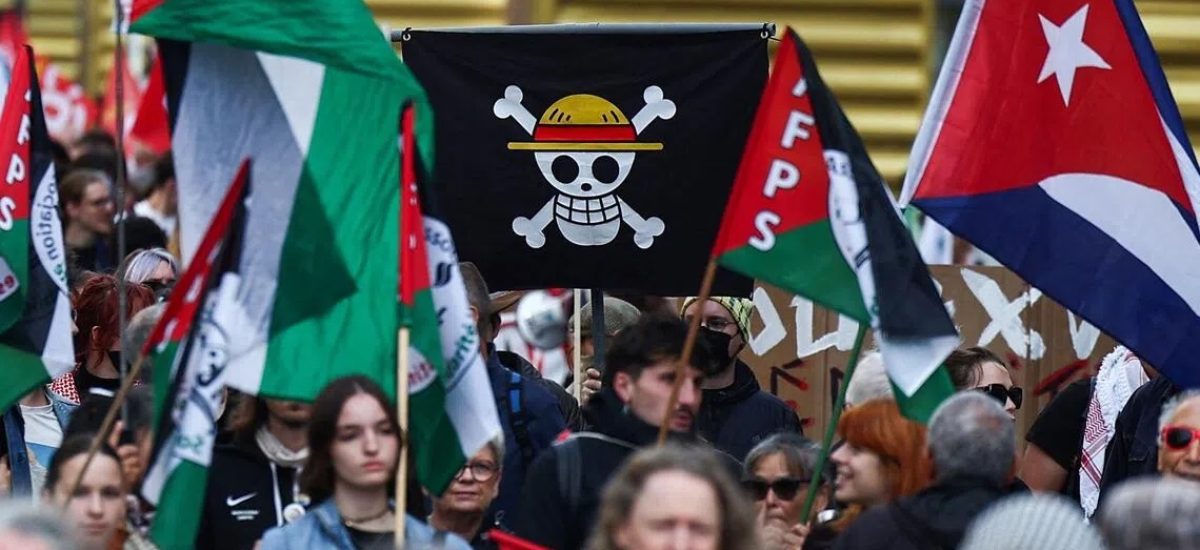
Across these youth-led protest movements, one emblem has emerged as a unifying symbol: the “One Piece” manga flag, featuring a skull wearing a straw hat. Its meaning draws from the Japanese manga’s narrative of a band of pirates who defy a corrupt world government in their quest for freedom. This fictional story of rebellion and perseverance has been reimagined in the real world as a symbol of liberation and defiance.
The flag imagery – freedom, resilience, and unity against oppression – resonates deeply with Gen Z protesters who see themselves as modern day rebels challenging broken systems. From Indonesia and Nepal to Morocco, Madagascar and Peru, young demonstrators have adopted the straw hat skull as a visual statement of their political frustration, creativity and determination to reclaim their future.
In postmodernism, grand narratives are rapidly being replaced by smaller, localized ones, and this shift appears to influence the changing mindsets of young people. They hold simple yet rapidly shifting expectations that align with these smaller narratives. When their leaders fail to meet those expectations, they begin to condemn the entire system. In some cases, this tendency varies but in most cases it holds true.
These young groups with their short term, fast changing outlook are a driving force behind the escalation of Gen Z protests, which often coincide and inspire each other. This interconnectedness may also explain why such movements cascade across the world within short periods.
These young, anonymous collectives, burning with a desire to play with fire, are sending a clear warning to every leader who misuses public power: the people are watching. To avoid being consumed by this growing wave of discontent, leaders must do their best to build transparent, fair and sustainable futures for all citizens.
Ultimately, Gen Z emphasizes that this is not the end. This is the beginning; the awakening of people’s voices against those who try to imprison the birds in their cages.