
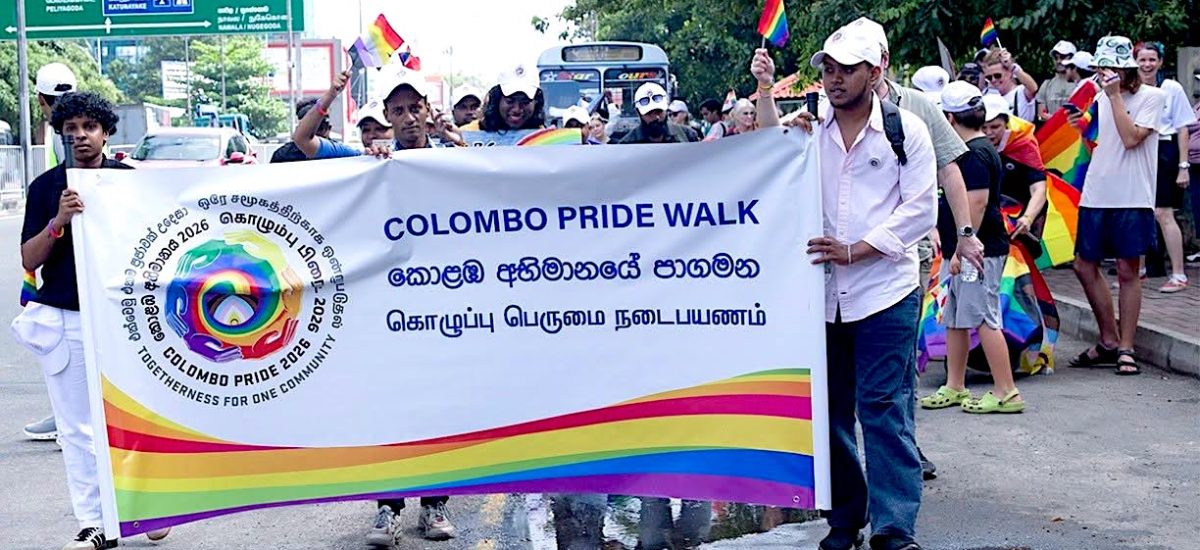

Photo by Jithmi Athukorale
“We are here to stay – whether they choose to understand us or not.”
On June 21, as the rest of the world marked the final day of LGBTQ+ Pride Month, a group of Sri Lankans gathered for the annual Pride Walk, a quiet but powerful act of visibility in a country where simply being yourself can still come with a cost. Pride events in Sri Lanka, held by organisations like Equal Ground, have grown year after year. But beyond the rainbow flags and the collective courage it takes to march, there are real lives, real fears and real stories that rarely make it into the mainstream conversation.
This article is an attempt to tell some of those stories not through statistics or policy papers but through the voices of two young people who live this reality every day. What they shared is not just about identity; it is about what it means to be human in a society that is still learning to see you as one.
Where we stand
Globally, the conversation around LGBTQ+ rights has shifted dramatically over the past two decades. Same-sex marriage is now legal in over 35 countries. Transgender rights are increasingly being enshrined in law. Discrimination protections exist in workplaces and schools across much of Europe, North America and beyond. Even Pope Francis made headlines by blessing same-sex couples, a moment that reverberated around the world, including here.
Sri Lanka, however, tells a different story. Rooted in colonial-era penal codes from the 1800s laws introduced by the British and never fully dismantled, the legal landscape remains deeply ambiguous for LGBTQ+ people. A clause prohibiting “sexual activity against the course of nature” has been used as a catch-all mechanism to police and silence the community although it is vague enough to mean almost anything. There is no clear-cut criminalisation but there is no protection either. It is a legal grey zone that leaves people vulnerable.
A statement by Cardinal Malcolm Ranjith declaring that gay marriage is prohibited added another layer of institutional pressure onto a community that is already navigating hostile terrain. The remark drew strong reactions and for many young LGBTQ+ Sri Lankans it raised a pointed question: why is this the priority?
Eve’s story
Eve is a Gen Z Sri Lankan who identifies as transgender. She describes the social landscape as a spectrum one where the older generation carries the heaviest weight of stigma while younger people tend to be more neutral, if not openly affirming.
“Depending on the general population,” Eve explains, “it’s probably not the greatest perception. The current running is that if you’re queer, you’re like a prostitute or something. We’re not necessarily seen as individuals.”
This is not just a social perception it bleeds into how the law is applied. The same anti-prostitution clauses in the penal code have been used as a workaround to harass and criminalise queer individuals. “Prostitution is illegal here,” she notes, “and it’s been used as a sort of workaround method to sort of silence the community.”
But Eve is careful not to paint the entire country with the same brush. Among Gen Z and millennials, the attitude is markedly different. Most people keep their opinions to themselves. They may not celebrate her but they treat her as a person and right now that matters.
What she finds most frustrating is not just individual prejudice but the system around it. The mental health support infrastructure is fragile at best. For transgender people, accessing a Gender Recognition Certificate requires going through a mental health professional but the lottery of which practitioner you encounter can determine your path forward. “You could either strike gold and have the sweetest therapist possible,” she says, “or you could literally end up with somebody who will try to convince you to be straight again.”
On religion and politics, two forces that are deeply intertwined, Eve offers a nuanced take. She believes the core teachings of most faiths are actually built on acceptance. The problem, she argues, is centuries of reinterpretation. “Take Buddhism as a whole. One of the preachings of the Buddha was that you aren’t supposed to worship him. But what are we doing now?” The same logic applies to how religious texts have been used to stigmatise the LGBTQ+ community a twisting of meaning that serves political ends more than spiritual ones. Her ask is disarmingly simple. “Just accept us,” she says. “That’s the only thing I’ve got to say.”
Identity, binders and finding your people
The second person asked to remain anonymous. She is 17, identifies as bisexual and non-binary and came out as non-binary last year although she has been out as bisexual for nearly six years. She has quietly and steadily built a life of authenticity around herself, one small safe space at a time.
Her journey began with a close-knit group of four friends, a found family of sorts, who navigated their individual identities together over nearly a decade of friendship. “We made a safe space for each other to develop and grow into the people we wanted to be,” she reflects. They have attended Pride together for the last four years.
For her, one of the most meaningful moments came not during a march or a public celebration but through a personal gesture. A friend studying in Australia researched safe chest binders on her behalf, consulted professors and arranged for one to be brought for her. “It meant that the people in my life understood and cared,” she says. “Although they didn’t understand completely, they were willing to learn.”
She speaks openly about the misconceptions that follow bisexual and non-binary people even within the LGBTQ+ community. When a bisexual woman dates a man, people assume she is straight. When she dates a woman, they assume she is a lesbian. “Some people even within the community do not understand that you can feel both ways,” she says with frustration.
On the question of non-binary identity, she pushes back against the oversimplification. “Everybody just assumes that on some days you want to feel like a girl, on other days you feel like a boy. But that’s not what it feels like to be non-binary. It’s more of a wanting to not be one thing specifically, being multiple amalgamations of personalities.”
Her advice to other young LGBTQ+ people, especially those living in conservative households or religious communities, is grounded. “Not everybody is going to be safe to come out to but try and find people who are willing to understand and accept you no matter what you are going through. When you find a person who cares about you, they will go to any lengths to make sure that you are not only comfortable but safe.”
The children who are watching
It would be incomplete to speak about Pride without acknowledging the youngest and most vulnerable members of this community: LGBTQ+ children and teenagers navigating their identity in environments that were not built for them.
The challenges begin early. Schools are rigidly gendered spaces. Uniforms enforce binary presentation. Mental health resources for young people are scarce and those that exist rarely have the training or sensitivity to support a teenager questioning their gender or sexuality. Many young people live in households where the topic cannot be raised at all, where coming out risks losing not just acceptance but shelter and financial support.
The fear is not abstract. There is a constant background hum of anxiety – a running calculation of who is safe and who is not, what to wear today and whether this interaction will turn hostile. “Something that runs in the back of most of our minds,” Eve says, “is am I going to get hate-crimed in the next 20 minutes?”
For children, that weight is carried without the emotional tools or life experience to process it, which is precisely why visibility matters not as a political statement but as a signal to a lonely 13 year-old that they are not alone and not broken.
What needs to change
There are a cluster of needs: legal reform, mental health support and, above all, education. The legal framework needs to move from colonial-era ambiguity to modern clarity with protections, not just loopholes. Mental health practitioners need training in LGBTQ+ affirming care. Public education in schools and workplaces needs to normalise what has always existed but rarely been spoken about.
None of this happens overnight but awareness is where it starts. Events like the Pride Walk, growing year by year in attendance and in confidence, are part of that slow turning of the tide. The fact that police showed up but could not do anything because the permits were in order and the law was on the side of the marchers is its own kind of progress.
At the heart of every conversation I had was a theme that cuts across gender, sexuality, religion and politics: the desire to be seen as a full human being. Not a sex worker. Not a phase. Not a threat to the fabric of society. Not a theological problem to be solved. Just a person with quirks and fears and friendships and dreams who deserves the same basic dignity as everyone else.
“We can be quirky,” Eve laughs. “We can be a little bit weird. But isn’t everybody a little bit weird at the end of the day?”
Sometimes, the most radical thing a person can do is simply be themselves and ask the world to meet them there. Whether you are part of the LGBTQ+ community or not, that is the invitation on the table. You do not have to understand everything. You do not have to have all the answers but you can choose to be someone who listens, who learns and who refuses to let another person carry their identity alone. Because at the end of the day, we are all in this together.