
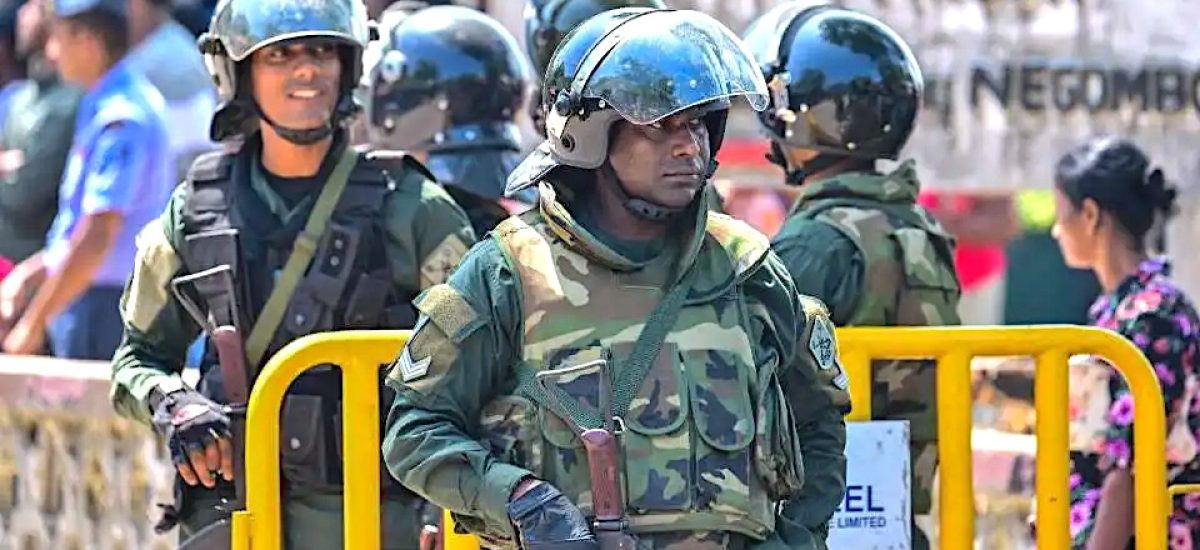

Photo courtesy of UCA News
On July 5, Sri Lanka witnessed the return of all too familiar violence. Rival factions of inmates, believed to be from rival drug gangs held within the same facility at Negombo Prison, allegedly seized weapons from the prison armoury and fought each other for control of it. By the time Justice Minister Harshana Nanayakkara acknowledged responsibility for an institution under his purview, the death toll had risen to 26 (seven prison officers and 19 inmates) and over 100 were wounded. The Special Task Force (STF) was deployed to retake the prison and the Commissioner General of Prisons launched a special investigation.
The sequence that unfolded on July 5 to 6 is not new; it is replicable to the ones before it. Riot, securitised suppression, committee, silence and recurrence. It is almost verbatim what followed the 2012 Welikada riot (27 dead) and the 2020 Mahara Prison riot and it echoes the state’s response to the 1983 Welikada massacre of 53 Tamil detainees during Black July pogrom. Every inquiry identifies overcrowding and administrative failure yet the underlying structures remain untouched until violence erupts again. In a way, prison riots resemble a carousel: a structure that does not move forward but revolves, discharging violence periodically and resetting to the same baseline condition that guarantees the next one.
Structural violence, beyond the metaphor
Structural violence, in the most novice sense, is harm embedded in institutions with no single actor or villain who can be held responsible while cultural violence normalises that harm by making it appear inevitable. It hence gets written into bodies, embodied in measurable patterns of suffering by ethnicity, religion, gender, class, ability and (presumed) sexuality.
In the case of prison riots in Sri Lanka, the crisis and repeated emergence of violence is not only legal or administrative but somatic. Firstly, prisons built for roughly 10,395 people held a daily average of 29,789 in 2025, which is 286.6 percent occupancy. Secondly, the prisons within the island contain predominantly unconvicted remand detainees, who comprise 65.4 percent of that inmate population. This means inmates sleeping in shifts, a documented sanitation shortage and tuberculosis rates roughly a hundred times the general population’s. None of this really reads violence in the very normative sense; however, is it only violence when one has struck someone within the walls of the facilities? These statistics read as neglect, underfunding and a problem that may be solved eventually. However, there remains a perceptual gap between what counts as violence that is itself a cultural-violence effect and hence structure persists without a name.
Another important aspect to note is that the prisons still operate within the Prison Ordinance No. 18 of 1877, which is usually seen as a footnote in legal documentation. The colonial governance operated through bifurcated rule where there was one law and register of rights for citizens and another, customary and coercive, for subjects. Sri Lanka is yet to dismantle it. The colonial blueprint of prisons prioritised locking away subjects over human welfare and it also left the obsolete foundation that is fundamentally incapable of housing current inmate populations. Additionally, the Human Rights Commission of Sri Lanka report in 2020 highlighted that the current nature of the Prison Ordinance is limitedly focused on rehabilitation and heavily focused on the correctional/punitive nature. The 1877 Ordinance encodes a bifurcated logic within which an ordinary judicial track remains open for the propertied and connected and an intensely coercive, quasi-permanent detention track for everyone else, especially the subjects who fall disproportionately within the lines of being poor, suspected of drug abuse and ethnically minoritised. The reform is not simply about the ordinance but the infrastructure as well. Welikada (1841), Mahara (1875) and Bogambara (1876) are not simply old buildings; they are the functioning ruins, colonial hierarchies of control surviving the formal end of colonial rule, which are now administered rather than transformed.
The political economy of non-reform
There is the issue of overcrowding, which remains the primary concern addressed by both the Department of Prisons (DOP) and the Human Rights Commission as well as the UN Committee. While this issue gets reflected, the inquiry must also ask why, after several deadly riots in over 50 years, has the issue of the remand bottleneck never been seriously addressed?
The population bearing the structural violence has no political power to convert the suffrage into a demand for policy change. However, it is important to consider that there may be several factors that benefit from leaving the structure untouched as such. Since the 2022 economic collapse and the subsequent IMF-supervised austerity programme, judicial capacity that includes court staffing and legal aid has competed against the fiscal consolidation targets that prioritise debt servicing over institutional building. Several scholars and activists have highlighted the subordination of institutional reform to macroeconomic stabilisation. Thinking through the issues that require attention such as bail reform requires investment. It requires more magistrates, more legal aid lawyers and faster case processing. The report by the DOP also acknowledges that there is a need for better sanitation, healthier food and medical supplies. Even if the government magically focuses on institutional reform, are persons on the list of reform? Perhaps not, as they remain politically unrewarding and because the population these would benefit already remain at the fringes of society. Here the idea of cultural violence is important as even in the list of equals, prisons remain last.
Ongoing operations such as Yukthiya, the anti-narcotics campaign responsible for roughly 30,000 arrests and half of all unconvicted admissions in 2024, are politically profitable. They perform decisive governance against a visible social ill even as the UN human rights office has condemned its lack of a rights-based approach. Several activists have called attention to the efficacy of the programme while actively participating in the moral panic associated with narcotics, primarily led by the elite, for further securitisation. The theatrics (as some critics called it) has both aesthetic as well as economic value that sustains power and politics within the elite. In this regard, structural violence persists because it is cheaper both politically as well as fiscally to manage its symptoms through periodic suppression and through intense surveillance and violence (e.g., the rise of shooting incidents associated with Yukthiya) than to fund its cause out of existence.
Policing, courts and prison form one mutually reinforcing apparatus rather than sequential stages of justice, a form of carceral continuum. However, the counterinsurgency apparatus must also be brought into critique. Counterinsurgent states treat detention not as incidental to war-like violence but as one of its central technologies. Here, the intense reliance on the STF is not just incidental but a doctrine of deploying paramilitary formations built for counterinsurgency against the LTTE. STF’s redeployment, as well as heavy involvement in the operation Yukthiya, is the continuation of that same institution (or institutional violence) that is now processing a population that is defined by class and drug suspicion while originally built for a population defined by ethnicity. A security apparatus built for war-like violence does not simply demobilise when the war ends; it looks for its next target. The ongoing violence – structural and cultural – has its own intersectionality of ethnic and gender hierarchies, which experience distinct forms of violence, as also highlighted by a report by the UN Office on Drugs and Crime (UNDOC).
If the nature of structural/cultural violence requires no single villain, transformation also does not require a single fix; instead, it needs the one that exposes the interlocking violence and is rooted in the intersectionality of legacies of colonial laws, histories of violence, subjugation of people’s everyday life, gender, ethnicity, class, caste, ability and sexuality.
What the reform requires is a redistribution of the power that currently makes the carousel of violence cheap to maintain and expensive to dismantle. The DOP says that it has ideas for the issues related to overcrowding but none of them address the structural and cultural violence that continues to dictate imprisonment. Sri Lanka remains a signatory of the UN Mandela Rulesyet according to UNDOC, when the evaluations for support to Sri Lanka were conducted, UNDOC mentioned that the plans of reform that are currently in place are not sustainable and remain short term oriented.
The nature of reform must begin with bail and case management, addressing the 65 percent remand population. It requires repealing and/or fundamental revision of the 1877 Ordinance as well as other such provisions (e.g., the PTA). Decouple prison management and address the issue of rehabilitation and reform seriously and urgently. There is no single axis of prison reform but prison reform should address structural, cultural and administrative violence collectively. As families of the security and the inmates mourn the loss of the lives and attend to the citizens wounded, there remains a not so silent call for reform.