
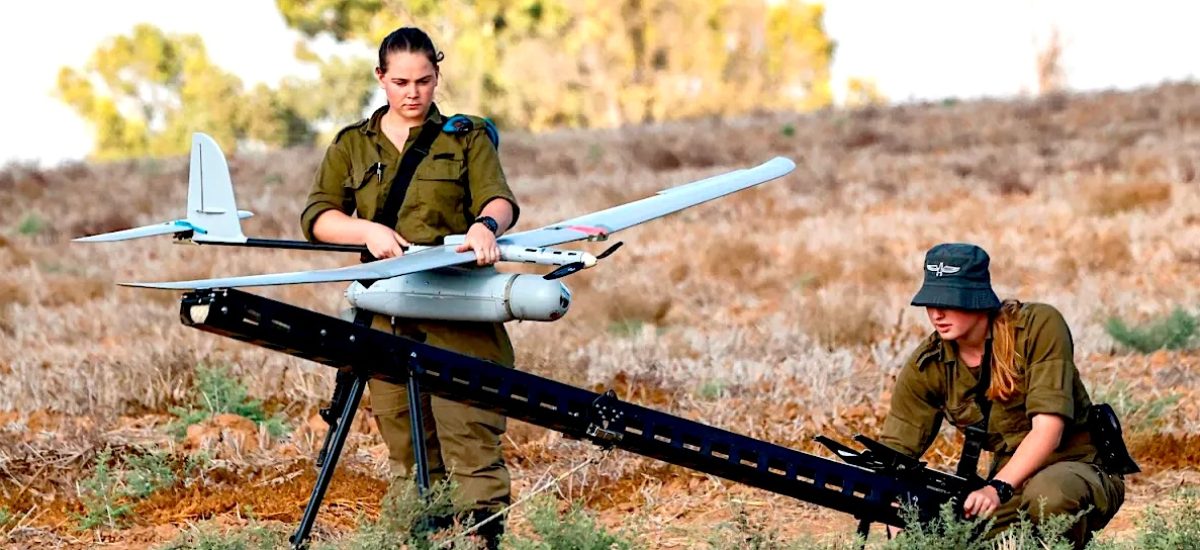

Photo courtesy of Foreign Policy
A government decision to buy four drones from Israel under emergency procurement powers and at a cost of Rs. 4.26 billion has proved highly controversial. Amidst ministers’ unconvincing attempts to explain, serious and interconnected moral and practical concerns remain.
It is claimed that these unmanned aerial vehicles (UAVS, commonly known as drones) will improve maritime surveillance and disaster response at no extra cost since they will be paid for through savings on helicopter maintenance from the Air Force budget. The drones will be supplied by BlueBird Aero Systems, of which the state-run Israel Aerospace Industries (IAI) owns 50%, and include two ThunderB UAVs, able to stay airborne for up to 14 hours and two others up to 20 hours.
The price would include training operators and three years’ maintenance for the aircraft, which would monitor an ocean area 27 times the size of the country’s landmass and track suspicious vessels, locate missing fisherfolk and help respond to natural disasters, including floods and cyclones. “The Sri Lanka Air Force is responsible for monitoring a large maritime area, and continuous surveillance using conventional aircraft is very costly,” Deputy Defence Minister Aruna Jayasekera told parliament.
There may well be a case for shifting at least some funding towards drones. However there are gaps in the government’s explanation. What additional costs may arise, taking into account all too many previous projects with major budget overruns? What will prevent a steep price rise after three years by which time Sri Lanka might be reliant on these devices and the software, hardware and expertise which goes with them? To what extent will helicopters still be needed, for instance for rescues, with ongoing costs on top of those for drones?
This ties in with a key question: why are emergency financial procedures justified instead of an ordinary tendering process? The sea area in Sri Lanka’s exclusive economic zone has not just grown dramatically and other concerns are also not new. The most obvious recent change is the worsening conflict in West Asia sparked by the actions of the closely-allied Israeli and US states, which has affected numerous other countries and made the oceans far more hazardous.
So it is not surprising that Sri Lanka Muslim Congress leader MP Rauff Hakeem strongly criticised the planned purchase, suggesting that the drones will be used to track Iranian vessels in the Indian Ocean and feed this intelligence to the US. He warned against dragging the armed forces into rivalries between foreign powers. A few days later Mujibur Rahman, an MP from a different opposition party, the Samagi Jana Balawegaya, raised wider concerns about Israeli activities and the presence of Mossad operatives in Sri Lanka. He claims that these threaten national security, long-term stability and intercommunal relations. While antisemitism should be avoided and Jewish people treated like those of any other ethnicity or faith, granting special privileges to Israeli citizens perpetrating or promoting serious crimes under international law, including overlooking alleged lawbreaking on Sri Lankan soil, is a different matter.
Even if the government does not intend to share information with the US authorities, it is unlikely that the Israeli state and connected organisations, with their notable skills in spyware and electronic snooping, will pass up this opportunity to make use of aircraft they make and sell. The region is becoming increasingly hazardous. Amidst threats to attack Iranian tankers, “The ability of the United States Navy to enforce this blockade extends across the entire Indian Ocean and beyond,” an adviser to a well-connected American anti-Iran lobby group said. US central command has warned that any country’s ships receiving Iranian cargo through ship to ship transfers could be intercepted or seized. If the deal goes ahead, Sri Lanka might well be seen as a party to any military action against ships which pass through its exclusive economic zone of over half a million square kilometres, and more broadly regarded as lining up with one side in a war which could escalate.
Why Sri Lanka should not buy drones from Israel
Sri Lankan leaders may well have felt under pressure from the US government under President Donald Trump to buy these drones from Benjamin Netanyahu’s regime but since then the balance of power in both Israel and the US has changed. Withdrawing from the deal makes even more sense than before.
The Israeli state’s horrific large scale violence against Palestinians has led to shock and anger across the world, including Sri Lanka. While powerful allies have long shielded it from having to comply with human rights and international humanitarian law, Hamas’ appalling action in October 2023 gave the regime an opportunity to take the brutality to a further level.
International bodies such as a UN Commission of Inquiry, global scholars and human rights organisations, including in Israel itself, have assembled extensive evidence of war crimes, crimes against humanity and genocide. UN special rapporteur Francesca Albanese has urged other countries to act, including to “Suspend arms transfers and trade that sustain unlawful occupation and genocide.” Even previously staunch allies have been distancing themselves and sometimes applying sanctions. This is likely to accelerate after a recent International Court of Justice ruling that Myanmar has committed genocide against its Rohingya minority, important in itself and which sends out a signal to Israeli leaders and those complicit in their crimes. That the Air Force has recently welcomed a Myanmar military delegation makes matters even worse.
Drones have played an important part in killing thousands of civilians, largely children, with grim television and internet footage viewed in numerous countries and an award-winning documentary by Israeli filmmakers, due to be streamed free in December. UAVs used in genocide include the ThunderB-VTOL. This is a bad time for Sri Lanka to join itself to this deadly trade, including paying money to a company half-owned by the Israeli state, so that profits can go directly into funding atrocities.
Buying drones from Israel reawakens past trauma and deepens divisions in Sri Lanka itself, since these were used in the civil war, with deadly effects on civilians. Indeed Israeli military advice and assistance played an earlier role in attacks on defenceless Sri Lankans in a military campaign initially against Tamils in the North and East that went on to wreak havoc in the South. Especially if, for instance, allies of Gotabaya Rajapaksa were to gain influence in the armed forces or even political control, I doubt that anyone would be surprised to see these drones used to target Sri Lankans.
Any extra costs due to failure to go through a proper procurement process will also take a less obvious toll when so many people are struggling financially. Even a small cut, by the standards of international trade and commerce, in funding for social programmes aimed at impoverished and insecure sections of the population can have a devastating effect on child and adult health. This, in turn, will increase social instability.
However, if Sri Lanka becomes a pawn in the war games of politicians in the US and Israel, which have already had a highly damaging impact on the economy and people’s wellbeing, the human and financial costs could be higher still. On top of the risks of antagonising Iran which, unpleasant though the regime is, would not ordinarily pose a threat to Sri Lanka, and its allies, a trigger-happy US military may well target ships mistakenly as almost happened with a Chinese vessel quite recently. If this were to happen to a ship thought to have been spotted by a drone owned by Sri Lanka, one of the better case scenarios could be strained relationships and perhaps having to pay a huge sum in damages. The worst case possibility is violent retaliation.
If Sri Lankans are put at risk because their government was trying to please President Trump, this does not mean that he will offer any protection. When the US government called on its allies to aid it in a war in Afghanistan earlier this century, Denmark was among those which answered the call and indeed had the highest per capita death toll among coalition forces, higher than the US itself. But in 2026 he not only insulted the allied dead but also threatened a military attack on the Danish armed forces in order to seize Greenland that has mineral wealth in which one of his friends has shown an interest. Expecting any kind of loyalty in return for serving and making sacrifices for him would be naïve.
For Sri Lanka to back away from the drone deal would be both prudent and principled. Whether the government will push ahead, despite all the concerns raised or reconsider remains to be seen.