
Photo courtesy of Lankasara
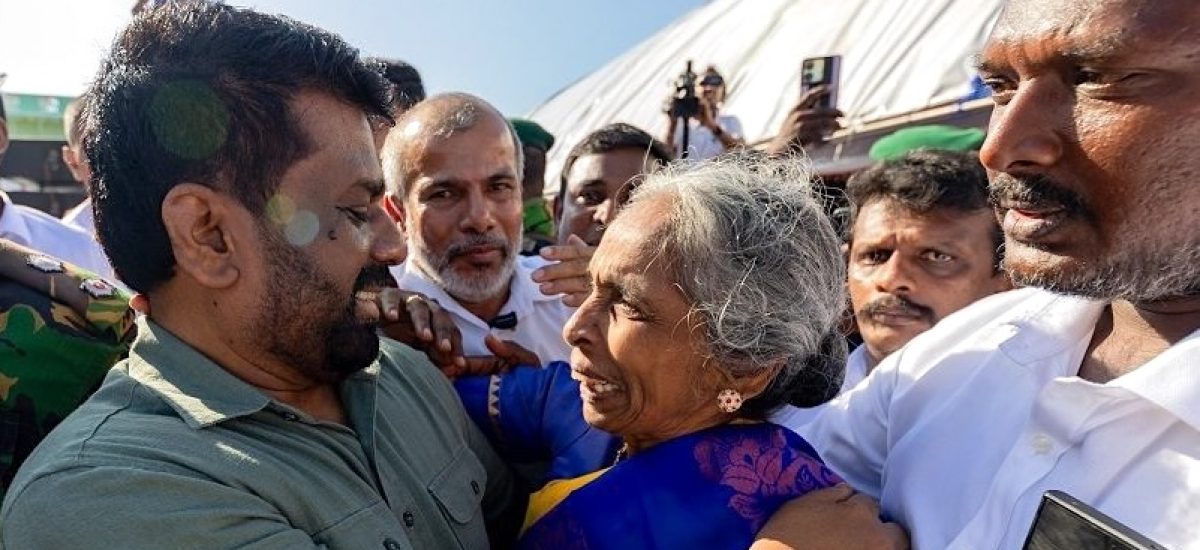
“There will no longer be a majority and minority; we will all be Sri Lankans.” President Anura Kumara Dissanayake made this declaration during his visit to Mannar in April 2025, presenting a common Sri Lankan identity as an objective of his government. The aspiration itself is difficult to object to. A country in which citizenship does not depend on ethnicity is a legitimate democratic ideal. But for Tamils, the important question is not whether they are Sri Lankan. It is what being Sri Lankan is expected to mean, who gets to define it and whether that identity gives them a meaningful place in shaping the country in which they live.
The NPP entered government with a mandate large enough to make this question particularly relevant. At the November 2024 parliamentary election, it won 159 of the 225 seats in parliament. In the Jaffna District, it won three of the six seats with 24.85 per cent of the vote. The NPP’s own policy commitments also went beyond ordinary improvements in administration. It promised a new constitutional framework, decentralisation of political and administrative power to local, district and provincial levels, Provincial Council elections, recognition of cultural differences and political partnership among ethnic communities. It also promised investigations into past killings and disappearances and the abolition of the Prevention of Terrorism Act (PTA).
That distinction matters when assessing the Tamil question. There is a danger in measuring the NPP’s record primarily through its broader performance in government. Fiscal discipline, action against corruption, improved public services and greater administrative discipline may matter greatly to citizens. But they do not, by themselves, answer the political questions that have shaped Tamil grievances for decades. A government can become more efficient without becoming more decentralised. It can become more accountable in some areas without redistributing political power. A more efficient central government is still a central government.
The NPP has therefore demonstrated that the state can be administered differently. The more difficult question is whether it is prepared to demonstrate that power can be shared differently.
Land, security and the limits of executive action
Land provides a clear illustration of this distinction. The NPP government has taken steps to release land held by the security forces and these should be acknowledged. President Dissanayake has also instructed the security forces to expedite the release and return of land no longer required for national security. But the political question is larger than the number of acres returned; it is about who has the authority to determine whether a community can use, retain or shape the future of its own land.
This is particularly important in the North and East where land questions involve not only military occupation but also state institutions responsible for archaeology, forests, wildlife and other forms of public administration. Such institutions may have legitimate statutory responsibilities but their decisions can have profound consequences for communities whose land, livelihoods, religious sites and cultural practices are affected. A piece of land may cease to be occupied by the military and still remain subject to another form of state control. The question is not only whether land is returned but who decides what happens to it, on what basis and with what participation from the people affected.
The same distinction applies to political expression. The NPP promised to abolish the PTA. Yet in June 2026, 24 year-old Tamil rapper Sangeethsan Ganeskumar was detained under the Act over a video that police alleged supported or glorified the LTTE. Human Rights Watch reported on the case and the continuing use of the PTA. The case, by itself, does not prove that the NPP has adopted an anti-Tamil policy. It does demonstrate, however, the gap between a promise to remove an exceptional legal framework and governing while that framework remains available.
Language presents a related problem. The constitution recognises Sinhala and Tamil as official languages yet constitutional recognition does not automatically produce equal experience of the state. Where citizens continue to encounter difficulties accessing public institutions, documents, services or information in their own language, the issue is not simply translation. It raises the question of whether the state is experienced as equally accessible by citizens regardless of language.
These examples point to a common problem: administrative action can make life better without changing the distribution of authority. Land can be released without communities acquiring greater influence over land policy; a government service can be improved without changing the relationship between the centre and the provinces. The issue is not the absence of action but the extent to which action changes the structures through which power is exercised.
This becomes clearest with devolution. Provincial councils were established through the 13th Amendment as institutions of provincial political authority. The NPP promised to decentralise political and administrative power and make provincial councils effective institutions. Yet all nine provincial councils remain without elected representatives. The present obstacle is linked to the electoral system introduced in 2017 and the failure to complete the required delimitation process. Parliament is examining the issue while the Election Commission has indicated that it can conduct elections once the necessary legal framework is established.
The legal obstacle is real but it cannot become a permanent explanation for political inaction. The NPP controls a two-thirds majority in parliament. If the existing electoral framework is defective, the government has the legislative capacity to propose an alternative and take responsibility for resolving the problem.
The distinction between local and provincial government is also important. Local democratic participation matters but it cannot simply substitute for the political authority envisaged through the provincial system. Participation in a government programme is not the same as having meaningful influence over the structures through which political decisions are made.
For many Tamils, that distinction cannot be separated from history. The Tamil political question did not emerge because government offices were inefficient or public services were poorly delivered. It developed through disputes over language, citizenship, land, constitutional arrangements, state power, security, devolution and the recognition of Tamil political aspirations. The war added an enormous layer of suffering, displacement, disappearances and allegations of grave violations.
The continuing excavation and investigation into Chemmani has brought that history back into public view. Its significance is not merely the number of remains but the unresolved questions of who these people were, how they died, who was responsible and whether the state can provide families with credible answers. Accountability is not simply reopening a case; it requires institutions capable of establishing facts, protecting evidence, identifying victims, prosecuting those responsible and providing families with truth and justice.
All of these questions ultimately return to the meaning of the common Sri Lankan identity that the government has placed at the centre of its political message. Tamils should not reject the idea of being Sri Lankan. But neither should they accept the idea that belonging can be created simply by being told that “we are all Sri Lankans”. Tamils should feel Sri Lankan because they are a meaningful part of the collective identity of the country, not because someone from the dominant community declares that they are. Belonging cannot be produced by declaration.
It is built when a community sees its language, history, culture, collective memory and political aspirations recognised as part of the country’s story rather than treated as matters that must fit within an identity defined elsewhere. The NPP’s own policy documents speak of acknowledging cultural differences, respecting diversity and creating a shared future for the country’s different communities. The test is whether that language produces a genuinely plural political identity rather than simply a new vocabulary for an old relationship.
Sri Lanka’s constitutional order continues to give Buddhism the foremost place while recognising Sinhala and Tamil as official languages. That does not establish that every aspect of the state operates according to a Sinhala-Buddhist agenda but it does demonstrate why the meaning of a supposedly common national identity cannot simply be assumed to be neutral.
The concern for Tamils is not that they should remain outside a Sri Lankan identity. It is that they should not have to surrender the political and cultural substance of their Tamil identity in order to enter it. A genuinely shared identity would allow a Tamil to be fully Tamil and fully Sri Lankan at the same time. It would recognise that Sri Lanka is not made plural merely by counting different communities as citizens; its institutions must also reflect the country’s plural histories, identities and legitimate interests in how power is organised.
Two years later: what has changed?
The question is not whether Sri Lanka has changed since November 2024. It clearly has. The government has altered the style of administration, pursued corruption cases, introduced different approaches to public management and taken decisions that previous governments either avoided or handled differently. Those changes matter.
But the Tamil question has to be measured against a different standard. Land has been released but the wider question of state control over land remains unresolved. The government has promised to replace the PTA but the Act remains available. Tamil is constitutionally an official language but equal language rights are not always experienced in practice. Local government elections have been held but Provincial Councils remain without elected representatives. Cases relating to past violations have received attention but the larger architecture of accountability remains incomplete. These are not isolated administrative shortcomings. They concern the distribution of power between the state and the communities that make up the state.
The NPP risks allowing improvements in administration to become a substitute for political transformation. A government may be cleaner, more disciplined and more responsive while leaving the underlying political relationship between the centre and minority communities largely intact.
The NPP did not come to power promising only a cleaner version of the existing state. Its own political language was broader. It promised decentralisation, recognition of diversity, stronger provincial councils and a shared Sri Lankan identity encompassing the country’s different communities. Those promises provide a legitimate basis on which to assess its record.
After two years, the uncomfortable conclusion is not that nothing has changed in Sri Lanka; much has changed. It is that nothing of comparable political substance has changed for the Tamil question.
That does not mean every issue can be solved in two years, nor that constitutional reform is easy. But two years is long enough to establish political direction. When a government possesses a two-thirds parliamentary majority and has identified decentralisation, diversity and constitutional reform as priorities, the continued absence of substantive movement becomes increasingly difficult to explain simply as a matter of time.
The question posed by the president in Mannar therefore remains unanswered. Saying that there will no longer be a majority and minority does not, by itself, remove the political history that produced those categories. Nor does declaring that everyone is Sri Lankan establish the conditions in which everyone can genuinely feel that they belong.
Tamils have not spent decades asking merely for a more efficient version of centralised government. They have asked for a political settlement in which their identity, language, land, security, history and aspirations are recognised within the structure of the state. Equal citizenship is essential but equality of individual citizenship does not automatically resolve questions about the distribution of political power.
The NPP has demonstrated that the state can be administered differently. It has yet to demonstrate that power can be shared differently. Until that happens, the call to “we are all Sri Lankans” risks becoming an attractive national slogan without resolving the harder question of what that Sri Lankan identity actually contains. Tamils should be able to say they are Sri Lankan because the country recognises them as one of its constituent peoples, because its institutions reflect that plural reality and because they have a meaningful say in decisions that shape their future.
That is the test of whether the language of equal citizenship has become political change or merely a new way of describing an old relationship.