
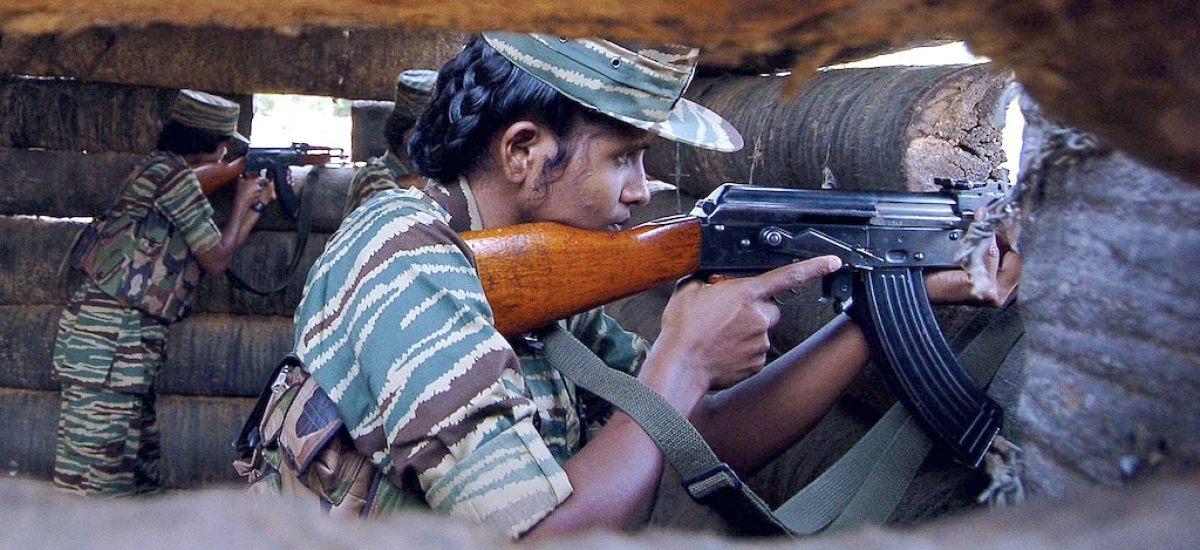

Photo courtesy of The Washington Post
Sri Lanka’s military defeat of the LTTE in 2009 ended the armed insurgency but it did not provide a political settlement. The experience of the Kurdistan Region of Iraq (KRI) offers an instructive, if imperfect, comparison. Both the KRI and Tamil Eelam emerged from prolonged conflict and developed institutions to govern territory. Their trajectories, however, were fundamentally different. The KRI gradually acquired constitutional recognition and an administrative existence that could endure beyond conflicts and leaders while Tamil Eelam’s governing structures remained closely bound to the LTTE and disappeared with its military defeat.
The comparison is not an argument for importing the KRI’s model into Sri Lanka. Rather, it points to a broader lesson: self-government becomes more durable when political authority is institutionalised beyond the movement that fought for it. Iraq’s federal constitution emerged from a very different history, including war, regime change and sustained external involvement. The relevant question for Sri Lanka is therefore whether existing and future arrangements can give Tamil majority areas sufficient authority, institutional continuity and democratic accountability to make self-government politically durable.
From armed sanctuary to recognised government
Iraqi Kurdish autonomy did not emerge from a single military victory. After the 1991 Kurdish uprising, the withdrawal of the Iraqi administration and the establishment of the no-fly zone created the conditions for Kurdish self-government. Elections followed in 1992 alongside the creation of regional administration and legislature. The arrangement was later embedded in Iraq’s post-2003 constitutional order. Article 117 of the 2005 Iraqi Constitution recognises the Kurdistan Region and its existing authorities as a federal region. That provision did not resolve disputes over territory, oil, revenue or the distribution of power. It nevertheless converted a precarious political fact into a constitutional one.
Recognition mattered because it allowed institutions to outlive battles and leaders. A parliament, ministries, courts, security bodies, universities and an international-facing administration gave external actors something more stable to engage with than an insurgent command. Research on the KRI describes this as a process of proto-state formation and soft nation building. The quality of those institutions remains contested and party influence continues to weaken their independence. But the central achievement was institutional continuity: even during crises, the claim to autonomy was carried by an established regional government rather than solely by an armed organisation.
External support reinforced that process, especially when Kurdish forces became important partners against the so-called Islamic State in Iraq and Syria (ISIL). Yet foreign backing was most useful because it attached to institutions already able to administer territory and represent the region. Protection created room for autonomy; governance prevented autonomy from disappearing whenever outside priorities changed.
Tamil Eelam’s institutions could not escape the movement
The LTTE also built institutions. Research on public authority in Tigerland shows that it operated police and judicial structures, played a role in service provision and combined independent institutions with pragmatic interaction with existing state services. This complicates the simplistic picture of a movement concerned only with combat. Another major study found that its state building placed strong emphasis on security, social welfare and economic development.
But those same studies identify the central weakness. The emerging apparatus was marked by authoritarian centralisation and few formal mechanisms of democratic representation. Institutions existed, but they did not develop sufficient independence from the LTTE’s military hierarchy. Political competitors were suppressed and civilians were subjected to serious abuses, further undermining the prospect of plural and accountable political authority. When the organisation was militarily destroyed, there was no autonomous civilian government with recognised legal standing capable of carrying its governing functions forward.
The military defeat of the LTTE did not resolve the underlying political conflict. Questions of land, accountability and the institutional reforms required for reconciliation remain unresolved. But the institutional order through which the LTTE had exercised authority was not sufficiently independent of the movement to survive its destruction.
The lesson is legitimacy, not military defeat
The contrast is therefore not simply between Kurdish success and Tamil failure. The KRI remains politically divided and economically vulnerable with persistent divisions between the Kurdistan Democratic Party (KDP), the ruling party in Iraqi Kurdistan and the senior partner in the KRI, and Patriotic Union of Kurdistan (PUK), a center-left party and a partner in the KRI, the weakening its political institutions. Constitutional recognition has not eliminated these weaknesses. Constitutional recognition has not eliminated these weaknesses. Likewise, the LTTE’s defeat cannot be reduced to deficient administration; the balance of military power and international conditions were decisive.
The narrower lesson is that durable self-determination requires three forms of conversion. Territorial control must become lawful authority. Movement structures must become institutions that can survive leadership change. Collective identity must become public legitimacy expressed through accountable government, not enforced political monopoly. The KRI achieved these conversions incompletely but sufficiently to preserve autonomy within Iraq. The LTTE’s system remained too closely fused with the fortunes and methods of the movement.
That helps explain why comparisons based only on battlefield performance are misleading. Armed movements often appear strongest when they can control territory and silence rivals. Yet that strength may conceal institutional fragility. A movement that cannot tolerate political competition may struggle to build genuinely independent institutions. By contrast, an imperfect regional government can endure serious crises because its authority is reproduced through law, administration and routine political bargaining.
What the comparison means for Sri Lanka
For Sri Lanka, the comparison brings the institutional question to the foreground. The issue is not simply how much authority should be devolved but whether devolved institutions have the responsibilities, resources and political safeguards needed to exercise that authority in practice. This is where Sri Lanka’s existing framework becomes particularly important.
The 13th Amendment remains the country’s existing constitutional framework for devolution but its limitations and incomplete implementation continue to shape debate. A 2024 analysis in Economic and Political Weekly notes how repeated promises of fuller implementation have reopened, rather than settled, the question of its effectiveness. Groundviews has likewise documented the continuing tension between Tamil political aspirations and the centralised political system in which they must be pursued. As Bart Klem argued after Sri Lanka’s 2024 presidential election, the fragmentation of Tamil politics weakens bargaining power even as political change may create new openings for power sharing and legal safeguards.
A durable settlement would therefore require more than devolved labels. Provincial institutions need meaningful responsibilities, predictable resources, democratic accountability and protection from arbitrary recentralisation. Tamil political actors, for their part, need institutions that are plural, publicly accountable and oriented towards everyday governance as well as historical claims. The continuing discussion within Tamil politics about leadership renewal and practical priorities shows why institutional credibility matters alongside constitutional design.
The comparison with the KRI should not be used to romanticise another autonomy project. It should sharpen the question Sri Lanka faces. Military victory ended the LTTE but it did not answer the political demand for dignity, representation and meaningful regional power. If self-government is to become durable, it must no longer depend on armed control or temporary promises from the centre. It must be embedded in institutions that citizens can shape, governments must respect and political defeat cannot erase.
Cudi Zerey is a management consultant specialising in public sector and defence transformation and a doctoral researcher focusing on sustainability and security.