
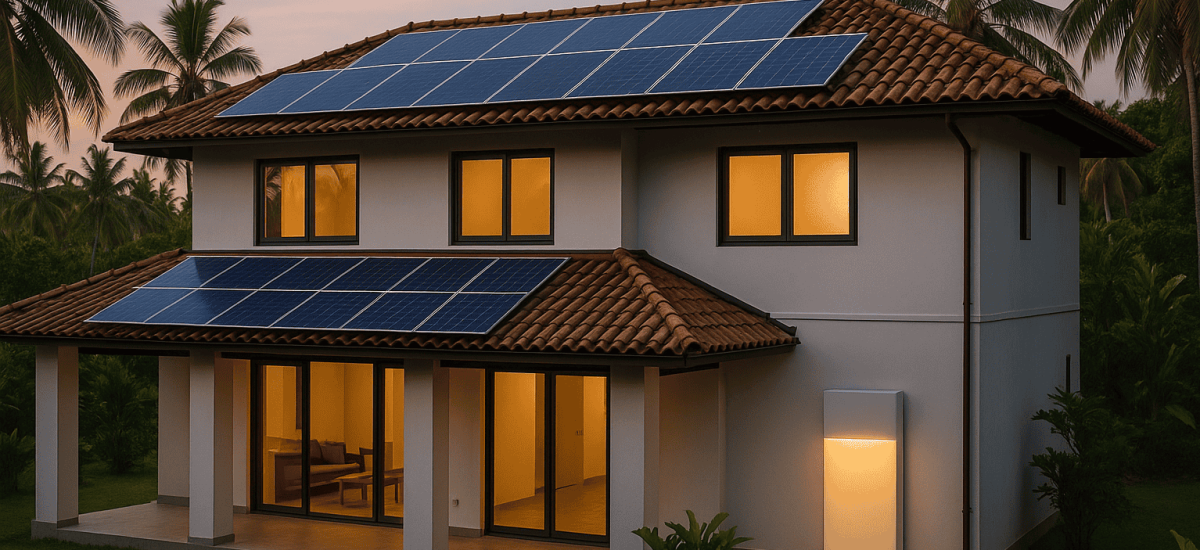

Photo courtesy of Deep Tech
Sri Lanka faces an extraordinary economic contradiction. Its sunshine is abundant, its entrepreneurs are resourceful and the technology needed to generate reliable electricity independently of the national grid is readily available. Yet people and businesses that want to produce their own electricity through standalone solar panels and batteries can find themselves confronting a regulatory framework designed for commercial power suppliers rather than ordinary consumers.
At a time when electricity reliability, fuel imports and investor confidence remain pressing concerns, this is more than a bureaucratic inconvenience. It is a missed opportunity to create businesses, strengthen rural economies, protect essential services and accelerate the transition to a low carbon economy.
Why should a hotel, farm, fishing enterprise or rural clinic need to navigate a licensing process intended for an electricity utility when it wants only to generate and consume its own power? The answer matters because standalone renewable energy is no longer simply an alternative for remote households. It is becoming the foundation for an entirely new generation of businesses.
Sri Lanka’s electricity crisis reveals a deeper contradiction: while unreliable power and regulatory uncertainty undermine businesses, entrepreneurs seeking energy independence face unnecessary licensing barriers. An open, proportionate regulatory framework would allow private initiative to flourish while safeguarding public safety. By replacing bureaucratic obstacles with clear technical standards, Sri Lanka could unlock innovation, attract investment and create transformative business opportunities across tourism, agriculture, fisheries, healthcare and transport. Progress begins when regulation enables enterprise rather than restricts it.
The next business frontier: energy independence as a service
The greatest opportunity lies not in selling solar panels and batteries alone, but in building businesses around what reliable electricity makes possible.
A farmer does not ultimately want a solar installation; they want to preserve produce, irrigate crops and earn more from each harvest. A hotel owner wants dependable power, lower operating costs and a stronger environmental proposition. A hospital needs its medicines refrigerated and its equipment operating when the grid fails.
This creates an opportunity for companies to move beyond equipment sales towards energy as a service models: installing, financing and maintaining systems in exchange for predictable payments or a share of the savings and income generated. For Sri Lanka, the implications extend across tourism, fisheries, agriculture, healthcare, telecommunications, transport and rural development.
Tourism: turning remote locations into premium destinations
The tourism industry has already demonstrated that energy independence can be a commercial advantage. The Bolagala Agro Floating Resort uses solar energy to power its floating accommodation, greenhouses and restaurants. Sun Siyam Pasikudah has introduced a floating ocean dining platform powered entirely by solar energy.
These ventures demonstrate a wider proposition: in tourism, off-grid energy can become part of the product itself. Imagine small eco-lodges, forest-edge retreats, island accommodation and floating restaurants operating without expensive grid extensions or dependence on diesel generators. Reliable solar and battery systems could allow entrepreneurs to develop destinations where conventional electricity infrastructure would be costly, impractical or environmentally intrusive.
The business opportunity is to standardise these solutions. Companies could offer pre-engineered energy packages for small resorts, boutique hotels and clusters of villas, combining solar generation, battery storage, monitoring and maintenance under a single contract. Hotel operators would avoid large upfront investments, while specialist providers would earn recurring revenue.
Financiers could develop dedicated products for sustainable tourism, and equipment suppliers could build local installation and maintenance networks. This is how a technical innovation becomes an industry: not through isolated demonstration projects, but through repeatable business models that make investment easier and more predictable.
Development would, of course, still need to comply with environmental and land use requirements, particularly in protected areas and sensitive coastal ecosystems.
Fisheries and agriculture: making every harvest more valuable
Perhaps the most compelling opportunity lies in the cold chain. Fish and fresh produce lose value when they cannot be stored, chilled or transported reliably. The consequences are felt by fishermen and farmers, who often have limited bargaining power and must sell quickly rather than wait for better prices.
Consider the fishing industry. Multi-day fishing boats may carry substantial quantities of ice, reportedly at a ratio of about two units of ice for every unit of fish. Ice occupies valuable storage space and introduces additional logistical costs. Reliable onboard refrigeration could reduce that burden and allow vessels to carry more saleable catch. The original policy analysis suggests that eliminating the space occupied by ice could potentially triple the fish harvest per trip in the circumstances described. That is a significant potential gain, although its real-world scale would depend on vessel design, refrigeration capacity, fishing practices and storage requirements.
The opportunity extends beyond boats. Solar powered ice makers, cold rooms and refrigerated collection centres could be established near fishing harbours and agricultural markets. Entrepreneurs could charge users by the crate, kilogram or day of storage, turning preservation into a commercially viable local service. Smallholder farmers would gain greater flexibility over when to sell their produce. Fishermen could reduce spoilage. Retailers and exporters would benefit from more consistent quality.
UNDP-supported initiatives have already demonstrated the potential of solar powered containerised cold rooms, including units capable of storing up to 5,000kg of vegetables.
The next step is to create businesses that aggregate demand and finance the infrastructure. Instead of requiring every farmer or fishing cooperative to purchase expensive equipment, a private operator could build a cold room, maintain it and charge customers for its use. Cooperatives, exporters, banks and development finance institutions could help secure demand and finance expansion.
The result would be more than cleaner electricity. It would be a more productive food economy with less waste and greater value retained by producers.
Disaster resilience: from emergency donations to dependable contracts
The experience of Cyclone Ditwah in 2025 illustrates the vulnerability of essential services when electricity fails. At Illipathanna Primary School in Badulla district, a solar photovoltaic system with battery storage was installed to support lighting, fans, medical refrigeration and satellite connectivity, allowing the school to function as a relief centre and clinic. At a remote hospital in Meemure, a hybrid solar system was installed after the facility had reportedly gone 25 days without reliable electricity. The hospital serves more than 100 patients daily and a community of approximately 1,400 people.
Such projects demonstrate the value of decentralised power. They also suggest a business model that Sri Lanka has yet to exploit fully. Rather than relying on emergency donations after each disaster, public agencies could contract private providers to guarantee electricity at designated hospitals, schools, shelters and communications facilities.
Under such arrangements, providers would finance, own or maintain the systems and receive agreed payments for availability and performance. Contracts could specify minimum backup duration, maintenance schedules and emergency response times. The government would pay for a measurable service rather than necessarily purchasing every asset outright. Businesses would gain predictable revenue, while communities would receive more dependable protection.
This model could create a specialist resilience industry combining renewable energy, battery storage, communications, remote monitoring and emergency logistics.
Telecommunications: turning fuel savings into investment
Telecommunications offers another commercially attractive market. Mobile base stations in rural and semi-urban areas often rely on diesel generators and batteries when grid power is unavailable or unreliable. Fuel transport, maintenance and generator operation can make these sites expensive to run.
Research on telecommunications sites has found that renewable hybrid systems can be economically viable. The source material cites potential operating cost savings approaching 90% for hybrid controllers compared with continuous generator operation with payback periods of less than three years in the circumstances studied.
If these results are reproduced across suitable sites, the investment case is compelling. Specialist firms could offer telecommunications operators complete power services, charging a monthly fee while assuming responsibility for equipment, maintenance and performance. Operators would reduce fuel expenditure and improve network reliability without having to manage every energy asset themselves.
The same model could serve remote tourism facilities, agricultural processing centres and other businesses where unreliable electricity carries a high operating cost.
Electric vehicles: charging where the grid cannot keep pace
Sri Lanka’s transition to electric mobility will depend on more than the availability of vehicles. Drivers need confidence that charging facilities will be accessible along highways and in remote destinations. Solar-assisted charging stations with battery storage could help address this problem, particularly where grid connections are weak, expensive or slow to obtain.
A charging station near a national park entrance, waterfall, tourist destination or highway rest stop could combine electricity sales with food, retail, parking and tourism services. Battery storage could help manage demand and maintain service during grid interruptions.
The business opportunity is to develop modular charging sites that can be deployed without waiting for major network upgrades. Investors would still need to assess vehicle demand, utilisation rates, equipment costs and charging tariffs carefully. But where the economics work, energy independence could become a competitive advantage rather than a compromise.
Rural communities: electrification as an engine of enterprise
The social case for off-grid power is equally strong, particularly in the estate sector. It is estimated that nearly 90% of people in the estate sector lack grid-connected electricity compared with 60% of the non-estate rural sector and 5% of urban dwellers.
An agrivoltaic pilot in Hantane combines semi-transparent solar panels with tea cultivation and includes a 12KW microgrid supplying 19 households in a nearby estate community.
Such initiatives point towards models that combine electricity generation with productive land use and community development. For plantation companies, decentralised power could support worker housing, processing facilities, irrigation and digital services. For local entrepreneurs, reliable electricity could enable refrigeration, workshops, small manufacturing, communications and other income generating activities.
Microgrids serving multiple households or businesses raise different questions from systems installed solely for self-consumption. They may require appropriate licensing, consumer protections and clear rules on ownership and electricity sales. But those differences are an argument for creating distinct regulatory categories, not for treating every off-grid installation as though it were a conventional utility.
A new market for investment, employment and exports
Taken together, these applications reveal a much larger economic opportunity. Sri Lanka could develop a domestic industry around the design, installation, financing and maintenance of decentralised energy systems. That industry could support engineers, electricians, battery technicians, software developers, equipment distributors and small contractors.
Banks and leasing companies could develop financing products tailored to solar powered cold rooms, tourism facilities, agricultural equipment and commercial backup systems. Insurers could create products covering equipment, business interruption and system performance. Technology companies could provide remote monitoring, predictive maintenance and energy management.
Local manufacturers might eventually supply mounting structures, enclosures, wiring assemblies and other components while firms could build expertise that is exportable to other island economies and countries with similar infrastructure challenges.
These gains are not automatic. They depend on skills, access to finance, dependable technical standards and credible consumer protections. Nor would every proposed installation be commercially viable.
But an unnecessary licensing barrier makes all these outcomes harder to achieve before investors can even test the market. There is also a foreign exchange dividend. Electricity generated and consumed locally can displace some generation from imported diesel and other fossil fuels. The resulting savings would depend on the fuel displaced, system costs and operating conditions but the national economic value could extend beyond the electricity bill.
Climate policy without waiting for the grid
Sri Lanka has committed to achieving 70% renewable electricity generation by 2030. Meeting that ambition will require more than expanding conventional grid-connected generation. Standalone solar and storage can provide an additional route to decarbonisation, particularly where businesses currently rely on diesel generators or where grid extensions are prohibitively expensive. Batteries can also reduce dependence on fuel-based backup generation during periods of grid disruption and help businesses manage their own demand.
Unlike some large energy infrastructure projects, privately financed standalone systems do not necessarily require public procurement or direct government subsidies. They can be installed where there is a clear commercial or social need.
Their contribution should nevertheless be measured realistically. Not every off-grid installation displaces fossil-fuel electricity and emissions benefits depend on what energy source it replaces. National planning should therefore count verified installations and estimate their actual contribution rather than assume that every additional kilowatt of solar capacity produces the same benefit.
The principle remains compelling: climate policy should enable practical emissions reductions wherever they can be achieved safely and economically.
Five reforms to unleash the opportunity
Sri Lanka does not need to abandon energy regulation. It needs to make regulation proportionate to the risks involved.
First, exempt genuinely isolated systems from energy licensing. A system with no physical connection to the distribution or transmission network and no capability to export electricity should not require an energy licence. A straightforward safety declaration should replace the full licensing process.
Second, define the regulatory boundaries clearly. The rules should distinguish between individual self-consumption, backup systems, community microgrids and commercial electricity suppliers. Systems that sell electricity to others or interact with the grid may require different safeguards.
Third, establish clear safety standards. Compliance should be based on published electrical and battery safety standards, competent installation and appropriate inspection. International standards, where applicable, can provide benchmarks for battery safety.
Fourth, incorporate decentralised energy into national planning. The government should recognise its potential contribution to peak demand management, fuel savings, rural electrification and disaster preparedness.
Finally, monitor without unnecessarily controlling. The state should collect proportionate, anonymised information on installed capacity to support planning without imposing unnecessary operational controls on systems that neither use nor supply the public grid.
These measures would give entrepreneurs clarity, protect consumers and allow regulators to concentrate on genuine public risks.
The choice is between dependence and possibility
Sri Lanka’s off-grid renewable energy opportunity is not confined to households seeking lower electricity bills. It encompasses a potential new economy: solar powered tourism, productive cold chains, resilient healthcare, lower cost telecommunications, electric vehicle charging and rural enterprise.
The most important transformation would be a change in how energy is understood. Electricity would no longer be solely a service delivered through a central network. It would also become a productive asset that businesses and communities could deploy to create value. That shift could generate investment and employment while reducing fuel dependence, improving resilience and supporting climate commitments.
The technology already exists. Examples are emerging in the market. The missing ingredient is a regulatory framework that distinguishes private self-generation from commercial electricity supply and allows legitimate enterprise to flourish.
Sri Lanka can continue to make citizens and businesses wait for the grid to deliver what they need or it can create the conditions for them to invest, innovate and build their own solutions.
The first approach preserves the existing constraints. The second opens the door to a new generation of businesses. Deregulating standalone off-grid energy is therefore not simply an energy sector reform; it is an opportunity to turn Sri Lanka’s sunshine into investment, productivity, resilience and economic renewal.