
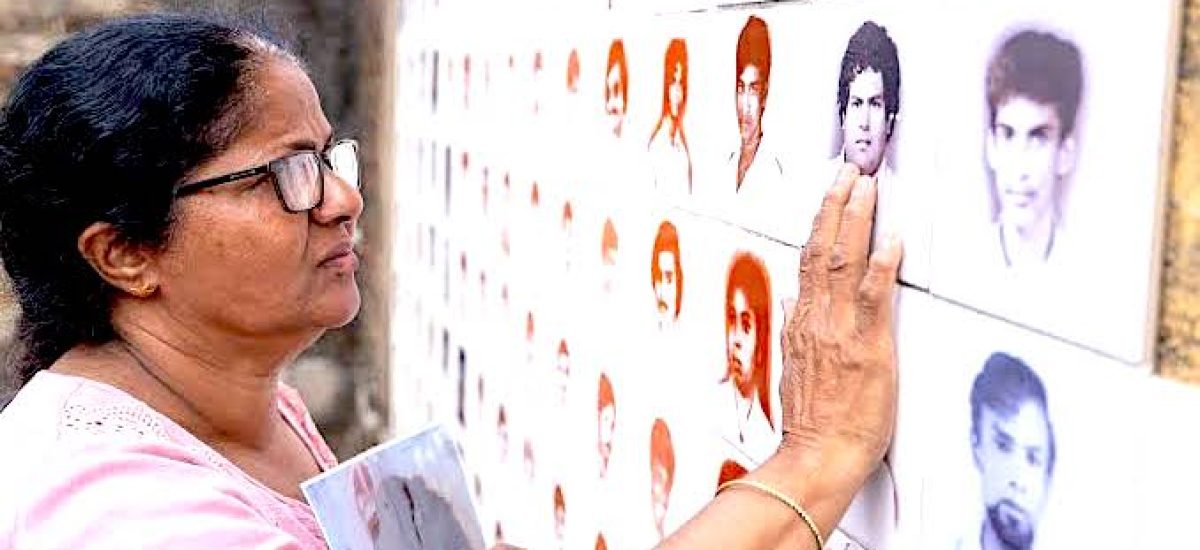

Photo courtesy of Levande Historia
Every year, Sri Lanka returns to a moment in its recent history that remains deeply unresolved in its collective consciousness. Around the commemoration of the end of the armed conflict, the country finds itself divided between competing forms of remembrance: one that celebrates military victory and the end of a protracted insurgency and another that mourns immense civilian suffering, particularly during the final stages of the war. Between these two positions, public discourse is often saturated with political symbolism, selective outrage and inherited narratives that leave limited space for genuine reflection.
More than a decade after the end of the war, Sri Lanka continues to struggle to articulate a shared framework of memory. The same events are interpreted through fundamentally different moral and political lenses, producing parallel histories rather than a unified national narrative. In this context, commemoration itself has become a site of contestation rather than reconciliation.
This fragmentation raises a deeper question: how does a post-conflict society remember its past without perpetuating its divisions? And more importantly, is it possible to construct an inclusive national identity when the very act of remembering remains politically polarised?
This article argues that the post-war challenge is not simply one of accountability or commemoration in isolation but the absence of a shared culture of memory capable of accommodating multiple forms of suffering while rejecting all forms of political violence. Without such a framework, reconciliation remains incomplete and national identity remains fragmented along historical and ethnic lines.
The trap of competitive victimhood
One of the most persistent features of the post-war discourse is the emergence of what may be described as competitive victimhood: a condition in which different communities seek, consciously or unconsciously, to establish moral legitimacy through their respective experiences of suffering.
Within this dynamic, Sinhala narratives of the war often foreground the experience of sustained terror, including bombings in public spaces, attacks on civilians and the broader climate of fear that shaped everyday life during the conflict. Tamil narratives, by contrast, frequently centre on experiences of displacement, civilian casualties and the catastrophic humanitarian consequences of the final phase of the war. These memories are deeply embedded in collective consciousness and continue to shape political identity and intergenerational memory within the community.
Muslim communities, while having experienced significant episodes of violence and displacement, including the expulsion of Northern Muslims in 1990, attacks such as the Kattankudy mosque massacre and later episodes of communal violence such as those in Digana and Beruwala, have also engaged with these crises in ways that have largely remained within civic and institutional frameworks. Similarly, in the aftermath of the Easter Sunday attacks, Muslim civil society, religious leaders and political representatives were actively involved in public condemnation, cooperation with state investigations and broader efforts to distance the community from extremist violence. These responses have contributed to public stability but have not always translated into a sustained or unified presence within national memory politics, which tends to privilege more dominant and institutionally consolidated narratives of the conflict and its aftermath.
Upcountry Tamil experiences similarly remain underrepresented within mainstream political discourse despite their historical depth and socio-economic significance.
The result is not a unified national memory but a fragmented landscape of suffering in which recognition of one group’s pain is often perceived as a dilution of another’s. In this environment, empathy becomes conditional and historical acknowledgment is frequently filtered through political alignment and strategic interpretation.
This condition has profound implications for post-war identity formation. When suffering becomes a marker of political legitimacy, remembrance risks transforming into competition. In such a context, the possibility of an inclusive national identity is weakened as collective memory becomes structured around comparative grievance rather than shared moral recognition.
Yet a stable post-conflict society requires precisely the opposite: a recognition that multiple communities can carry legitimate histories of pain without those histories negating one another. The challenge, therefore, is not to rank suffering or assign exclusive moral authority but to construct a civic framework in which civilian loss is acknowledged across communities while remaining resistant to political instrumentalisation.
The ethics of mourning in post-conflict societies
Every post-conflict society is ultimately confronted with a difficult ethical question: how does a nation remember the dead without converting memory into justification for violence and how does it acknowledge suffering without turning grief into political allegiance?
In Sri Lanka this question becomes particularly charged because mourning itself has often been interpreted through ideological lenses. The act of remembering is frequently required to pass a political test: who is being mourned and what side of the conflict they are perceived to represent. This produces a condition in which grief is no longer universally human but selectively validated.
Yet it is difficult to sustain any serious moral framework in which a mother is required to justify her right to mourn her child. Whether that child was Sinhala, Tamil, Muslim, Burgher, a civilian or a combatant, death dissolves the categories through which political identity is constructed. War may be analysed in strategic or legal terms but its consequences are always experienced at the level of irreducible human loss.
At the same time, acknowledging suffering must not result in the erasure of moral responsibility. The LTTE, as an armed non-state actor, systematically engaged in practices that violated the core principles of International Humanitarian Law, including distinction, proportionality and protection of civilians. Suicide bombings, targeted assassinations, the recruitment of child soldiers and attacks on civilian infrastructure were not incidental features of the conflict but central components of its operational logic. These actions inflicted profound harm not only on the state but also on Tamil civilians themselves, including dissenting Tamil political voices and communities living under its control.
However, the moral illegitimacy of the LTTE’s methods does not exhaust the ethical and legal questions raised by the broader conduct of war. The fact that an armed group operates outside the framework of state responsibility does not remove the obligation of a state to adhere to international legal standards and constitutional principles. On the contrary, the legitimacy of state power is measured precisely by its capacity to operate within constraints that non-state actors do not observe. This distinction is not a matter of moral equivalence but of legal and institutional asymmetry.
It is within this tension that Sri Lanka’s memory politics becomes particularly complex. For some, remembrance is inseparable from victory and national survival. For others, it is inseparable from loss and trauma. But in both cases, there is a risk that memory becomes instrumentalised either as a form of uncritical glorification or as a permanent indictment that leaves no room for historical closure.
A more sustainable ethical framework requires the separation of three elements that are often collapsed in public discourse: mourning, moral judgment and political endorsement. Mourning must remain universally accessible. Moral judgment must remain possible and necessary. Political endorsement, however, should not be assumed as a consequence of either.
In this sense, the act of remembering the dead, whether civilians or soldiers, does not require the endorsement of the political structures under which they lived or fought. Nor does it require the denial of harm caused by those structures. A society capable of sustaining this distinction is one that can begin to move from fragmented memory toward a more inclusive civic identity.
The moral burden of the state and the limits of militarised memory
In any post-conflict society, the role of the state carries a distinct moral and legal weight that cannot be equated with that of non-state armed actors. This distinction is not merely rhetorical; it is grounded in constitutional responsibility, democratic accountability and the framework of international humanitarian law. A state, by definition, claims legitimacy through its institutions, its monopoly over the use of force and its obligation to protect all citizens within its jurisdiction. These claims necessarily impose higher standards of conduct, particularly in contexts of armed conflict.
In Sri Lanka, however, the transition from war to post-war governance has also produced an enduring tension between state legitimacy and militarised memory. The narrative of victory and sacrifice, while politically and emotionally significant for many, risks becoming the sole interpretive framework through which the war is remembered. When memory is filtered exclusively through military triumph, it can obscure the broader ethical and legal complexities inherent in prolonged internal conflict.
This does not diminish the lived reality of soldiers who served under extreme conditions, many of whom were young individuals exposed to prolonged violence, psychological trauma and life-threatening operational environments. The personal sacrifice of military personnel, including those who lost their lives or returned with lasting physical and psychological injuries, forms a legitimate part of the national memory of the conflict. However, institutional respect for military service does not preclude critical reflection on the conduct of war as a matter of state responsibility.
A democratic state must therefore maintain a clear distinction between honouring service and uncritically sanctifying outcomes. When the memory of war becomes exclusively celebratory, it risks narrowing the space for accountability and limiting the possibility of a more comprehensive historical understanding. Conversely, when critique of state conduct is conflated with disloyalty or denial of sacrifice, it undermines the very democratic principles that distinguish state authority from insurgent violence.
The challenge, therefore, lies in resisting the reduction of complex historical events into singular narratives of victory or victimhood. A mature post-conflict society must be capable of recognising that institutional accountability and national remembrance are not mutually exclusive. On the contrary, it is precisely the capacity to hold both that defines the ethical maturity of a democratic state.
In this sense, the moral burden of the state is not only to ensure security but also to sustain a memory culture that can accommodate discomfort, acknowledge error where necessary and preserve space for plural interpretations of the past. Without such a framework, post-war identity risks becoming rigidly defined by triumphalism on one side and permanent grievance on the other, both of which inhibit the formation of a shared civic identity.
Sri Lanka’s post-war condition is not defined solely by the absence of armed conflict but by the continued struggle over how that conflict is remembered, interpreted and ethically situated within the national consciousness. The persistence of competing narratives of victory, victimhood and accountability reflects not only unresolved historical grievances but also the absence of a shared civic language capable of accommodating complexity without collapsing into denial or condemnation.
At the heart of this challenge lies a fundamental ethical question: whether a society emerging from prolonged internal conflict can sustain a form of collective memory that recognises human suffering without requiring political conformity. The evidence suggests that Sri Lanka continues to grapple with this tension. Memory remains unevenly distributed, emotionally charged and frequently instrumentalised within political discourse.
Yet any sustainable path forward must begin with a simple but demanding principle: that human grief cannot be hierarchically validated. The loss of a civilian life does not require ideological endorsement to be acknowledged. A mother mourning her child cannot be asked to justify the political identity of the dead in order for her grief to be recognised. Similarly, the memory of soldiers who died in service cannot be reduced to abstraction or political caricature nor can it be invoked in a manner that forecloses critical reflection on the broader conduct of war and its consequences.
An inclusive Sri Lankan identity will not emerge from the elimination of difference but from the disciplined capacity to hold competing memories within a shared moral and civic space. This requires resisting both triumphalist narratives that silence suffering and grievance-based narratives that deny complexity. It also requires recognising that accountability, remembrance and reconciliation are not mutually exclusive endeavours but interdependent components of a mature post-conflict society.
Ultimately, the politics of memory remains unfinished. The past continues to shape the present not because it is fully known but because it is still being contested. Whether this contestation leads to deeper fragmentation or toward a more inclusive national imagination will depend on the willingness of both state and society to accept that remembrance is not a threat to unity but a precondition for it.