

Photo courtesy of Kumanan
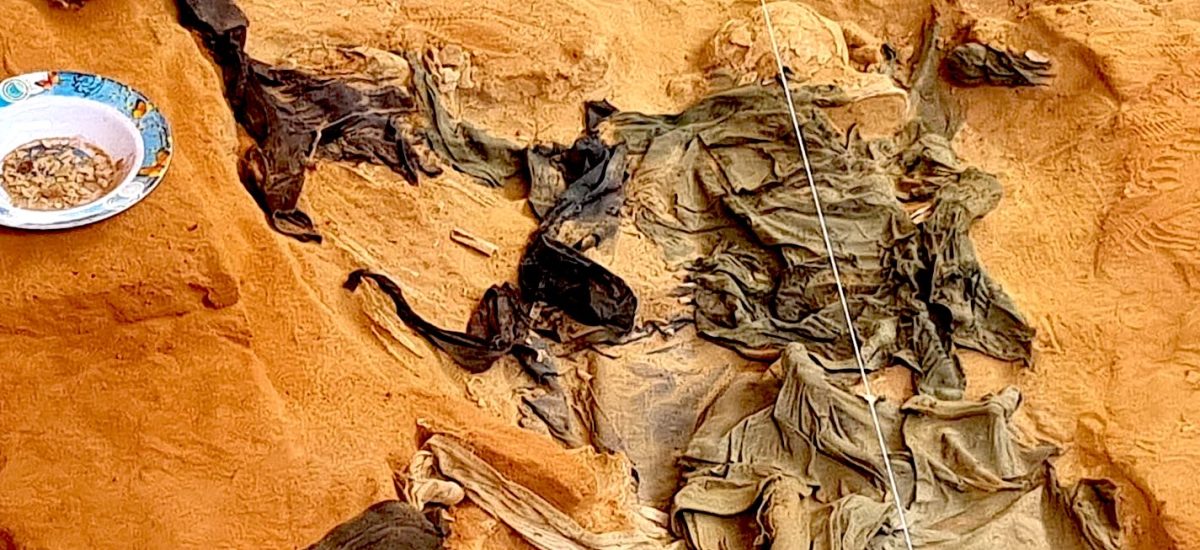
On July 15, it was day 33 of the resumption of the excavation of the Chemmani mass grave site. Two more skeletons were identified, bringing the total number cleaned and identified across all three phases to 414, with 409 fully exhumed.
International Truth and Justice Project has just published a report entitled Chemmani Mass Grave: ‘We Are Still Searching’, detailing the case since it was first uncovered 30 years ago. The report names seven Army officers, identified by their own men as well as other witnesses, as being involved in a series of war crimes that resulted in the bodies of men, women and children at Chemmani.
Reproduced below are the executive summary and the conclusion from the report.
Executive summary
‘We are still searching,’ is how the statements of the families typically end. It has been thirty years of waiting for a body to mourn, let alone justice.
Chemmani mass grave in the northern Jaffna Peninsula is just one of countless mass graves that dot the island. But it stands out for the sheer scale of the cover up of crimes against humanity committed by the Sri Lankan military during the civil war.
It has been thirty years since it was first discovered but despite enormous publicity and two phases of excavation, one still in progress, no commander has yet been held criminally accountable for the crimes committed by the Sri Lankan Army over many decades in the Jaffna Peninsula connected to this grave. What is most astonishing is that the Army continued to use the site as a dumping ground for bodies even after an initial excavation. Nothing speaks to the level of impunity more than this.
The mass grave first came to light after the rape and murder of schoolgirl Krishanthy Kumaraswamy in 1996. An irrigation worker informed the girl’s mother of her abduction, only to be later arrested himself by the Army and disappeared. For safe measure even the person who witnessed his arrest was also later disappeared. Meanwhile, Krishanthy’s mother, brother and a neighbour rushed to the area and were themselves murdered, stripped naked and buried in a shallow grave. These were not uncontrolled acts of violence, but hours of brutality, reinforced by systematic killing of the witnesses.
A murder and gang rape case was brought by Krishanthy’s sister, her only surviving sibling. In 1998, death sentences were given to four junior soldiers and a policeman, as well as a sixth accused who absconded from justice and has never been found. A Lance Corporal told the court up to 400 bodies had been illegally buried in the area – saying almost every evening corpses were delivered and soldiers disposed of them. There were attempts to silence him. He and his family were threatened by prison officials and feared for their lives. One evening he was beaten unconscious by a guard who wanted him to sign a letter recanting in return for alighter sentence.
Procedural obstructions by the Government and military delayed the start of excavations at Chemmani. This led to concerns that flood water would damage the forensic evidence but inaction continued. A few inconclusive soil sampleswere collected from the wrong area, without the guidance of the convicted soldiers who had actually buried the corpses. Themagistrate magistrate reprimanded the Army for interference, while the Attorney General’s office tried to prevent the convicted soldiers appearing in court in Jaffna on security grounds. Despite this, in 1999, 15 skeletons were excavated from multiple burial sites during the first phase of excavation, many with hands tied behind their backs and blindfolds indicating summary execution. In 2000, four higher ranking Army officers were arrested along with a police interpreter, but their case was transferred to the capital Colombo on the questionable grounds that the soldiers feared for their lives in Jaffna. Almost at once all the suspects werebailed. For a year no funds were made available to send forensic samples abroad, contravening the order of the magistrate.
Meanwhile soldiers named and accused in habeas corpus cases flatly denied all the facts and quibbled over the precise titles of Army camps. By 2004, lawyers for the respondents in these habeas corpus cases refused to appear on the grounds they hadn’t been properly briefed. In their absence, it was ironically the complainants who found themselves being challenged in court. Then the investigation stalled as the war intensified. Nevertheless, hundreds of families whose loved ones had disappeared continued to speak out and demand action. Their accounts were terrible. One man had been arrested by the Army even though he had a different name from the man they were seeking. It was a callous and random substitution. Another mother couldn’t find her son, then 158 days later, out of the blue, he whistled at her from a passing Army truck. It was the last time she saw him.
In 2025 building work unearthed jumbled human remains and soon the second phase of excavation at Chemmani began. By the end of the year, a total of 239 skeletons had been excavated and removed, while by the end of June 2026, the number of excavated skeletons had risen to 409 in work that is due to continue. Original estimates stated that there might be as many as 600 bodies illegally dumped there. In the intervening decades the Army officers alleged to be in charge at the time of crimes against humanity have been promoted and protected.
On 19 June 2026, the current Minister of Justice and National Integration, Harshana Nanayakkara, visited Chemmani, where he made statements implying both that his government had no information on suspected perpetrators, and that this lack of information had prevented the start of any criminal enquiries. He also implied that the already protracted and hamperedChemmani excavations had to be completed before forensic and criminal investigations could begin. These positions are inconsistent with an extensive documentary and judicial record, accumulated over nearly three decades, and they risk perpetuatinglongstanding patterns of delay and obstruction, by successive administrations, when faced with efforts to secure truth andaccountability for the crimes associated with Chemmani.
Conclusion
The Chemmani mass grave represents one of the clearest and most documented instances of enforced disappearances and extrajudicial killings in Sri Lanka’s recent history.
The material set out in this report, including the sworn victim affidavits, contemporaneous judicial records, perpetrator admissions made under supervision, forensic findings from two phases of excavation, and the conduct of State authorities themselves, establishes reasonable grounds to believe that members of the Sri Lankan security forces committed serious violation of international human rights law and international humanitarian law, amounting to crimes under international criminal law.
The evidence further demonstrates that these violations were not isolated or spontaneous acts, but formed part of a broader and systematic pattern of arbitrary detentions, torture, executions and enforced disappearances as well as the secret disposal of bodies in the Jaffna Peninsula across 1996-1997.
The scale of the crimes, the repeated use of the same sites and methods, the targeting of civilians, and the involvement of multiple units operating under identifiable chains of command, engage the responsibility not only of direct perpetrators, but also of military and civilian superiors who knew or should have known of these crimes and failed to prevent or repress them.
Equally grave is the Sri Lankan State’s sustained failure, over nearly three decades, to meet its international legal obligations in response to these crimes, as set out in the findings, despite early and credible perpetrator testimony implicating senior officers; despite judicial findings and court-ordered investigations; and despite the recovery of human remains bearing clear indicators of execution, the authorities failed to conduct prompt, independent, impartial, and effective investigations, as required under international law. Instead, investigations were delayed, fragmented, transferred, or rendered ineffective through procedural obstruction, resource deprivation, and witness intimidation.
This pattern of inaction and interference constitutes a continuing violation of Sri Lanka’s obligations under international human rights law: as recognised under international jurisprudence, the duty to investigate enforced disappearances and extrajudicial killings is not extinguished by the passage of time; it persists for as long as the fate and whereabouts of the victims remain unknown and those responsible remain unaccountable.
The State’s failure to preserve crime scenes, protect witnesses, secure forensic evidence, and pursue prosecutions in good faith has directly undermined victims’ rights to truth, justice, and an effective remedy. Central to this failure has been a deliberate and sustained strategy of denial, by successive Sri Lankan governments having sought to obscure or minimise the crimes associated with Chemmani through public misrepresentation, the discrediting of victims and civil society actors, and resistance to international scrutiny.163 International jurisprudence is clear that such denial – particularly when accompanied by obstruction of investigations – may itself constitute a distinct violation of victims’ rights, including the right to truth, and may amount to cruel, inhuman or degrading treatment of surviving family members. In this sense, denial has operated not merely as rhetoric, but as a mechanism through which impunity has been entrenched.
The harm suffered by victims’ families has therefore been cumulative and ongoing, as recognised under international law. Families of the disappeared have endured decades of uncertainty, fear, intimidation, and psychological suffering, compounded by the State’s refusal to provide reliable information or return remains for burial. Under international law, relatives of the disappeared are themselves recognised as victims, entitled to protection and reparation. Sri Lanka’s failure to acknowledge this status or to provide meaningful reparations constitutes an additional breach of its obligations.
The renewed excavations at Chemmani since 2025 underscore both the magnitude of the crimes and the depth of earlier State failure. That hundreds of remains are only now being exhumed – decades after credible evidence first emerged – stands as an indictment of prolonged bad faith. Without independent investigations, prosecutions of those most responsible, and comprehensive victim-centred reparations, further exhumations risk becoming another cycle of exposure without accountability, in violation of international standards governing mass-grave investigations.
In sum, Chemmani is not only a site of past atrocity; it is a continuing crime scene in terms of international law. Sri Lanka remains in breach of its international obligations to investigate, prosecute, provide reparations, and guarantee non-recurrence. Until the State confronts the truth of Chemmani openly, holds perpetrators accountable at all levels of command, and places victims’ rights at the centre of its response, the suffering of families will persist – and the State’s responsibility under international law will continue to accrue.
Chemmani bears striking parallels to other mass-grave contexts where State denial and delayed accountability have entrenched impunity and prolonged victim suffering – most notably in Argentina’s ‘disappeared’ cases, Bosnia and Herzegovina’s post-Srebrenica graves, Guatemala’s counter-insurgency mass burials, and Peru’s conflict-era disappearances. In each of these contexts, early obstruction and denial by State authorities delayed truth-recovery and exacerbated harm, while later breakthroughs – driven by forensic science, judicial independence, and sustained international pressure – demonstrated that accountability remains possible even decades after the crimes.
The central lesson from these experiences is clear: denial does not stabilise societies emerging from mass violence; it corrodes institutions, perpetuates trauma, and deepens divisions. Conversely, credible investigations, prosecutions of those most responsible, and victim-centred reparations are not acts of political concession, but legal obligations and essential conditions for non-recurrence.
Chemmani now stands at the same crossroads, with accountability and victim-centred justice remaining the decisive test of Sri Lanka’s compliance with its international obligations.