
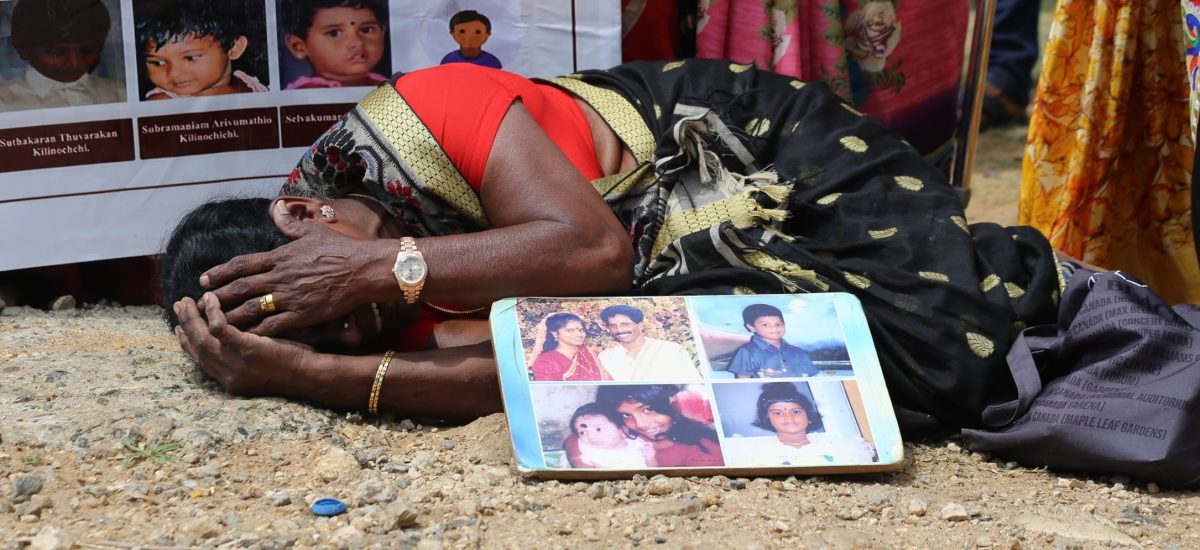

Photo courtesy of Tamil Guardian
The UN Human Righs Council (HRC) will take up the case of Sri Lanka when it begins its 63rd session in Geneva on September 7, which opens with an address by UN High Commissioner for Human Rights Volker Türk and an update on reconciliation and accountability in Sri Lanka. The HRC has released an advance copy of the report that Mr. Turk will present to the HRC.
Published below is the press release issued by the HRC on the report and a list of recommendations to the government and the international community on how to take Sri Lanka’s transitional justice process forward.
A UN Human Rights report published today calls on the Sri Lankan Government to build on the steps it has taken to bolster accountability for human rights violations and advance reconciliation and healing.
The report, which covers the period between October 2025 and July 2026, notes the steps taken to tackle corruption, as well as the high-profile arrests and investigations in connection with political killings, enforced disappearances and the 2019 Easter Sunday attacks. This was also a period during which Sri Lanka found itself grappling with the challenges caused by Cyclone Ditwah and the global spike in energy prices.
Despite its promise of legal and institutional reforms, however, the Government continues to apply the repressive Prevention of Terrorism Act (PTA), resulting in arbitrary arrests and prolonged detentions without charge, the report states. Civil society actors, activists and journalists are subjected to state surveillance, and tensions over land and religious sites continue to simmer.
“This Government still has an opportunity to turn the tide on decades of abuse of executive power, repressive laws and custodial violence, and entrenched impunity,” said UN High Commissioner for Human Rights Volker Türk. “While it is encouraging that the Sri Lankan authorities have taken action to address corruption cases and some crimes linked to the post-war period, more needs to be done to end the long legacy of impunity in the country.”
The report highlights continued cases of torture and deaths in custody. The Human Rights Commission of Sri Lanka documented 602 cases of torture and ill-treatment in 2025 and 138 cases as of April 2026. It also reported receiving 18 cases of deaths in custody last year and another three by April this year. In one such case, a 40-year-old inmate detained for a minor drug-related offence died at Welikada Prison in Colombo on 3 May allegedly from severe beatings.
The report also highlights the violent riots at Negombo prison in July, which resulted in at least 32 deaths, underscoring the urgent need for prison reform to address systemic issues, including severe overcrowding.
The UN Human Rights Office also received at least 16 allegations of surveillance against civil society actors, activists and journalists, information “indicating a clear and continuing pattern of state surveillance, intimidation and reprisals by military and intelligence officials, including from the Criminal Investigations Department or the Terrorism Investigation Division”, says the report.
“Individuals are repeatedly questioned about their travels, especially to Geneva and engagement with UN human rights processes, as well as their organisational affiliations, funding sources, and participation in protests or commemorative events,” the report states.
While the Government has continued to denounce racism and promote national unity, wider efforts to ensure truth and justice risk being stalled and the momentum for transformative change being lost, warns the report.
Failures to effectively investigate and prosecute crimes under international law allegedly committed during the armed conflict persist.
“It is crucial that there is decisive and meaningful action toward accountability for crimes and violations by all parties during the more than two-decade armed conflict,” High Commissioner Türk said.
The UN Human Rights Chief noted the recent decision by the Attorney-General to indict former Chief Minister of the Eastern Province, Sivanesathurai Chandrakathan, also known as Pillayan, and three others in connection with the abduction and murder of former Eastern University Vice Chancellor Professor Subramanian Ravindranath in 2006.
“It is, however, regrettable that many other serious emblematic cases remain stalled for years, including the killing of 17 Action Contre La Faim aid workers in Muttur 20 years ago,” he said, calling for meaningful steps to resolve such delays.
The High Commissioner urged Sri Lanka to redouble its reconciliation and accountability efforts. He called for a moratorium on the use of the Prevention of Terrorism Act, pending its repeal, as well as the release of long-term detainees held under it.
Türk also called for all individuals credibly accused of human rights violations to be excluded from senior positions in government, the security sector, or diplomatic service, until such allegations are genuinely addressed and resolved.
He urged the Government to support victims’ memorialization initiatives, and the release of military-occupied lands.
(a) Foster an enabling environment for reconciliation, accountability, and national unity by implementing confidence-building measures, including the release of military-occupied lands, preventing further land acquisitions, and expediting land titling processes in the north and east; releasing long-term detainees held under the PTA; supporting victims’ memorialization initiatives; and strengthening the independence and credibility of the OMP through international expertise and independent monitoring;
(b) Implement its commitment to devolution of political and administrative power to every local government, district and province;
(c) Impose a moratorium on the Prevention of Terrorism Act, expedite its repeal, and ensure that any replacement legislation complies with international human rights law and the benchmarks set out by United Nations human rights experts;
(d) Repeal or amend laws, including proposed legislation, that unduly restrict the rights to freedom of opinion and expression, association, and peaceful assembly, such as the Online Safety Act, the ICCPR Act and the draft NGO (Registration and Supervision) Act.
(e) Publicly issue clear instructions to all military, intelligence, and police forces that enforced disappearances, extrajudicial killings, torture, sexual violence, and other human rights violations are strictly prohibited and will be thoroughly investigated and prosecuted;
(f) Remove from office, and refrain from appointing or promoting, individuals credibly alleged to have committed human rights violations to senior positions in government, the security sector, or diplomatic service;
(g) Establish a credible domestic human rights screening and accountability framework aligned with United Nations standards, to provide adequate safeguards in connection with Sri Lanka’s participation in United Nations-mandated or supported operations and other international security deployments;
(h) Expedite establishment of a public prosecutorial body and ensure that it is fully independent, effective and robust to be able to investigate and assess relevant information and make independent prosecutorial decisions;
(i) Consider the creation of a special judicial mechanism with an independent special counsel in relation to the cases of human rights violations and violations of international humanitarian law committed in previous decades, and seek international assistance;
(j) Accelerate investigations and prosecutions in all cases of human rights violations, including emblematic cases as well as the Easter Sunday bombings, in compliance with international human rights norms and standards, seek international assistance to strengthen capacities, and ensure victim and witness protection;
(k) Accede to the Rome Statute of the International Criminal Court;
(l) Pursue prison reform to address systemic issues of violence an overcrowding, including restricting imprisonment as a measure of last resort and adopt a health-centred response to drug use;
(m) Following full and meaningful participation, ensure equitable reconstruction and land and housing rights for the Malaiyahar Tamil community;
(n) Ensure pledges on land return are time-bound, transparent, adequately reviewed and recorded, and publicly available;
(o) Order all security agencies and intelligence to immediately end all forms of surveillance and harassment of and reprisals against representative of CSOs, human rights defenders, journalists, conflict-era victims and their families, especially women;
(p) Extend invitations to relevant Special procedure mandate holders to conduct country visits.
The High Commissioner recommends that the Human Rights Council and Member States, as applicable:
(a) Assist Sri Lanka in advancing legal and institutional reforms, including initiatives to ensure accountability in accordance with international standards and support country-wide reconciliation;
(b) Cooperate in the investigation and prosecution, through States’ competent national judicial processes, of individuals alleged to have committed crimes under international law in Sri Lanka by any party, through the application of extraterritorial or universal jurisdiction, mutual legal assistance and other international avenues where appropriate;
(c) Consider, as part of a broader set of accountability measures consistent with international law, the adoption of targeted sanctions, such as asset freezes and travel restrictions, against individuals credibly alleged to be responsible for serious violations of international human rights law or international humanitarian law; and
(d) Support to Sri Lanka in post-Ditwah reconstruction with particular focus on population groups most at risk, in line with the 2030 Agenda on Sustainable Development.