
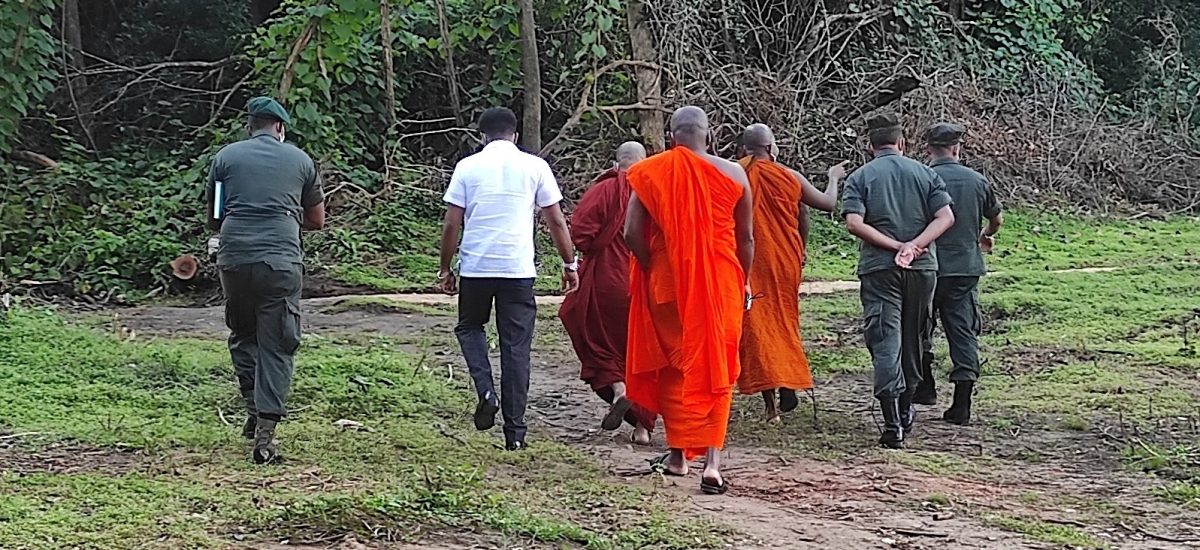

Photo courtesy of Tamil Guardian
Tisaranee Gunasekara, in her article in Groundviews, Land Mining Sri Lanka in Vadunnagala, says that Pallegama Hemarathana Thero, who is accused of child rape and no longer the Atamasthanadhipati, gifted a Sri Maha Bodhi sapling to me that I planted it in Vadunnagala archaeological site in the Northern Province, which is being promoted via social media as the next battle field between Sinhala Buddhists and Tamil Hindus.
She says that Galgamuve Shanthibodhi Thero, a monk at the forefront of land wars in the Northern Province, planned a mass sil campaign on the poya day while Hindus were having their Purattasi Pujas and I that waded into that troubled waters armed with the Sri Maha Bodhi sapling. Then she predicts an ethno-religious explosion in the very near future at Vadunnagala.
Tisaranee then goes on to say that Rajapaksas are in troubled waters, salvation is needed and fast and I enter with the bo sapling. She casts doubt whether the sapling was a real or a bogus one taken from the back door to deceive people with an ulterior motive.
The truth is as follows :
- The Sri Maha Bodhi sapling was never gifted to me. It was requested by and gifted to Ven Pimburaththeve Santhindriyalankara Thero of Welioya historical Kumbakarnagala Raja Maha Vihara and received by his pupil Ven Paduma Thero.
- The official certificate that accompanied the bo sapling confirming the authenticity of the plant clearly mentions these facts.
- I was only one of the devotees who attended the ceremony of receiving and planting bo sapling at the site.
- The bo sapling was never planted at Vadunnagala. It was planted at Kumbakarnagala Raja Maha Vihara, Kiriibbanweva in Welioya.
- The Archaeological Department approval was obtained and the bo sapling was planted as per the instructions given by the botanical expert in charge of the protection and maintenance of the Sri Maha Bodhi.
- The bo saplings were gifted not only to Kumbakarnagala Vihara but to many a selected number of temples.
- The bo sapling for Kumbakarnagala Vihara, which I attended, was received on September 25, 2026.
- Every temple that received the bo sapling had to submit three letters of recommendations from the head priests of three Buddhist temples in area.
- The bo saplings were distributed for three days with official certificates signed by the Atamasthanadipathi himself.
Tisaranee insults Pallegama Hemarathana Thero and calls him the disgraced former custodian of Sri Maha Bodhi. Hemarathana Thero is a very famous senior monk who has held many senior positions and appointed as Atamasthanadhipathi. He is still an accused and even the charges are not yet framed against him.
Yet the principle of justice remains unequivocal; whether the accused is a Buddhist monk or anyone else, being accused is not the same as being found guilty. Until a competent court reaches its final verdict, he is entitled to the presumption of innocence. The allegation could not be proved by the DNA test and that is why the Thero is back in the Atamasthanadhipathi seat until the AG decides whether to file a case or not.
There was a sil campaign at Vadunnagala and also there was a Hindu religious observance. The Vadunnagala Pabbatha Viharaya is an ancient Buddhist archaeological site associated with an early historic period of hill monastery. It has been a Buddhist vihara complex nearly 2,000 years ago. The Brahian inscription record that the caves being donated to Sanga. The Archaeological Department confirms that Hindu religious items have been placed on top of the hill about three to four years ago.
Kurundi Viharaya is also an ancient Buddhist monastic complex established by King Kallatanaga in 110 BC. The viharaya is traditionally associated with the composition of the Kurundi Attakatha, one of the ancient Sinhala commentaries on the Tripitaka. Here too the Archaeological Department confirms that Hindu religious items have been placed recently.
Tisaranee quoted Ashokan Rock Edict 7 in which the king says that all religions should reside everywhere. The king was affirming the freedom of people to practice their respective religions but not granting a licence to place the sacred symbols of one faith upon a sacred object belonging to another faith and treat that act as an exercise of religious freedom. Freedom of religion does not by itself mean the freedom to appropriate or alter the sacred symbols and objects of another faith.
The North and East contain thousands of Buddhist archaeological remains. These ancient sites constitute important historical evidence of the long standing presence and heritage of Buddhism in these region and they therefore have profound significance understanding of Sri Lanka’s history.
The bo sapling was received with utmost reverence and taken to the Welioya temple. It was planted at an auspicious time amid chanting of pirith. The very next day, the area that had been suffering from drought and had remained perched for a considerable period, was blessed with torrential rain.
Buddhist archaeological remains in the North are being destroyed at an alarming rate. Yet, when Sinhala Buddhists and Buddhist monks come forward to protect this heritage, they are accused of creating religious conflict and inciting communal tensions.