
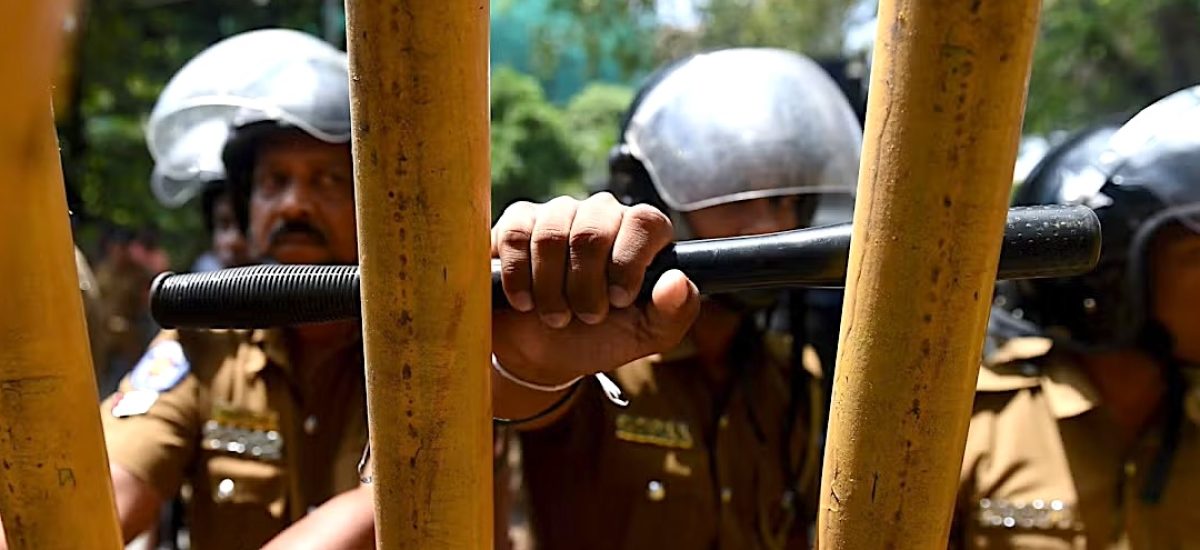

Photo courtesy of HRW
Sri Lanka is considering two new laws to tackle terrorism and organised crime. Both aim to strengthen public safety but they also raise questions about detention, police powers and individual rights. What do these laws mean for the country and its people?
While reading Facebook comments about the proposed Protection of the State from Terrorism Bill (PSTA), I noticed something surprising. Some people were saying that the existing Prevention of Terrorism Act (PTA) was better than the proposed replacement.
How could a law criticised for more than four decades suddenly become preferable to the new one? Were the commenters exaggerating? Had they misunderstood the Bill or did they have a point worth examining?
The PTA has been criticised for prolonged detention, police confessions and allegations of torture. Then I noticed another development: the government was also proposing a Prevention of Organised Crimes Bill. One Bill deals with terrorism and the other deals with criminal networks. Yet both raise questions about detention, police powers and the role of independent courts.
What kind of state are we building, and how much power should it have over an ordinary citizen?
Nobody wants terrorism or organised crime
Sri Lanka has good reasons to take security seriously. The country experienced a long civil war and the Easter Sunday attacks of 2019. Organised crime brings other dangers: drugs, shootings, intimidation and networks operating across borders.
The present government has reported significant action. Police figures indicate that narcotics seizures increased from approximately 10,871 kilograms in 2024 to 23,692 kilograms in 2025. Authorities have also pursued suspected criminals overseas and investigated criminal assets.
These efforts deserve recognition. However, more seizures do not necessarily prove that trafficking has declined. Nor does an arrest establish guilt. What matters is whether networks are disrupted and cases result in convictions based on reliable evidence.
Previous governments also carried out major anti-drug operations, including Yukthiya, which drew both enforcement claims and criticism over alleged abuses. So major police operations have been possible under existing laws.
This does not prove that new legislation is unnecessary. Cross border crime may expose genuine legal gaps. The government has cited international cooperation and obligations under the UN Convention against Transnational Organized Crime as reasons for reform. But which precise obstacles require additional detention and police powers?
The PTA began as temporary legislation in 1979 and became permanent in 1982. It survived the end of the war and repeated promises of reform.
Consider Sahan Kirthi. Arrested under the PTA in 2007 at age 21, he alleged that police beat him and threatened his sister to obtain a confession. He was charged years later and acquitted in 2014. Human Rights Watch also documented a woman called Durga (a pseudonym) who spent about seven years in detention before acquittal. Her children grew up largely without her.
These cases do not suggest that every suspect is innocent or that terrorism is unimportant. They show the cost when detention continues for years before guilt is established. If someone is eventually acquitted, who returns the lost years to that person and family?
Why give the Defense Secretary this power?
The proposed PSTA includes safeguards concerning legal advice, medical examinations, detention inspections and peaceful dissent. Those improvements should be recognised. But it would also empower the Defence Secretary to issue an initial detention order of up to two months following an application by senior police authorities, without prior judicial approval. Further detention orders could extend the period to an aggregate of one year, subject to the Bill’s procedures.
Imagine the process. Police arrest a person on suspicion of terrorism and request more time. The Defence Secretary approves the order. The suspect remains in custody although no court has found that person guilty.
Police may have genuine reasons for suspicion. But what if the information is incomplete? What if the wrong person has been identified? What if a future administration uses such powers improperly? The issue is not whether today’s Defense Secretary is trustworthy. It is whether a senior executive official should have this power over personal liberty. Why should a ministry secretary rather than an independent judge authorise the initial two months?
A suspect must be brought before a magistrate within 48 hours. That is important. Yet appearing before a judge is not the same as having a judge independently decide whether continued detention is justified.
Under the proposed arrangement, a magistrate presented with a valid executive detention order must give effect to it. The magistrate has responsibilities for the detainee’s welfare, and later detention involves additional procedures. Critics nevertheless argue that the initial judicial oversight is too limited. What is the value of judicial appearance if the judge has limited authority to reject the initial executive decision?
The PSTA also raises questions about how terrorism is defined. It contains protection for peaceful protest and dissent but rights groups say the definition and other powers should be examined together. The issue is not simply what the present government intends; future administrations may interpret broad provisions differently.
In June 2026, Tamil rapper Sangeethsan Ganeskumar known as Hiphop Sangee was arrested under the existing PTA over a music video. Police alleged the video supported the LTTE while Human Rights Watch criticised the use of counterterrorism powers in the case.
An arrest does not prove that police acted unlawfully. However, it shows why clear definitions matter. When artistic expression becomes the subject of a terrorism investigation, how do we distinguish a real security threat from lawful expression?
Experience from other countries
New Zealand experienced the Christchurch mosque attacks in 2019. It has counterterrorism laws but its Bill of Rights Act also protects against arbitrary detention, provides access to legal advice and allows detention to be challenged in court.
The UK permits terrorism suspects to be held without charge for up to 14 days under its ordinary special framework with judicial authorisation required for continued detention beyond the initial period.
These are not identical legal systems. Judicial remand and police investigative detention are also different. Nevertheless, they show that special security powers can coexist with independent judicial checks. Why should Sri Lanka’s initial executive detention power be so extensive and what evidence justifies that choice?
Another Bill, another Executive Secretary
The proposed Organised Crimes Bill addresses a different problem: criminal networks that may intimidate witnesses, move money and operate across borders. Special investigative tools may be justified.
Yet the Centre for Policy Alternatives says the Bill would permit police detention for up to 72 hours before produce before a magistrate followed by executive detention orders issued by the Secretary to the Ministry responsible for the police, potentially reaching one year. It has questioned the magistrate’s limited discretion.
Under the PSTA, one ministry secretary would authorise initial detention. Under the Organised Crimes Bill, another secretary would exercise comparable powers. Different threats, but a familiar question: why should prolonged detention begin with an executive decision rather than an independent judicial one?
The problem with police confessions
Sri Lanka’s ordinary evidence law generally excludes confessions made to police officers. That safeguard reflects a simple risk: a person in custody may confess because of fear, pressure or mistreatment.
The Organised Crimes Bill would permit certain confessions made to officers of Assistant Superintendent Rank or above to be admitted subject to conditions. Critics have noted the similarity to controversial PTA arrangements.
There are reasons to take this concern seriously. In September 2025, the Supreme Court found that a police officer had violated the rights of a 16 year-old boy arrested over an alleged jewellery theft. The court found wrongful arrest, torture and unlawful detention; the boy was later acquitted.
This was not a terrorism case. That is precisely why it matters: abuse can arise even in ordinary investigations. Human Rights Watchalso documented allegations of coerced confessions under the PTA, including a judge’s account of excluding such evidence in many cases he heard during part of 2017.
These examples do not mean every police officer acts unlawfully or every confession is false but a senior rank alone does not guarantee that a confession was voluntary. If police confessions were a major concern under the PTA, why introduce a similar exception through the Organised Crimes Bill?
In October 2026, a 29 year-old suspect died following his arrest in a drug-related investigation at Homagama. His family alleged assault; police gave a different account. Three officers were suspended and investigations began.
The circumstances and responsibility have not been conclusively established. This is not a proven case of torture or forced confession. Suspension and investigation are important accountability measures, but they also raise a preventive question. Should safeguards operate mainly after a person is harmed or should the law make abuse harder to commit in the first place?
Are we solving the right problem?
What prevents successful prosecutions of organised criminal networks? Is it insufficient detention time or problems with forensic capacity, witness protection, financial investigations and cross border evidence?
The Organised Crimes Bill contains measures that may address genuine gaps but its broad provisions should be examined carefully. The Centre for Policy Alternatives has raised concerns about indicators such as clothing, tattoos, associations and places visited when identifying alleged criminal-group membership.
Such information may help an investigation but association should not replace proof of criminal conduct nor should stronger executive powers be treated as a substitute for stronger investigative institutions.
What does system change mean?
The present government came to office promising system change. For many people that meant fairer institutions, less political interference and equal treatment before the law. Does system change mean transferring detention authority from a minister to a ministry secretary? Does it mean creating another executive detention regime for organised crime or should it mean giving independent courts greater control over personal liberty?
These questions concern institutions, not personalities. A law passed today will remain available to future governments. Sri Lanka’s experience with the PTA shows how long exceptional powers can survive.
Parliament should ask which specific legal gaps require prolonged executive detention, what evidence supports police confession provisions and whether better investigations, witness protection and international cooperation could achieve the same objectives with fewer restrictions on liberty.
The government should have an opportunity to explain its case. Parliament should examine the evidence and improve provisions where safeguards are insufficient.
The question that remains
I began by wondering why some Facebook commenters thought the PTA was better than its proposed replacement. I do not believe the answer is to defend the PTA; its history raises too many concerns.
But changing the name of a law does not automatically remove its problems. Both proposed Bills pursue legitimate public safety aims but both also raise questions about detention, police powers and judicial independence.
The debate should not be reduced to support for or opposition to the present government. People can support strong action against terrorism and organised crime while insisting on safeguards against wrongful detention and abuse. Would we accept these same powers if they were exercised by a government we did not trust? Governments change. Ministers change. Secretaries change. Laws may remain for generations.
The real test of system change is not simply whether a new government uses old powers more carefully; it is whether the system places effective limits on the misuse of power.